Mabel Peloponnese
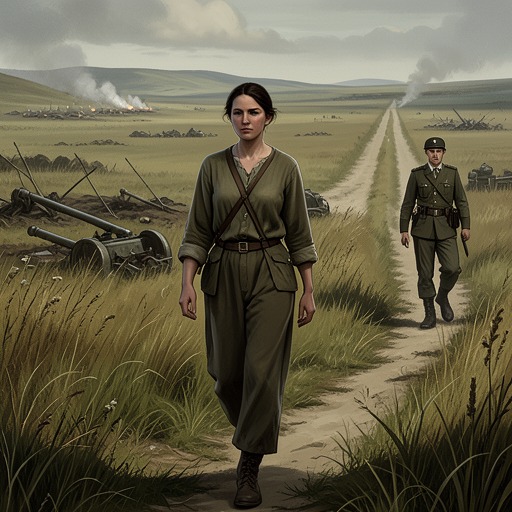
NeverthelessMabel Peloponnese is a peasant of Navon whose pursuit of a life beyond domestic expectation becomes inseparable from grief, war, and the question of who may claim a place in the kingdom’s defense. The novel first finds her working in a field with her father, Amyntas, rather than learning the household skills expected of girls. After her parents are killed, she does not return to the castle; she goes to the military base and openly asks to become a soldier. Her route carries her beyond the familiar limits of village and palace, but the story ends not with a homecoming: Mabel is captured and taken toward Tzara.
Identity and Background
Mabel’s introduction sets her apart through the contrast between where she is and where convention expects her to be. While other girls might be at fairs, buying provisions, choosing dresses, or learning sewing and cooking from their mothers, Mabel is in the fields with Amyntas. The king’s servants have difficulty finding her because she is a peasant and is working outside the places they might expect to look. This is not merely a difference in pastime: the work and setting establish her as someone whose life is not organized around preparation for marriage and domestic service.
Her childhood home nevertheless matters deeply to her. It is a rustic village house where Amyntas sharpens his sword in the evening and her mother prepares food over a fire. Mabel remembers sleeping in a tiny corner of the house and thinking that she was meant for something greater than others expected of her. Yet ambition does not mean rejection of Navon. She considers home her world and wants to spend her life there, not only because it holds her memories but because her attachment to the kingdom exceeds simple familiarity.
Home, Loss, and the Choice to Enlist
Navon’s political vulnerability forms the backdrop to Mabel’s personal turning point. In Navi Spyridaki’s office, negotiations over alliances are constrained by neighboring kingdoms exploiting Navon’s weakness; the proposed exchange of the kingdom’s best products and special privileges troubles him, while his counselors resist unfavorable long-term terms. The setting locates Mabel’s later decision within a crisis in which the kingdom’s protection is uncertain and military need presses against political limits.
When brutal men attack the village, Mabel sees residents driven from their homes and assaulted, but she cannot stop to help: she has somewhere she must go. At her family home, she searches and finds Amyntas beneath the wooden pot-storage structure, dead after being beaten and murdered. His death is not a battlefield loss. Mabel arrives too late for a farewell, a final recommendation, or the questions she might have asked him. She also fears for her mother, whom she regards as more vulnerable than her father. Her grief carries a sense of helplessness and self-reproach: she prays that she could have been better.
Mabel does not return to the castle after her parents’ deaths. The king leaves her alone for three days, after which she would otherwise have had to resume what had been interrupted; she decides there is no reason to go back and that she will not be trapped there again. At the military base she finds young people summoned from across Navon, many lacking the experience and technique of soldiers. The crowd includes peasants, blacksmiths, philosophers, artists, and aristocrats, and their varied appearances register the range of people being called into an army that needs recruits.
The commander assumes that Mabel may need money and offers help, including a hearing with the king. She declines that explanation and says she wants to be a soldier. When told that a soldier would have to be a man, she answers that she can be a soldier while being a woman. The exchange makes her aim explicit: she is not asking only for relief from hardship but challenging the rule that military identity belongs to men. The evidence establishes her demand, rather than detailing the formal terms or outcome of her enlistment.
Routes Beyond the Kingdom’s Familiar Spaces
Mabel’s movements give physical form to her changing circumstances. Navon’s castle stands on a wooded hill, with a mountain range and forest complicating an approach; the stone bridge at the fortress provides the passage in. Leaving the castle for the village is also a deliberate journey. Without a horse, Mabel takes the long road along the riverbanks, with a valley across the way. She chooses to walk rather than take a horse from the full stables, and the extended route connects her to the landscape she regards as home.
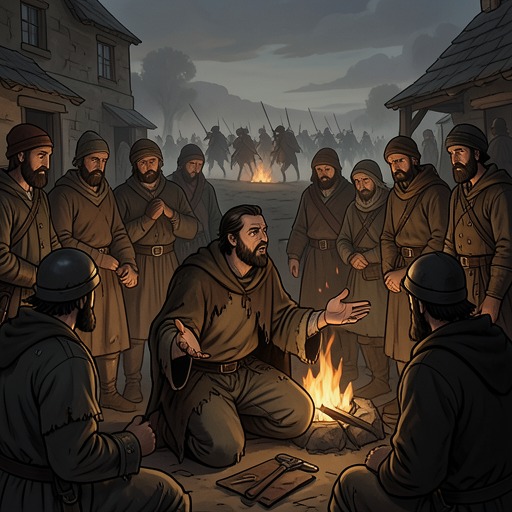
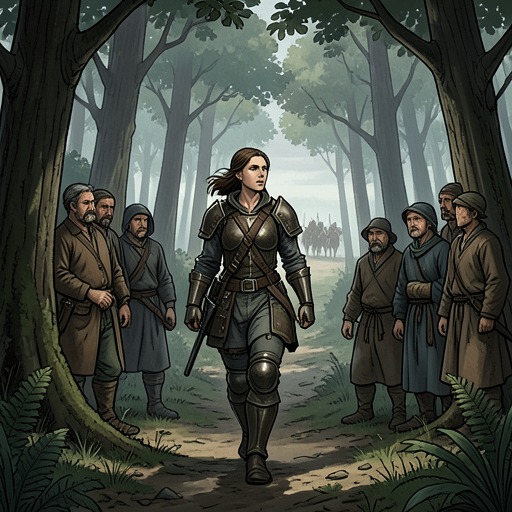
Later, her movements carry her into spaces associated with political danger and people outside royal authority. She travels with Shai toward a tavern in the forest, then rides with the others up a hill and through a narrow canyon to a high hideout where outlaws are concealed from the king’s sight. Shai reassures her that no one will interfere with someone sent by the prince, but Mabel corrects him: she was not sent by the prince. That distinction preserves her independence even as she enters a world of revolutionary plans and bounty hunters. Her journey is not simply an extension of royal authority; she asserts that her presence there is her own.
On another journey, Mabel rides in synchrony with soldiers escorting a princess. She travels in the rear group with Yelsew, the commander, and Vilanis, while the general, Liniquer, and Sven ride ahead. The route crosses a long, elevated bridge wide enough for three horses abreast or two carriages. Mabel’s throat tightens at the sight of the river below, and she tells Yelsew she does not remember crossing that bridge when she left Navon. The bridge is both a practical passage and a point at which travel exposes her to fear; her continued movement does not make her invulnerable.
Capture and the Mulan Framework
Mabel’s story closes this portion of its arc in captivity. During an encounter with the King's Winner, the soldier’s bindings loosen. Mabel recognizes what is happening and begins to call for help, but he frees himself and covers her mouth. She is his prisoner. The reversal is stark: the woman who has insisted on the right to enter military life is once again placed under another person’s control, and her movement across borders becomes forced rather than chosen.
In the epilogue, Mabel wakes as a carriage travels along a rough road. The escort hurries its horses to the border of Tzara, whose immense wall conceals the city and protects its villages and plantations. From outside, only the desert and the tops of high buildings are visible; entering the royal city is harder than leaving it. Mabel sees the castle’s dark structures and shudders, uncertain about what awaits her. Her arrival in Tzara therefore ends not in safety or return but at another fortified threshold, with her future unresolved.
The Ballad of Mulan frames Mabel’s story through recurring chapter epigraphs. The opening image evokes Mulan at a loom; a later passage links a father’s name to a call to war; the epilogue asks how a hare’s sex can be distinguished when hares run side by side. These motifs place domestic labor, military obligation, and gendered identification beside Mabel’s choices. The novel’s movement from her refusal of prescribed feminine work to her demand to serve, and then to her capture and uncertain transport, develops that frame without supplying a completed return home. Mabel’s attachment to Navon remains powerful, but the narrative leaves her beyond its border, where the freedom she claimed has not yet become secure.