Balthasar
NeverthelessBalthasar is a conqueror whose pursuit of wider dominion turns distant political violence into an immediate danger for Navon. Accounts of his campaigns describe a growing army, the subjugation of kingdoms, and the overthrow of rulers; a later disclosure also makes him Shai’s brother and places a personal succession conflict inside the broader threat of invasion.
Identity and Background
Balthasar is described as a ruler unsatisfied with the limits of his own kingdom. According to an account Mabel’s father gives her, he seeks to become emperor and to conquer the whole country. His ambitions are therefore not presented as a single border dispute: they imply a continuing project of expansion, in which independent kingdoms risk losing both their political autonomy and their rulers.
The story also connects Balthasar to a royal family history of violence. Mabel recalls hearing of a young king whose mother was murdered by his half-brother, and of Balthasar leaving the boy in a hostile place rather than killing him directly. The later identification of Shai as Balthasar’s missing brother gives this earlier account particular significance: the threat to Navon is bound up with a concealed family history and a possible contest over succession.
Conquests and Methods of Rule
Balthasar’s father describes him as someone who takes villages and conquers kingdoms, then enslaves the populations and kills their kings. The account stresses the scale behind those methods: Balthasar has accumulated an arsenal large enough for an army and so many soldiers that his military base can no longer accommodate them. His power is portrayed not simply as personal ambition but as an organized capacity to keep making war.
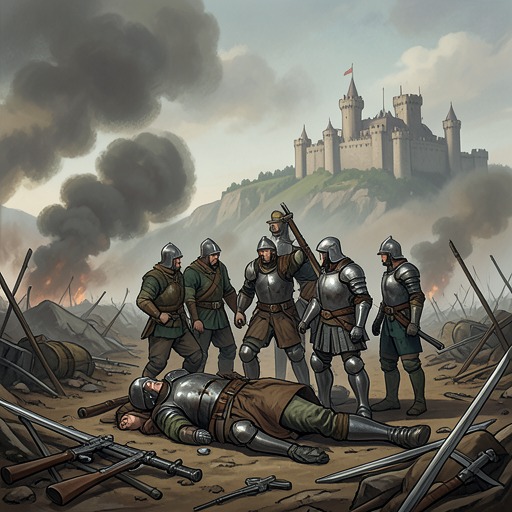
The campaign against Andalusia offers a concrete example. Balthasar marched there with about five thousand men and conquered it without losing many of them. King Agustin escaped into the mountains, but was captured after the royal city burned. Balthasar then subjected him to humiliation and made him a slave, along with the people of his kingdom. The episode presents conquest as a process that continues after a battlefield victory: the defeated ruler and population are made to live under the conqueror’s authority.
These reports reach other lands and become a warning beyond the places already conquered. Balthasar’s army is said to be growing day by day, while other rulers fail to act despite the possibility that they, too, could become targets. His expansion thus creates a political problem for neighboring kingdoms: fear of provoking him encourages inaction, even as that inaction leaves each kingdom more exposed.
The Threat to Navon
Navon has little experience of being threatened on its own territory. Its earlier battles were fought on behalf of other kingdoms, under alliances that traded soldiers for protection. Those arrangements left the kingdom vulnerable when its former ally feared Balthasar’s wrath and Navon itself lacked the soldiers to defend its land. The account treats this weakness as partly the consequence of Navon’s past choices, but Balthasar’s expansion is the force that makes the weakness urgent.
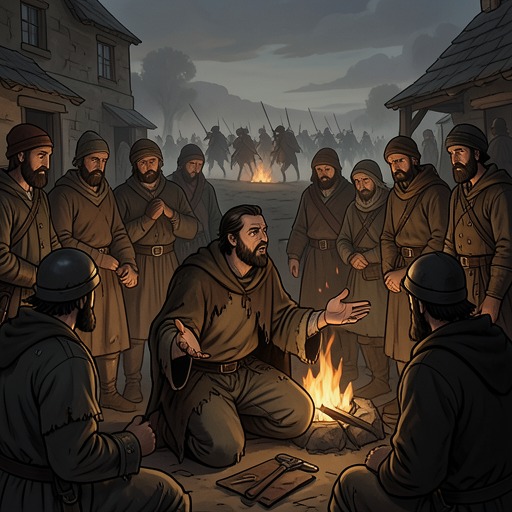
As the danger closes in, Navi warns that Balthasar will come after destroying the city. At an outlaws’ refuge, news that Balthasar’s men are rising provokes an argument over how they found the hidden encampment. Alastair suspects Shai and his men brought danger with them; Shai rejects the accusation and calls the arrival a coincidence. The episode establishes the fear attached to Balthasar’s forces without proving that they deliberately tracked the group to that place.
Later, Shai brings Navi a warning that Tzara will cross Navon’s boundaries and says that scouts and allies have confirmed the approach. Navi responds by ordering the village brought inside and the army summoned. The threatened invasion turns the question of Balthasar’s power into a practical test of Navon’s ability to protect its people, rather than a distant report about other kingdoms.
Balthasar and Shai
A captor tells Mabel that Shai is Balthasar’s missing brother and that Shai’s true name is Golnar. The captor further alleges that Shai used Mabel to obtain an army and intends to dethrone Balthasar and take his place, describing Mabel and Navon’s forces as instruments in that plan. Because this account comes from the person holding Mabel, its accusations about Shai’s motives are presented as that speaker’s claims; the disclosure of the brothers’ connection is nevertheless a major reframing of Shai’s identity and of the conflict surrounding Balthasar.
The revelation links the political struggle over kingdoms to a family struggle over power. Balthasar is not only the expansionist ruler threatening Navon but also the brother against whom Shai may be acting. The earlier story of a boy abandoned by his half-brother supplies a possible history for that opposition, while the later account places Mabel and the forces assembled around Navon within its consequences. The narrative does not reduce the invasion to a private dispute, but the revealed kinship makes the conflict more intimate and politically charged.
Narrative Role and Significance
Balthasar functions chiefly as a force described through other characters’ testimony and through the consequences attributed to his campaigns. The reports move from a warning given to Mabel, to accounts of Andalusia’s conquest, to the approach of his forces toward Navon. This widening scale makes his power legible before he appears directly: first as a ruler whose ambitions threaten distant peoples, then as the danger that exposes Navon’s military and diplomatic vulnerability.
His role also sharpens the story’s contrast between self-protection and collective defense. Kingdoms that fear him may refuse alliances, while his conquests make continued neutrality increasingly precarious. The revelation about Shai adds a second dimension to that pressure: resistance may be entangled with a claim to rule, not simply with the defense of threatened populations. Balthasar therefore stands at the intersection of military expansion, political paralysis, and a concealed succession conflict, while the available accounts leave the full extent of his character beyond what other people report about him.