Amyntas
NeverthelessAmyntas is Mabel Peloponnese’s father and a former commander of the Navon King's Army, remembered as a brave and honorable defender. Once celebrated for risking his life to protect his soldiers and the king, he becomes a veteran whose service is largely forgotten after he is injured. His history links the royal household to Mabel’s family, while his example gives her both permission to imagine a life beyond prescribed expectations and a reason to mourn what she could not ask him before his death.
Identity and Military Service
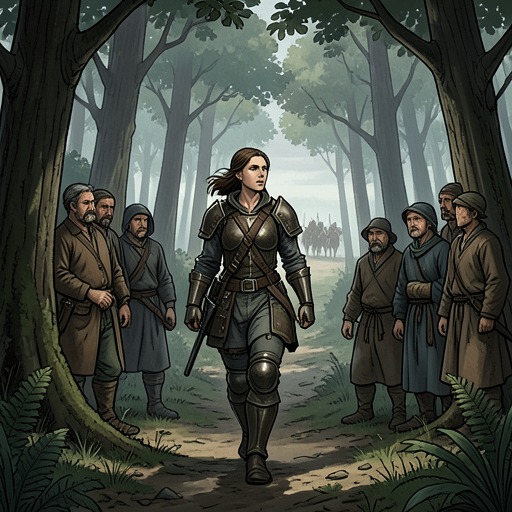
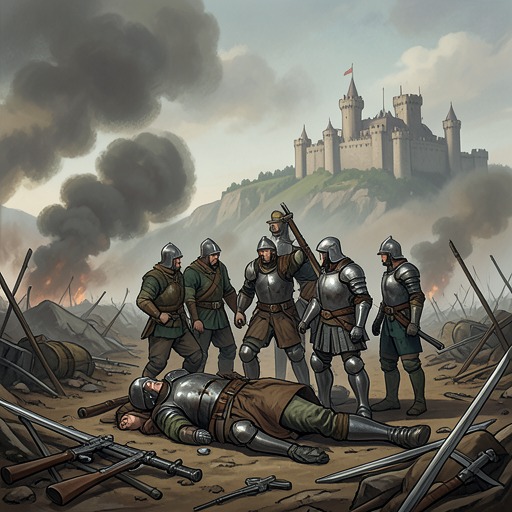
Amyntas had once stood at the head of an army and faced danger repeatedly on behalf of the men under his command. The narrative identifies him as Amyntas the Defender, a title that reflects a career defined by protection rather than conquest. His service included campaigns fought for other kingdoms, part of the alliance system through which Navon supplied soldiers to defend powerful neighbors. That history places his personal loyalty within a larger national cost: Navon’s people had been drawn into wars that did not belong to them, and many soldiers deserted rather than continue fighting those battles.
His military standing did not survive his injury intact. He was no longer the commander he had been, and the former glory of his service receded from public view. The change from an admired leader to an overlooked veteran is presented as a painful loss of identity, especially for someone who believed a life spent protecting others should at least be remembered. Amyntas’s story therefore contains a contrast between the risks he accepted in service and the neglect that followed when he could no longer serve in the same way.
The King’s Debt and Amyntas’s Family
The king’s connection to Amyntas is personal as well as political: they had served together in the army, and Amyntas had saved the king’s life more than once. On one occasion, Amyntas was injured while preventing the king from being struck by a runaway horse. When the king asked what he could do in return, Amyntas mentioned his son, Gael. The request establishes the family’s place in a debt of loyalty, though it does not mean that Amyntas received the recognition he had hoped for during his later years.
The king eventually considers how to honor that debt at a moment when Mabel’s future is being decided. He explains that Amyntas had named Gael, but Gael had become a deserter and only one daughter remained. The king’s decision to arrange Mabel’s engagement is thus connected to Amyntas’s past service and to the family’s altered circumstances. The narrative presents this as an effort to repay an old obligation, not as evidence that Amyntas himself had been publicly restored to his former status. His loyalty is remembered in the palace even as, outside it, he has lived with the consequences of being forgotten.
A Father Who Prepared Mabel
Amyntas’s influence on Mabel is clearest in what he taught her. She understands that he gave her knowledge and abilities that girls were not expected to possess, and she asks whether he would still be proud if she chose a path other than becoming a princess—something society considered unsuitable for a girl. His answer supports her independence: he would be proud of what she did, but urges her to choose meaningful work rather than wait for others to act on her behalf. The exchange does not specify every skill he taught, but it makes clear that his preparation helped Mabel imagine a life shaped by her own choices.
Their conversation also shows that Mabel seeks more than permission. She asks why he taught her what she was not supposed to know and made her into someone she could not openly be. The question holds together affection and frustration: his teaching has enlarged her possibilities, while the gendered limits around her make those possibilities difficult to inhabit. Amyntas’s response gives her a principle rather than a prescribed role. He does not tell her what she must become; he affirms her capacity to choose an action that matters.
On another walk beyond their home, Amyntas asks Mabel to recall a story about a young king whose mother had been murdered by his half-brother. Mabel remembers that Balthasar left the boy in a hostile place rather than kill him directly. Amyntas then describes Balthasar as a conqueror seeking to expand his power, enslaving conquered kingdoms and killing their kings, with an army and arsenal large enough to threaten Navon. The story is both a warning about the danger approaching the kingdom and an instance of Amyntas preparing his daughter to understand the political world beyond their village. His lessons join practical readiness to a sober account of power and its human consequences.
Death and Mabel’s Inheritance
When the invasion reaches the village, Mabel sees residents being driven from their homes and harmed, but she continues toward her family’s house because she has somewhere she must go. She finds Amyntas beneath the wooden storage area used for pots, already dead after being attacked. He has not fallen in a battle or in the defense of his soldiers; his death occurs away from a battlefield, in the disorder of the assault. That difference matters to Mabel because it denies him the kind of ending she associates with a commander’s service and leaves no final farewell, recommendation, or answer to the questions she still wanted to ask.
Mabel thinks of her father’s belief that Navon should be prepared for war, and of how unprepared the kingdom has proved to be. She also turns her attention to her mother, Darice, whose safety remains uncertain in the attack. In the aftermath of finding Amyntas, Mabel prays that she could be better. The moment makes his influence newly urgent: the abilities he fostered are now bound to the danger he had warned her to understand, while his death removes the possibility of further guidance. His legacy is not a public restoration of his military fame but the knowledge, resolve, and sense of responsibility carried forward by his daughter.