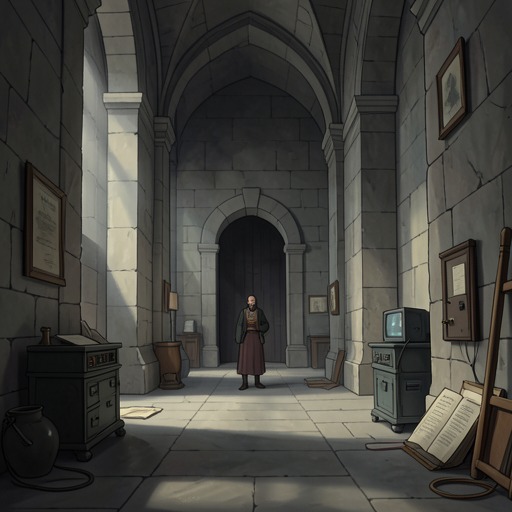
Piranesi explores the First Vestibule and finds Laurence’s note
PiranesiPiranesi explores the First Vestibule and finds Laurence’s note at a moment when the House’s mapped spaces begin to suggest a route beyond them. The visit brings together his painstaking knowledge of the Halls, the bodily signs of an unfamiliar environment, and a piece of ordinary litter that proves to be a message. Piranesi responds not by keeping the paper as a private clue but by writing directions for Laurence and leaving them where another person might find them.
A Starting Point Piranesi Had Neglected
The First Vestibule had a special place in Piranesi’s system of numbering: when he devised it years earlier, he chose this Vestibule as the point from which all the other Halls were reckoned. That choice now strikes him as evidence of a strong connection, since he does not think he would have selected it without one. Yet he can no longer remember what the connection was. His brief consideration of whether The Other is right that he is forgetting things ends in an effort to push the thought away. The visit therefore begins with a gap in his own memory, before the material evidence of a former visitor opens another kind of gap in his understanding.
The Vestibule is larger and gloomier than most, and eight Minotaur statues, each about nine metres high, dominate it. Their bulk darkens the pavement; their horns jut into the empty air, and their expressions remain solemn and inscrutable. The arrangement makes the space feel imposing without making it wholly closed. In the south-eastern corner, shadows fall between two Minotaurs, creating what first looks like the possibility of a corridor beyond the visible Hall.
A Threshold in the Shadows
The corner carries bodily clues that Piranesi has noticed before but usually forgets immediately: the temperature is several degrees colder than in nearby Halls, and a draught brings the smell of rain, metal and petrol. This time he concentrates on the scent and follows the draught along the southern wall to the pair of Minotaurs. Between them, he can almost see a passage extending toward a distant patch of misty light. Other lights seem to flicker within it; a vibration and a dashing sound reach him, like the Waves but less regular. The impression is transient, but its details make the corner seem less like a mere optical trick than a boundary through which another environment might be sensed.
Footsteps and voices abruptly intensify that impression. Piranesi hears one speaker complain about what he was hired to do, followed by a glummer voice commenting on people’s lack of shame. He recoils as if stung. When he cautiously looks again, the shadows appear unremarkable; the lights and sounds are gone, though the cold draught and the smell remain. The scene offers no settled explanation for what he perceived. Instead, a fleeting glimpse of voices and movement is set against the ordinary persistence of air and scent, leaving the corner charged with possibility but not confirming what lies beyond it.
Litter, Memory, and a Message
Four old crisp packets blow one after another across the pavement, reviving a recurring nuisance. Piranesi had previously collected and burned crisp packets, fish-finger wrappers and sausage-roll wrappings to keep them from marring the House’s beauty. He does not know who ate the food, though he wishes the unknown person had been tidier. He had also found a dirty, foul-smelling sleeping bag beneath the marble sweep of the staircase, washed it, and kept it for use. These discarded objects point to a human presence that has left mundane traces in a monumental world of statues and Halls.
He runs after the packets. The fourth is not food packaging at all but a crumpled sheet of paper. Smoothed out, it proves to be a written request addressed to someone capable of giving directions to the statue of an elderly fox teaching young squirrels and other creatures. The writer calls the task easy and leaves space for an answer, with a biro beside the recipient’s lunch; a postscript asks that person to remember a multivitamin. The note’s practical, almost domestic instructions sharply contrast with the scale of the Vestibule and the uncanny glimpse at its corner. Its empty answer space also shows that the requested directions have not yet been supplied.
Piranesi Answers Laurence
Piranesi reads the sheet as evidence of two former inhabitants: a person named Laurence, who wrote the note, and the person who received it, whose lunch and multivitamin Laurence provided. He considers whether either might be 16, then dismisses the possibility because The Other has said that 16 does not know the way to the House. Laurence and the recipient, by contrast, seem to have known these Halls before. Piranesi allows for another possibility: that they belonged to the far-distant Halls. Because Laurence might still be alive and waiting for the information, Piranesi judges that taking the paper would be wrong.
He uses his own pen to fill the blank space, addressing Laurence and giving a precise route to the statue in the Fourth Western Hall. The directions begin by going through the western door, then specify the third door on the right into the First North-Western Hall. From there, Laurence is to follow the southern, or left-hand, wall and take the third door to a corridor leading to the Fourth Western Hall; the statue stands in its north-western corner. Piranesi adds that it is one of his own favourites. Rather than merely identify the note’s writer, he offers the useful knowledge the writer requested, turning an unanswered message into an exchange across time and distance.
Piranesi wishes he could keep the paper, because it is evidence of people whose identities and circumstances remain uncertain. Nevertheless, he leaves it at the foot of the Minotaur nearest the south-eastern corner and weighs it down with a small pebble. The gesture places the reply at the same threshold where he sensed a possible passage, but the note itself gives no proof that Laurence will return or receive it. The result is a modest act of trust: Piranesi preserves the possibility of contact without knowing who will find his answer.
Routes, Care, and the House
The episode belongs to a larger pattern in which route knowledge is both practical and relational. Elsewhere, Piranesi explains that reaching the One-Hundred-and-Ninety-Second Western Hall means crossing the Seventy-Eighth Vestibule, where the Tides scatter jagged debris from the Lower Halls. With no shoes, the broken marble threatens cuts and infection, making the journey laborious as well as possible. Here, by contrast, his route instructions enable someone else to reach a favourite statue safely and efficiently. The same detailed knowledge that helps him navigate danger becomes an offering to an absent person.
This exchange also anticipates the importance of marks and written directions in the House. When Piranesi later traces 16’s path from the Sixth North-Western Hall back to the First Vestibule, he follows yellow-chalk marks below his own eye level. At each doorway, 16 has repeated the directions beneath the frame so that a Tide or mishap destroying one mark will not erase the others. Piranesi’s own answer to Laurence is less systematic: it is a single paper weighted by a pebble. Yet both acts treat navigation as knowledge that should be made legible to someone else. The First Vestibule thus functions at once as the origin of Piranesi’s map, a point of possible passage, and a place where written traces make a solitary world briefly social.
The corner returns at the close of Piranesi’s passage out of the House. Carrying his journals and favourite pens, he walks with Sarah Raphael toward the same two Minotaurs. Their shadows shimmer and suggest a corridor or alleyway, with dim walls and lights flashing in moving colours that he cannot interpret. He looks back at the House; Raphael takes his hand, and together they enter the corridor. The later departure gives the earlier visit a striking resonance: the First Vestibule’s shadowed gap was not simply an isolated curiosity, but a recurring threshold in the story. Piranesi’s visit does not explain the passage, yet it records how careful observation, remembered routes and attention to another person’s needs prepare him to approach it.