Kately brought Matthew into the labyrinth world through a ritual
PiranesiKetterley’s ritual brings Matthew Rose Sorensen from a modern London sitting room into the labyrinth, making a supposed experiment in access to another world the means of a concealed abduction. Its decisive turn is not simply that the rite works: Matthew arrives to find Ketterley already at ease, smiling at him as a successful experiment and admitting that a young, healthy man was what he wanted.
Theories Behind the Ritual
Ketterley’s act grows out of a theory inherited from Laurence Arne-Sayles. Arne-Sayles argued that ancient people’s dialogue with the world had been real: the world could answer and bend, while powers once available to human beings had departed when that dialogue ended. In his first book, he treated those powers as irretrievably lost; in his second, after experimenting with ritual magic, he proposed that some might be recovered through a physical link to someone who had possessed them. Actual human remains, or part of a body, offered the strongest link.
That theory had already taken a concrete and controversial form around Marepool III, a preserved head in the Manchester Museum. Arne-Sayles claimed that divination had identified it as the head of a king and seer, whose knowledge could advance his research. After the museum director refused his request to borrow the head for a rite intended to transfer that knowledge, Arne-Sayles mobilized students to demonstrate. The episode establishes a pattern relevant to Ketterley’s later action: ritual is presented not as idle symbolism but as a technology for obtaining access to knowledge and power.
Ketterley’s account of Arne-Sayles’s teaching complicates that history. Arne-Sayles claimed that he could reach the labyrinth-world simply by adjusting his frame of mind and returning to a childlike, prerational consciousness. His students, he said, generally could not do the same, so he devised a ritual for them as a concession to their lesser ability. The ritual Ketterley later performs therefore carries the authority of a teacher’s explanation while also exposing the hierarchy embedded in it: Arne-Sayles’s claimed spontaneous access is set against a prescribed procedure for students.
From Conversation to Performance
The immediate occasion is a conversation about Arne-Sayles and the influence he exerted over his students. When Ketterley asks whether Matthew truly wants to understand that influence, Matthew agrees. Ketterley answers that they should perform the ritual, and Matthew is startled that he means to do it then. He asks whether Ketterley remembers it; Ketterley says he does. Matthew’s consent is tentative and curious, not an informed acceptance of the danger that follows. He even asks whether drugs are required, and Ketterley replies that the coffee Matthew has already had should suffice.
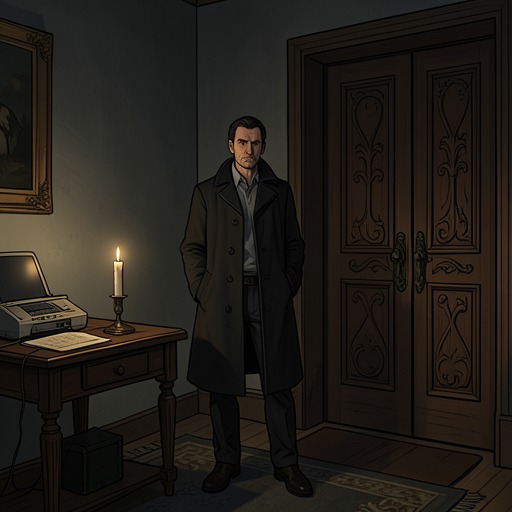
Ketterley stages the procedure in a sitting room furnished in a modern, minimalist European style. He lowers the blinds and takes a candle in an old-fashioned brass candlestick with a square base, an incongruous object against the room’s contemporary furnishings. He leaves an area clear of furniture and positions Matthew there, facing the door to the hall. The arrangement makes an ordinary domestic interior function as a prepared ritual space, with the doorway and candle as its focal points.
He also picks up Matthew’s messenger bag and places it on his shoulder. The bag contains Matthew’s journals, index, and pens; Ketterley tells him he will need his notebooks in the labyrinth. The gesture can sound like practical preparation, even like accommodation of Matthew’s habits, but it also makes the transition feel anticipated and planned. In retrospect, the narrator writing the account records terror at knowing what is coming, while stressing that at the time he felt no foreboding. The difference between later knowledge and his earlier amusement gives the scene its retrospective suspense.
The Crossing
Ketterley places the candle on the hall floor just beyond the sitting-room door. Beneath it is a dark stain in the oak, with a lighter square where the candlestick’s base fits precisely. This small, material trace suggests that the spot has been used repeatedly: the rite is not improvised for Matthew, even though he initially treats it as an occasion to expose Ketterley’s dishonesty. Ketterley tells him to focus on the candle, turns off the lights, and stands slightly behind him.
In the darkness, with orange streetlight filtering through the blinds, Ketterley chants in a language Matthew does not know. Matthew guesses from its resemblance to Welsh and Cornish that it is Brittonic; he hears the name Addedomarus several times. Ketterley tells him to close his eyes. The chanting continues, then gives way to a deep, animal-like growl that seems to rise from Ketterley’s body, growing louder and wilder. Matthew begins the scene amused and incredulous, mentally preparing questions that might reveal a fraud; the performance does not persuade him gradually so much as overtake the assumptions on which that plan rests.
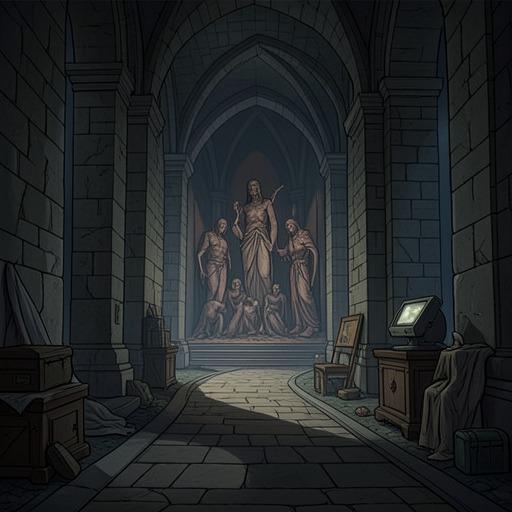
The shift is sudden. With Matthew’s eyes shut, the darkness becomes greyer and cooler, and the air feels colder and damper. The familiar hum of London has stopped. He hears waves striking walls in a space that seems vast and empty. When he opens his eyes, he is surrounded by the walls of a huge hall; statues of Minotaurs rise over him, their horns thrust into the air and their faces solemn and unreadable. The sensory contrast—the extinguished city noise, damp air, waves, and monumental statues—marks the rite’s result as a change of world, not merely a change of mood.
Capture and Reversal
Ketterley stands in his shirtsleeves, completely at ease. His smile is that of someone watching an experiment succeed unexpectedly well. He tells Matthew he is delighted to see him and explains that a young, healthy man is exactly what he wanted. That admission recasts the preceding actions: the candle, the chant, the bag placed on Matthew’s shoulder, and the invitation framed as an answer to Matthew’s curiosity have served an objective Ketterley withheld.
Matthew’s response is an urgent demand that Ketterley put him back. Ketterley laughs instead, and the scene ends with that laughter continuing. The ritual’s apparent success thus produces an immediate reversal in the relationship between the two men. Matthew had entered as a skeptical investigator hoping to expose dishonesty; he emerges in the labyrinth as the object of Ketterley’s experiment, with no demonstrated means of returning.
Narrative Significance
The episode joins the book’s competing accounts of ritual to a concrete alteration of place. Arne-Sayles’s claims about prerational consciousness and access to the labyrinth have so far been reported as ideas and as a teacher’s explanation of his students’ failure. Ketterley’s enactment makes the passage itself the proof Matthew cannot dismiss. Yet the scene does not treat successful access as benevolent revelation: Ketterley’s composure and his preference for a young, healthy subject expose the coercive purpose beneath the rite’s scholarly framing.
Its narration sharpens that reversal by placing Matthew’s later fear beside his former lack of fear. At the time, he expects a chance to question Ketterley and laughs inwardly at the apparent absurdity; in the act of writing, he already knows the danger awaiting him. The ritual therefore has two outcomes: it opens a path into the labyrinth and reveals what Ketterley intends to do with the person he has brought there. The passage from domestic familiarity to the Minotaur-filled hall is also a passage from apparent consent to unmistakable captivity.