Search for the Great and Secret Knowledge
PiranesiThe Search for the Great and Secret Knowledge is the long-running investigation shared by Piranesi and the Other: an attempt to uncover a hidden source of power that the Other believes lies somewhere in the World. Its decisive turn comes when Piranesi withdraws from the project. A moonlit encounter with the House leads him to reject the idea that its worth depends on solving it, while the Other remains intent on converting the quest into a ritual and a program of research.
The Quest and Its Promised Powers
The Other’s premise is expansive but uncertain. He believes that a Great and Secret Knowledge is concealed somewhere in the World, and that finding it will grant them enormous powers. He does not know precisely what the Knowledge consists of; its promise is assembled from possibilities. Among them are defeating Death and becoming immortal, learning telepathically what other people think, extinguishing and reigniting the Sun and stars, and dominating lesser intellects by bending them to their will. The quest therefore has no settled object to test. It gathers its force from the scale of the powers imagined for it.
Piranesi and the Other pursue the Knowledge together, meeting on Tuesdays and Fridays to discuss their work. Their meetings are regular but tightly bounded: the Other organizes his time meticulously and never allows a session to exceed an hour. The arrangement gives the investigation the outward form of disciplined collaboration, even though its goal remains conjectural. The Other sets the tempo and supplies the ambition; Piranesi participates in the research while inhabiting a world whose value he will eventually understand in a different way.
From Investigation to Ritual
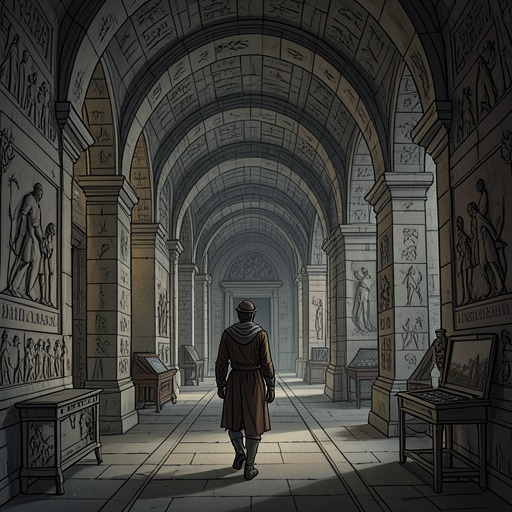
The search is not confined to discussion. In the Second South-Western Hall, the Other tells Piranesi that he will be working on the ritual that day and that Piranesi may prefer not to remain nearby. The ritual is intended to free the Great and Secret Knowledge from whatever holds it captive in the World and transfer it to the pair. They have already performed it four times, each in a slightly different version. The Other has made further changes and wants to hear how they sound in situ, treating the House as the setting in which an experimental procedure can be tested.
This turn from inquiry to ceremony sharpens the quest’s underlying tension. The Knowledge remains undefined, yet the Other acts as if it is a captive entity that a revised ritual might release. His language joins scientific adjustment to magical procedure: versions are altered, their sound is assessed in place, and the anticipated reward is made to justify further risk. The search’s methods thus become more concrete even as its object stays obscure.
Piranesi’s Revelation
Piranesi’s departure from the quest develops during a journey home after observing the night sky. He realizes that he no longer believes in the Knowledge in the way the search requires. He does not decide that it is impossible; he allows that it may exist or may not. The decisive change is that either possibility has ceased to matter to him, and he no longer intends to spend his time looking for it.
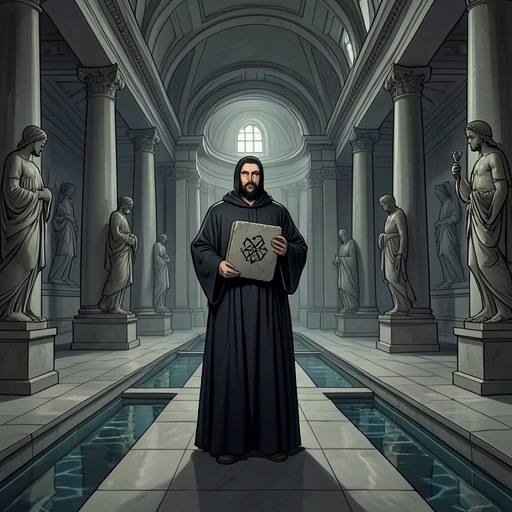
He describes this change as a revelation: its truth came before he could retrace the reasoning that had led him there. When he tries to recover those steps, his attention returns to the One-Hundred-and-Ninety-Second Western Hall in moonlight. He recalls its beauty and calm, and the statues’ reverent faces turned, or seeming to turn, toward the Moon. That image does not provide a new clue in the search. Instead, it changes the terms by which the search itself can be judged.
Piranesi sees that the quest has encouraged them to treat the House as a riddle to unravel or a text to interpret. In that model, discovery of the Knowledge would extract the House’s value, leaving only scenery behind. The moonlit hall makes the implication appear absurd: the House is not merely a means to a result. Piranesi’s conclusion is that it is valuable because it is the House, sufficient in and of itself. The search has taught him to look past the place in pursuit of a promised prize; his revelation restores the place as the point.
The Break Between the Two Researchers
The divergence becomes explicit when the Other decides to go to the room and perform the ritual there. It lies farther into the labyrinth than he has ever travelled, and he acknowledges the risks, but measures them against rewards he considers potentially immense. He asks Piranesi to return to the room and establish which constellations can be seen at different times of year, making the astronomical observations part of the next stage of the plan.
Piranesi answers by announcing that the search must cease and that they should establish a new program of scientific research instead. His proposal attempts to translate his revelation into the language of their shared work, but the Other is occupied with notes on his shining device and initially does not attend. Piranesi has to clarify that he is speaking about abandoning the Knowledge and about what the House has revealed to him. The interruption is telling: at the moment one researcher tries to redefine the value of their inquiry, the other is still recording information for its continuation.
The quest therefore ends for Piranesi as a commitment, not as a settled verdict on whether the Knowledge exists. The Other’s ritual plan and demand for further observations remain opposed to Piranesi’s recognition that the House cannot be reduced to a route toward power. Their shared investigation has brought them to a division in purpose: for the Other, the House is a site through which the sought-after Knowledge may be reached; for Piranesi, attending to the House has made the promised prize insignificant. The contrast gives the search its larger significance, turning a quest for mastery into a test of whether a world must be solved to possess value.