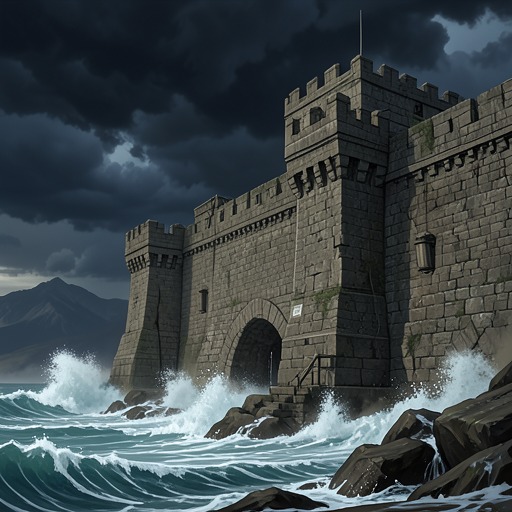
Piranesi moves the dead to safety from the flood
PiranesiPiranesi moves the dead to safety from the flood in an act of practical rescue that also expresses his most consistent ethic: the dead remain members of a community, entitled to care, shelter, and remembrance. As the waters threaten the halls where they rest, he carries their remains to the Upper Halls, handling each person according to the particulars of their bones and his relationship with them. The labor is arduous, but it gives him a way to act amid fear, and turns preservation into both a physical task and a form of companionship.
The Dead and the Coming Flood
With the exception of the Concealed Person, all the dead stand in the path of the floodwaters. Piranesi begins moving them on a Sunday, during the ninth month of the year the albatross came to the South-Western Halls. The task grows out of a longstanding practice: he visits the dead, brings them food, water, and water lilies from the Drowned Halls, and tells them about his work and the wonders he has seen. His attention to them is not limited to the flood emergency; moving them to safety extends an established relationship of care into a crisis.
The bones he protects have distinctive histories and arrangements. The Biscuit-Box Man’s long bones had been tied with seaweed twine, while the small bones were kept in a red biscuit box bearing the words Huntley Palmers and Family Circle. Piranesi had previously retied the larger bones with fish-leather cord when the old seaweed bindings fell apart. The People of the Alcove, in turn, had gathered the Fish-Leather Man’s bones and laid him with their own dead, a collective act of reverence that Piranesi now continues by protecting the remains entrusted to the House’s halls.
Carrying the Bones to Safety
For the Biscuit-Box Man, Piranesi lays the bones on a blanket, leaving those inside the biscuit box in their container. He ties the blanket into a sack with seaweed twine, carries it through the Second Vestibule and up the staircase to the Upper Halls, then places the bones on the plinth of a statue of a shepherdess holding a lamb. He returns for the biscuit box rather than treating the remains as one undifferentiated load: the bones and their small-bone container are both part of the person he is preserving.
He moves the People of the Alcove and the Folded-Up Child by whichever staircase lies closest to their usual dwelling places, storing each carefully in an Upper Hall. The Fish-Leather Man stays wrapped in his blanket, since his many tiny bone fragments might otherwise be lost. The Folded-Up Child also remains bundled, but for a different reason: Piranesi wants her to feel safe in an unfamiliar place. The distinction matters. His handling responds both to the physical vulnerability of fragile remains and to the personal meaning he gives the child, whose curled skeleton he has especially cherished and to whom he has imagined the House might have intended him as a companion.
The transfer takes the best part of three days. The remains of each dead person weigh between 2.5 and 4.5 kilograms, and the staircases rise 25 metres. Piranesi does not present the work as effortless devotion: its weight and repeated climbs make protection a bodily undertaking, measured in loads carried and heights ascended. Yet he finds the hard physical labor helpful. It interrupts his continual thoughts about the injuries the Other has inflicted and his fears concerning 16, giving anxiety a task to follow rather than allowing it to dominate his attention.
Protecting What Sustains Him
The dead are not the only things Piranesi removes from the flood’s reach. His journals and index are almost as dear to him as his life, so he gathers them into a brown leather messenger bag, wraps the bag in heavy-gauge plastic, and carries it to the Upper Halls, placing it beside the Biscuit-Box Man. The location makes the archive part of the same operation of safeguarding: records of his life and the remains of the dead are brought together above the threatened water.
He also stores his fishing gear, sleeping bags, pots, pans, bowls, spoons, and other possessions in high places, beyond the flood’s reach. His final task is to collect the remaining plastic bowls he uses to gather fresh water. This sequence shows the rescue’s practical breadth: he preserves not only the dead and his journals, but the equipment on which his continued life in the House depends. Care here is neither purely ceremonial nor detached from survival; it includes the everyday objects that make future shelter and work possible.
Meaning and Aftermath
Piranesi’s treatment of the remains contrasts with the earlier story of Marepool III, a head that Laurence Arne-Sayles sought to use in a magical rite. Arne-Sayles claimed the head belonged to a king and seer and hoped to transfer its knowledge to himself; after the museum refused his request to borrow it, a later break-in left the head handled, with candle wax and mistletoe fragments adhering to it. Against this attempt to appropriate a dead person’s knowledge for private ambition, Piranesi’s rescue is defined by preservation, careful placement, and regard for the dead as individuals rather than instruments.
The flood preparations also reveal how his beliefs take material form. The House’s dead are not simply a collection of bones to be catalogued: they have accustomed places, distinct remains, and relationships that dictate how Piranesi moves them. His concern that the Folded-Up Child feel safe, his caution about the Fish-Leather Man’s fragments, and his return for the Biscuit-Box Man’s box all resist the reduction of a person to what is easiest to carry. The narrative makes this ethic visible through procedure—wrapping, tying, climbing, placing—rather than through an abstract declaration.
After the flood, Piranesi finds Dr Ketterley’s body battered against the walls and statues in an angle of the staircase in the Eighth Vestibule. He disentangles it from the balustrade, straightens the body, arranges the limbs, and cradles the broken head in his lap, speaking words of comfort and asking forgiveness for having been angry. This later act extends the same care to a man with whom he has been in conflict: the work of tending the dead does not depend on innocence or affection being uncomplicated. Together, the preparations and their aftermath make rescue an expression of Piranesi’s commitment to restore dignity where violence and the flood have left disorder.