To the 192nd Western Hall
PiranesiMatthew Rose Sorensen’s journey to the One-Hundred-and-Ninety-Second Western Hall is both a difficult physical expedition and a decisive change in how he understands the House. Sent to determine which stars could be seen through the hall’s doorway, he encounters a darkness unlike any he knows and, under the Full Moon, a sculpted crowd gathered toward the sky. The sight leads him to abandon the search for the Great and Secret Knowledge: the House is not a puzzle whose value will be extracted by solving it, but a world valuable in itself.
Purpose and Difficult Route
The journey grew out of The Other’s question about the stars visible from the doorway of the One-Hundred-and-Ninety-Second Western Hall. Matthew had resolved to explore as much of the World as he could in his lifetime, and had already travelled as far as the Nine-Hundred-and-Sixtieth Hall to the West, the Eight-Hundred-and-Ninetieth Hall to the North, and the Seven-Hundred-and-Sixty-Eighth Hall to the South. His journeys had taken him through Upper Halls where clouds moved and statues emerged from mist, Drowned Halls where white water lilies covered dark water, and eastern Derelict Halls broken by collapsed ceilings, floors, and walls. Wherever he looked, halls and passageways continued into the distance; he had seen no sign that the World was ending. The House’s statues filled nearly every available space, while empty niches, plinths, and patches of bare wall made absence a mystery in its own right.
The route to the western hall was not simply a matter of distance. The path passed through the Seventy-Eighth Vestibule, where tides brought debris up from the Lower Halls and scattered it across the surrounding halls. Jagged fragments could cut bare feet and create a risk of infection. When The Other challenged the delay, Matthew explained the material change that made the familiar route dangerous: he used to have shoes, and now he had none. The contrast between The Other’s neat suit and shining shoes and Matthew’s ragged, seawater-rotted clothes sharpened the practical inequality behind the expedition.
On the nineteenth day of the sixth month, Matthew completed his usual work—fishing, gathering seaweed, and cataloguing statues—collected supplies, and set out. The House’s wonders accompanied the hazardous route. In the Forty-Fifth Vestibule, a staircase had become a bed of mussels; a statue there was nearly engulfed, with only half its staring face and one white arm still exposed. Matthew sketched it in his journal. At the Seventy-Eighth Vestibule, rubble made the floor uneven and treacherous, a thin sheet of water ran beneath the stones, and broken statues lay piled in the corners. In the Eighty-Eighth Western Hall, a nesting colony of herring gulls attacked his intrusion, forcing him to wave his arms and shout as he passed.
Entering the Dark Hall
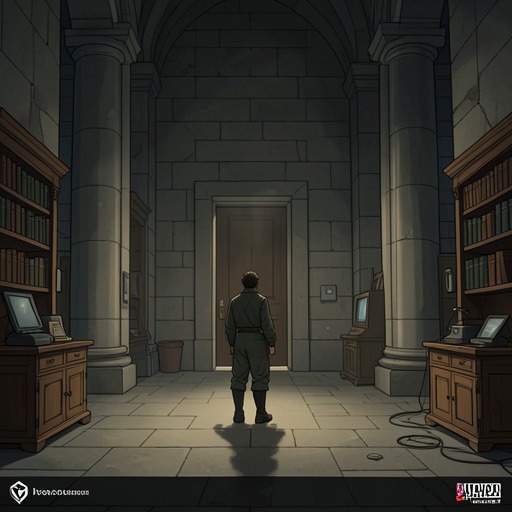
At the One-Hundred-and-Ninety-Second Western Hall, Matthew stopped at its single door. The neighboring halls were softly blue with twilight, but this windowless hall was dark enough to hide its statues. A faint draught came from within, like a cold breath. Matthew had expected to identify the stars by working out the hall’s orientation and consulting his star maps. At the doorway, he recognized the limits of that plan: the opening was about four metres wide and eleven metres high, large as a door but tiny against the sky. To know which stars it framed, he would have to spend the night inside.
He entered, walked about twenty metres, turned toward the single door—which aligned precisely with a corridor window—and settled down in his blanket. Darkness and the unseen statues at his back made him acutely uneasy. His usual sleeping place, the Third Northern Hall, was full of birds whose small movements he heard at night; here he could detect none, as if the birds too found the hall unsettling. To steady himself, he attended to the familiar sound of the sea in the Lower Halls, water lapping against the walls in countless chambers. He fell asleep to it.
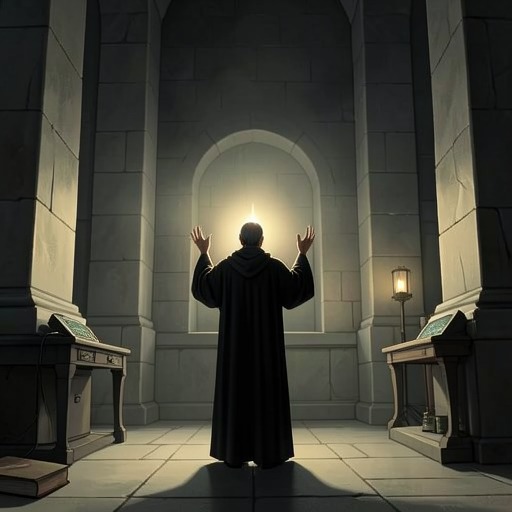
He woke to a Full Moon positioned in the centre of the doorway, its light entering the hall. The statues were revealed not as separate figures but as a crowd, all apparently turned toward the opening and the moon. Two figures embraced; one person laid a hand on another’s shoulder to draw forward for a better view; a child held its father’s hand. A dog, indifferent to the moon, stood on its hind legs with its paws against its master, demanding attention. On the rear wall, a disorderly mass of figures pressed together. At the front stood a young man in moonlight, elated, holding a banner. The composition gave Matthew an intimation of a world inhabited by thousands rather than two people.
The Revelation on the Return
As the moon declined westward, its light faded and the constellations brightened in the window opposite the doorway. Matthew recorded the stars and constellations he saw. After a few hours’ sleep at dawn, he began the journey home. The practical task had been accomplished, but the experience had altered the question he carried away from the hall.
On the return, he realized that he no longer believed the Great and Secret Knowledge was worth pursuing. He did not conclude that it could not exist; he considered both its existence and nonexistence possible. What had changed was its importance. The realization came as a revelation before he could retrace the reasoning that led to it. His mind returned instead to the moonlit hall: its beauty, calm, and statues’ reverent attention to the Moon. The scene had made the House’s value felt before it could be reduced to an argument or a theory.
The search for Knowledge had encouraged Matthew and The Other to treat the House as a riddle to be solved or a text to be interpreted. Under that logic, discovering the secret would take the value out of the place, leaving scenery behind. The moonlit crowd reversed the premise: the House is valuable because it is the House, sufficient in itself rather than a means to an end. Matthew’s conclusion is not that knowledge has no value, but that the promised secret must not turn the world that contains it into a mere instrument.
A New Direction
The revelation also clarified Matthew’s unease with The Other’s account of the powers the Knowledge would grant. The Other had spoken of controlling lesser minds. Matthew rejected the premise behind that promise: there were no lesser minds, only himself and The Other, both with keen and lively intellects. Even hypothetically, he could see no reason to want control over another mind. His change of direction therefore involved an ethical distinction as well as an intellectual one: inquiry need not be organized around domination.
Abandoning the hunt for the Knowledge opened the possibility of a different science, one that could follow whatever path the data suggested. The thought made Matthew excited and happy, and he was eager to return to The Other and explain it. The journey had begun as obedience to a question set by his companion, and its dangerous route depended on his having to cross broken stone without shoes. Yet the night’s central outcome was not simply an answer about stars. The hall’s crowd, its moonlit doorway, and the quiet attention of its statues redirected Matthew’s inquiry toward the House itself and away from the promise that its worth lay in what could be taken from it.