The Other’s Batter-Sea memory test
PiranesiThe Other’s Batter-Sea memory test is a conversation about memory that turns, by evening, into an unsettling encounter with its limits. The Other asks Piranesi to distinguish what he can genuinely remember from what he might merely claim to know, and tests him with a place that does not exist. Piranesi understands the logic of the test; what neither man can account for is the fragmentary image that the word later awakens.
The test and its setting
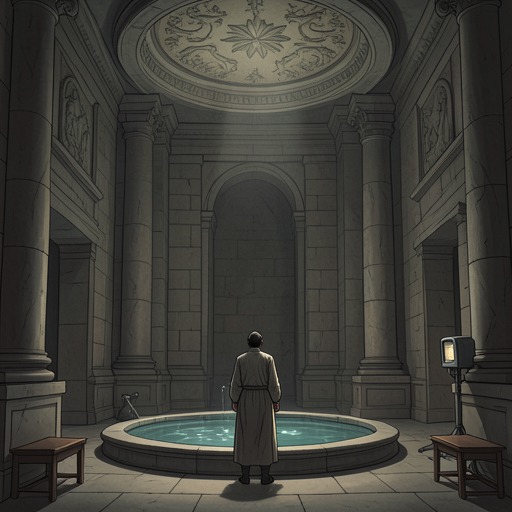
On the twenty-ninth day of the fifth month in the year the albatross came to the south-western halls, Piranesi goes at ten in the morning to the Second South-Western Hall to meet the Other. The Other is already there, leaning against an Empty Plinth and tapping at one of his shining devices. His charcoal-wool suit and bright white shirt stand out against his olive-toned skin. Without looking up, he says that he needs data.
Piranesi recognizes this manner as typical of the Other: absorbed in his scientific work, he often forgets greetings and farewells, or to ask how Piranesi is. Piranesi does not resent the omission; he admires the Other’s dedication. That trust and familiarity frame the exchange. The Other is not introduced as an adversary but as a researcher whose attention to Piranesi’s mind is accepted as part of their relationship.
The Other asks Piranesi what he remembers. Asked for examples, Piranesi describes a detailed, practical spatial memory: if he has visited a distant Hall, he can give the route through the intervening Halls, identify notable Statues on the Walls, and recall their positions and approximate distances. His account presents memory as knowledge that can be demonstrated through the intricate geography of the House, rather than as a general recollection of the past.
Batter-Sea as a control question
The Other interrupts this explanation with a single question: does Piranesi remember Batter-Sea? Piranesi initially does not understand what is being asked. After the Other remains silent and watches him closely, Piranesi decides that Batter-Sea is not a word with a referent: nothing in the World corresponds to that combination of sounds.
The question’s odd construction is the method. A real Hall unknown to the Other would not offer a reliable test: the Other could not judge whether Piranesi’s directions were accurate. Batter-Sea, by contrast, sounds enough like a place to tempt a false claim, but is invented. Piranesi realizes that if he professed to remember it and described a route, the Other would know that he was boasting rather than reporting a memory. The nonsense word functions as a control because it gives the Other a way to distinguish genuine recall from an unverifiable performance.
Piranesi explains the design aloud, including the implication of a place battered by the sea. The Other confirms that this is exactly what he is doing, and the two laugh together. The moment makes Piranesi an active interpreter of the experiment: he does not merely answer questions but infers the researcher’s purpose and articulates its logic. At the same time, his confidence in that explanation rests on the assumption that Batter-Sea has no personal significance for him.
A word returns in fragments
That evening, Piranesi goes to the Eighth Vestibule to fish. He is thinking about supper and the beauty of the Statues in the evening light, not consciously turning over his morning conversation. As he casts his net into the Waters of the Lower Staircase, an image rises before him: a black scribble against a grey sky, accompanied by a flicker of bright red. White words on a black background seem to drift toward him. A sudden blare of noise and a metallic taste also accompany the fragments.
The elements do not resolve into a clear scene or coherent memory. Piranesi describes them as fragments, or ghosts of images, that seem to gather around the word Batter-Sea. He tries to hold them and sharpen their focus, but they fade like a dream. The episode therefore does not prove what the image depicts or where it came from; it establishes only that the supposedly meaningless word has become attached to something that Piranesi cannot consciously retrieve or interpret.
Significance and unresolved implication
The sequence moves from a controlled question to an uncontrolled response. In the morning, Batter-Sea is useful precisely because it has no referent: it exposes a lie if Piranesi claims knowledge of it. In the evening, the same word attracts images, writing, noise, and bodily sensation that Piranesi cannot explain. The shift complicates the test without invalidating its immediate result. Piranesi does not claim to know a route to Batter-Sea; instead, the word prompts a different, incomplete kind of remembering.
The Other’s test is thus significant both as an examination of Piranesi’s reported spatial memory and as a hinge in the narration of memory itself. Piranesi can confidently map the House while remaining unable to make sense of the fragments that surface outside the conversation. The entry ends not with a recovered account, but with the images disappearing. Batter-Sea remains an unanswered disturbance: a made-up place-name that proves impossible to treat as merely meaningless once Piranesi has heard it.