16 leave a written message for Piranesi
Piranesi16’s written message to Piranesi is the first direct written contact Piranesi has received from another human being, and it transforms a rule against reading into a difficult choice between safety and connection. Finding 16’s extensive message in the Sixth North-Western Hall, Piranesi erases it while blindfolded, yet leaves scattered fragments and secretly writes back. The exchange exposes how strongly he wants to know 16, even as he tries to protect himself from the madness he believes her words might cause.
The message in the Sixth North-Western Hall
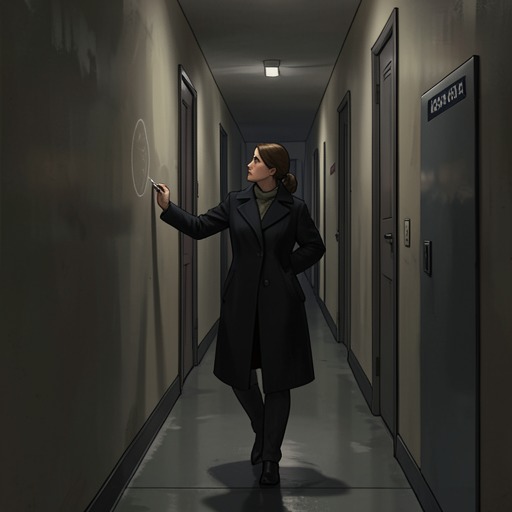
After seeing 16 shine a torch on the message Piranesi had left for him, Piranesi watched from concealment as 16 knelt and wrote rapidly in the Sixth North-Western Hall. He could not read what she was writing. The moment mattered to him nonetheless: no one had ever written to him before, and he found himself pleased that 16’s reply was long. That pleasure immediately unsettled him. He reminded himself that he was not permitted to read it and believed that doing so would make him go mad; a part of him felt that learning what 16 had written might be worth that risk.
The message occupied an area of pavement approximately 60 by 80 centimetres. When Piranesi returned to the hall the next morning, the rooks greeted him, but he hurried to the writing. He had set out with his Index and journals, yet found no entry for Raphael; the question he wanted to ask The Other would also have to wait, since it was not a day on which they met. Against those deferred searches, the message offered an immediate, perilous source of knowledge.
Erasure without reading
Piranesi believed that the message’s continued presence would give him a powerful urge to read it, so he decided to destroy it. He ran to the Third Northern Hall for an old, ragged shirt, tore the garment in half, and used one piece as a blindfold. With the other, he swept across the pavement to erase 16’s words without looking at them. This was not simply a refusal to read: it was an improvised method for preventing the message from reaching him while he carried out its destruction.
After a couple of minutes, Piranesi removed the blindfold and discovered that the erasure was incomplete. Fragments remained, including the phrases “COMPREHENSIBLE? MY” and “NAME,” followed by further broken words. He judged that the remnants made little sense at first glance and hoped they would not affect him; at that point, he felt fine. But he did not continue cleaning until every trace had disappeared. Later he acknowledged that he had left the surviving half-phrases and sentences untouched, concealing this choice from The Other.
Piranesi’s written reply
Rather than erase the remaining writing, Piranesi knelt and answered it. He addressed the note to 16, warned that The Other would try to kill her if she remained in their halls, and disclosed that The Other had a gun. He also declared that he had erased her message without reading it, that her words had not touched him or made him mad, and that her plan had failed. He ended by urging 16 to return to the far-distant halls from which she had come.
The reply is at once a warning and a claim of resistance. Piranesi presents the unread message as powerless over him, but the act of answering proves that the contact has already changed his conduct. He has taken in enough of the surviving fragments to respond, and he now communicates privately with 16 while withholding the exchange from The Other. His insistence that he has not been affected sits beside his admission that he wants to learn everything he can about her, so long as he can do so without going mad.
Fragments, secrecy, and danger
Piranesi’s later reflections make clear that his curiosity concerns 16 as another human being, not simply the fact that she is a woman. He does not tell The Other that 16 wrote to him, or that he preserved pieces of her message. The concealment gives the fragments a second function: they are both the remains of a forbidden communication and evidence of Piranesi’s private departure from the rule he claims to obey.
Among the surviving text, Piranesi recognizes a reference to Valentine Ketterley and connects it with the Prophet’s identification of The Other as Val Ketterley. He interprets another fragment as possibly referring to other victims whom 16 had groomed, while admitting that its meaning is unclear. These readings are partial and tentative, not a complete account of 16’s message. The exchange therefore produces knowledge without resolving its dangers: Piranesi learns enough to connect The Other with a name and to fear for 16’s safety, but deliberately leaves much of what she wrote unread.
Narrative significance
The episode makes writing itself an unstable form of contact. Piranesi’s rule prohibits reading 16’s words, but it does not prevent him from seeing their physical traces, forming interpretations, replying, or keeping the remains secret. His blindfold turns obedience into an act requiring ingenuity, while the incomplete erasure reveals that his restraint is not absolute. The message’s force lies less in any fully recovered statement than in the actions it provokes: Piranesi risks communication, warns 16, and withholds the truth from The Other.
The exchange also establishes a contrast between the long message Piranesi cannot bring himself to read and his own emphatic reply, which insists that he remains untouched. That insistence is undermined by the scene’s consequences. He is no longer merely waiting for a permitted meeting with The Other; he has entered a hidden correspondence with 16 and is carrying fragments of her words forward. The writing becomes an early sign that Piranesi’s desire for human knowledge is already competing with the restrictions meant to contain it.