Arn-Selles enters the maze
PiranesiLaurence Arne-Sayles’s entry into the Other World begins with an argument about how a door can be found and ends in a marble chamber surrounded by eight Minotaur statues. In his account, the threshold opens not because he completes an elaborate ritual, but because childhood memory restores a way of seeing that modern rationality had suppressed. The story makes recollection itself the decisive act of passage: a remembered garden becomes the route into the House.
The Door and the Lost State of Mind
In 1979, Arne-Sayles published The Half-Seen Door, his third and most famous book, setting out ideas about other worlds and describing how he entered one after a period of struggle. The account presents the door as something more than a fixed portal to be located once and for all. After a person has found it, Arne-Sayles writes, it is always available; the difficulty lies in seeing it for the first time. His proposed method is to cleanse one’s vision by returning, physically or in memory, to the last place where the world seemed fluid and responsive rather than governed by modern rationality.
For Arne-Sayles, that place was the garden at his childhood home in Lyme Regis. By the time he sought to return, the house had passed through several owners. Its new occupants refused his request to stand in the garden for several hours while performing an Ancient Celtic ritual. He learned from a friendly milkman when they would be away, returned during their holiday, and broke into the garden. The episode makes the threshold crossing begin as a literal trespass into a personal past: denied permission to enter openly, he goes back by stealth to the site he associates with an earlier, unrestrained state of mind.
Remembering the Garden
The day Arne-Sayles entered the garden was cold, rainy, and grey. He stood on the lawn among the roses his mother had planted, now sharing their beds with flowers he considered vulgar. Behind the rain he saw masses of colour—white, apricot, pink, gold, and red. Instead of relying on the ritual he had prepared, he concentrated on remembering himself as a child there, at what he described as the last time both his mind and the world had been unfettered.
His memory was concrete and personal: he had stood before the roses in a blue wool romper suit, holding a metal soldier whose paint was beginning to peel. Remembering proved unexpectedly potent. Arne-Sayles says that his mind was freed at once and his vision cleansed; the complicated ritual became unnecessary. The rain ceased to occupy his awareness, and he experienced himself as standing in the clear, strong sunlight of early childhood, with the roses’ colours made supernaturally bright. The passage therefore gives the entrance a specific cause within Arne-Sayles’s own account: not ritual performance, but the force of recovered childhood perception.
Finding and Crossing the Threshold
As Arne-Sayles’s vision changed, doors into other worlds began to appear around him. He recognized among them the one he wanted: the door into which, in his description, everything forgotten flows. Its edges were frayed and worn, as though old ideas had passed out of this world through it. The image connects the physical appearance of the threshold to the book’s account of forgetting, while also distinguishing this particular door from the other openings he sees.
He located it in a gap between two roses, Antoine Rivoire and Coquette des Blanches, and stepped through. The entry thus moves from a familiar garden and remembered childhood objects into an unmistakably strange interior without separating the crossing from the act of looking. The door becomes visible only after the memories that restore his vision; recognition precedes entry, and entry follows immediately once he knows which opening he seeks.
The First Chamber
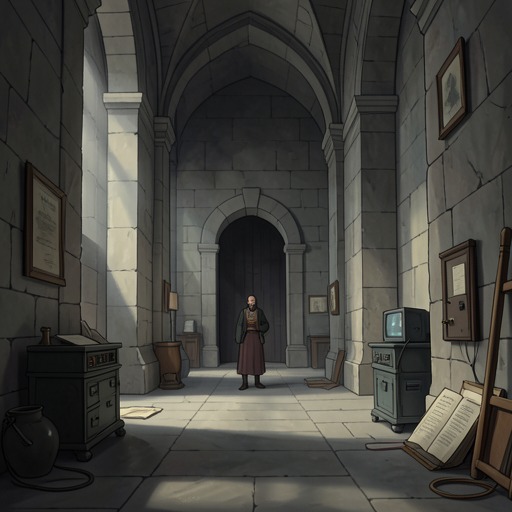
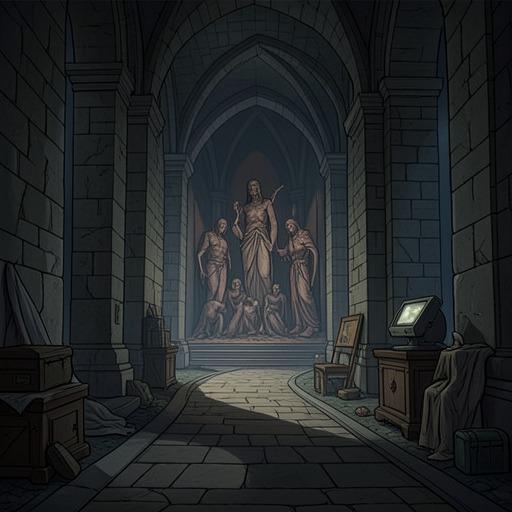
On the other side, Arne-Sayles found himself in a vast chamber with stone flooring and marble walls. Eight enormous statues surrounded him, each different and each depicting a Minotaur. A great marble staircase rose to a disorienting height and descended to an equally disorienting depth. The chamber offers the first clear spatial form of the world he had sought: a place of monumental architecture, repeated statuary, and vertical reaches that defeat ordinary measures of scale.
A strange thundering filled his ears, like the sound of a sea. That sound links the chamber to the House’s wider watery environment, but Arne-Sayles’s account at this point stops with his arrival and his resolve to remain calm. It establishes the moment of entry, not a complete explanation of the world or a full account of what follows. The contrast between the rain-soaked garden and the immense interior gives the scene its force: a private memory opens onto a space whose scale and statues make the remembered garden seem only a threshold.
Narrative Significance
Arne-Sayles’s account is an embedded explanation of how he entered the House, and it supplies a revealing counterpoint to the House’s navigable but hazardous geography. Its halls extend in ordered sequences, yet travel through them depends on knowledge of routes and on attention to conditions: the passage toward the One-Hundred-and-Ninety-Second Western Hall, for instance, runs through a vestibule where tides scatter sharp debris that can injure bare feet. Elsewhere, 16’s route is recorded in yellow chalk beneath doorframes so that directions will survive a tide or mishap. Against these practical forms of access, Arne-Sayles describes a door that appears through an inward recovery of perception.
His story also sits beside Piranesi’s own expansive experience of the House. Piranesi has travelled as far as the Nine-Hundred-and-Sixtieth Hall to the West, the Eight-Hundred-and-Ninetieth Hall to the North, and the Seven-Hundred-and-Sixty-Eighth Hall to the South; he has climbed into cloud-filled upper halls, explored drowned halls carpeted with water lilies, and seen eastern halls where ceilings, floors, and sometimes walls have collapsed. From doorways, he sees only the regular progression of halls and passages into the distance, not evidence that the world is ending. Arne-Sayles’s remembered passage supplies a different kind of orientation: not a map of distance, but a personal account of the mental state through which entry first became possible.
The garden episode gives memory a double role. It is the means by which Arne-Sayles claims to cross into another world, and it is also the source material from which he makes that crossing intelligible in The Half-Seen Door. His account identifies the blue romper suit, the peeling metal soldier, his mother’s roses, and a specific gap between two named flowers as the details that lead to the threshold. Set against the House’s innumerable halls and statues, those small particulars make the entrance legible as an intensely personal route into an immense shared space.