Piranesi discovers and reads the old journals
PiranesiPiranesi’s discovery and reading of the old journals transforms his notebooks from a record of life in the House into material evidence that his present identity rests on a concealed and largely inaccessible past. An index entry for Stanley Ovenden leads him to older writing in his own hand, but its unfamiliar names and places initially seem like meaningless products of madness. As he investigates the notebooks’ numbering and missing pages, the journals reveal both the scale of his forgetting and the difficulty of recovering a past that the House has obscured.
The Index and the First Contradiction
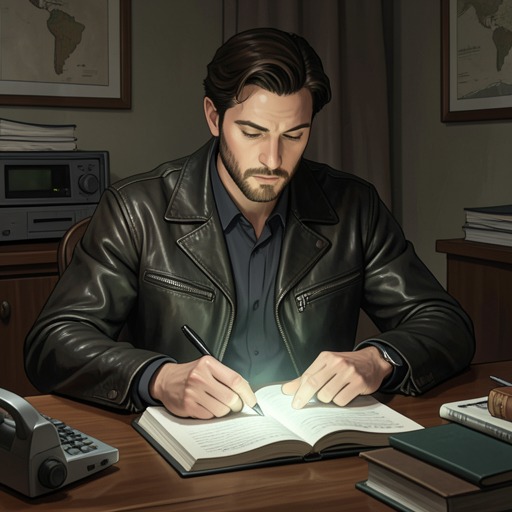
While making entries about the identities of the Dead, Piranesi consults the index and finds a reference to Stanley Ovenden, identified as a student of Laurence Arne-Sayles. The entry points to Journal no. 21, page 154, and to another entry about Maurizio Giussani’s disappearance. The reference unsettles him because he has no memory of Ovenden, and because the journal he is currently writing is number 10. He insists to himself that there is no Journal no. 21 and that there could never have been one. Yet the index’s detail resists dismissal: Ovenden’s name is already there, though it meant nothing to Piranesi when the Prophet spoke it.
The index expands the contradiction beyond a single person. It directs him to references to other journals he believes do not exist, including numbers 11, 17, 18, and 20. Numbers 3 and 5 do exist among his surviving journals, but even those references may concern different books. The entries were written in his own handwriting, though the pen, ink, and script differ from his present materials and practice: the writing is rounder, heavier, and younger. The archive therefore presents a double estrangement. The words appear to be his, but neither their world nor the earlier self who wrote them feels recognizable.
Altered Covers and a Hidden Biography
To test what the index implies, Piranesi retrieves his journals from the brown leather messenger bag hidden behind the Statue of an Angel caught on a Rose Bush in the North-Eastern Corner. He counts nine. The physical books contradict the possibility that he has simply overlooked a larger collection, but their covers offer a different explanation: the first three were originally numbered 21, 22, and 23. Someone scratched out the initial numeral 2 and turned them into numbers 1, 2, and 3. Because the white gel ink could not be completely removed, the old numerals remain visible as ghostly traces beneath the new labels.
The numbering lets him connect the index to a biography in the first journal, originally number 21. On page 154, an entry dated 22 January 2012 identifies Stanley Ovenden as born in Nottingham in 1958, educated in mathematics at the University of Birmingham, and a postgraduate researcher from 1981. After attending one of Arne-Sayles’s lectures, Ovenden abandoned mathematics and began a PhD in anthropology at the University of Manchester under Arne-Sayles’s supervision. These details belong to a world Piranesi cannot yet comprehend, but the Prophet’s reference to Ovenden confirms that the name is not merely an invention in a disordered notebook.
Piranesi also reads the journal’s account of the disappearance of Maurizio Giussani. The old entry records that Giussani was never seen again after a night when several people, including Ovenden, Ketterley, and D’Agostino, gave accounts of his departure. Piranesi stops reading before he can make sense of the full account. Names such as Birmingham, Perugia, Nottingham, and university strike him as nonsense, without anything in the World to which they could refer. He fears that he is already mad, or had been mad when he wrote the entries, and drops the journal onto the pavement before walking away from it.
Fear, Recognition, and Cautious Reading
The notebooks provoke an immediate bodily recoil: Piranesi wants to throw the journal away and put physical distance between himself and what it contains. Even after leaving it on the pavement, the unfamiliar words continue to echo in his mind, accompanied by pressure and the sense that half-formed ideas might break into consciousness. He returns to the Third Northern Hall, eats a little fish, drinks water, and visits familiar statues. Their beauty steadies him enough to reflect more calmly the following morning.
His calmer reading does not resolve the past; instead, it reveals fragments of recognition that he cannot hold. The word Birmingham brings a burst of noise, movement, and color, with a fleeting image of towers and spires beneath a grey sky. The impressions feel both nightmarish and strangely familiar, then fade as soon as he tries to examine them. He also considers whether words such as university might have acquired meaning from the House’s Statues of Scholars, but recognizes that this is only a tentative explanation. The entries combine incomprehensible outside references with details that connect to people and evidence already present in his life, leaving neither complete disbelief nor confident recognition available to him.
Piranesi accepts that he must have been seriously ill, but revises his first judgment that the old writing is simply gibberish. He sees two reasons to study it: the journals may preserve actual information about people who lived, and understanding his own earlier illness may help him identify its triggers and guard against it. He also acknowledges a danger in the act of reading itself. The notebooks bring painful emotions and nightmarish thoughts, so he resolves to proceed carefully and take in only small portions at a time. The journals become both a record to investigate and a potential source of renewed distress.
Missing Pages and the Material Archive
A later return to the journals makes their physical history as consequential as their written contents. When Piranesi looks up further entries about Ketterley, he finds that the relevant pages have disappeared: the last ten pages of Journal no. 22 and the first thirty-two pages of Journal no. 23 are gone, their torn edges still caught in the spines. The loss cannot be explained by the books’ renumbering alone. Piranesi considers whether the Prophet or 16 might have removed the material, but has no evidence that either could have found the messenger bag where he keeps the journals. He also admits that he has no recollection of tearing the pages himself, while recognizing that other actions and writings have vanished from his memory.
The scraps gathered from gull nests in the Eighty-Eighth Western Hall offer a physical link to the missing text. Piranesi had recovered seventy-nine fragments from thirty-five nests, softening the gulls’ droppings with warm water applied by rag so the paper would not dissolve. When he later examines the pieces, one bears the page number 231, identifying it as a fragment from Journal no. 2. He begins assembling the scraps and finds approximately thirty entries covering 15 November to 20 December 2012, including a longer entry titled “The events of 15 November 2012.” The pages once separated from the journals have passed through the House and into the gulls’ nests; their return turns an unexplained absence into evidence that can be handled and read.
The altered numbering and torn pages make the journals an unstable archive: their contents survive only in altered volumes, incomplete references, and fragments whose histories Piranesi cannot fully remember. Even the surviving notebooks carry traces of prior changes, while his younger handwriting makes authorship recognizable but not reassuring. Reading them is therefore not a straightforward recovery of a continuous biography. It is a piecemeal investigation in which the material condition of each record—its number, script, missing pages, or recovered scraps—both supplies information and exposes what remains unavailable.
Significance for Identity and Memory
The discovery changes how Piranesi understands the relation between his present self and his past. He has long accepted that the House causes forgetfulness, relying on the assurances of the Other and the Prophet; the journals give that general explanation concrete form. He finds evidence that he wrote about a world whose names he cannot place, that his journals were renumbered, and that part of their record is missing. The gap is not simply an absence of remembered facts: it separates the person who wrote the entries from the person now trying to read them.
The episode’s central reversal lies in the journals’ status. At first, they appear to confirm Piranesi’s fear that his past writing is the product of madness. Yet their specific references, the Prophet’s knowledge of Ovenden, and the recovered page fragments make them consequential evidence rather than disposable nonsense. They do not restore his former identity all at once, and Piranesi does not force a complete interpretation from the scraps. Instead, he adopts cautious study, acknowledging both the possible knowledge the journals contain and the harm that reading them can cause. The act of discovery thus begins not with certainty, but with a disciplined willingness to face a past that remains strange even in his own handwriting.