Piranesi helps the albatrosses build their nest
PiranesiPiranesi helps the albatrosses build their nest by turning a moment of wonder into sustained, material care. After an albatross appears in the South-Western Halls, he recognizes that the pair need dry nesting material, gives them part of his stores despite the cost to his own warmth, and sees them build a nest, lay an egg, and care for a chick. The episode gives its year a name and shows how Piranesi’s reverence for the House takes practical form: attention to another creature’s needs, followed by work to meet them.
Arrival in the Halls
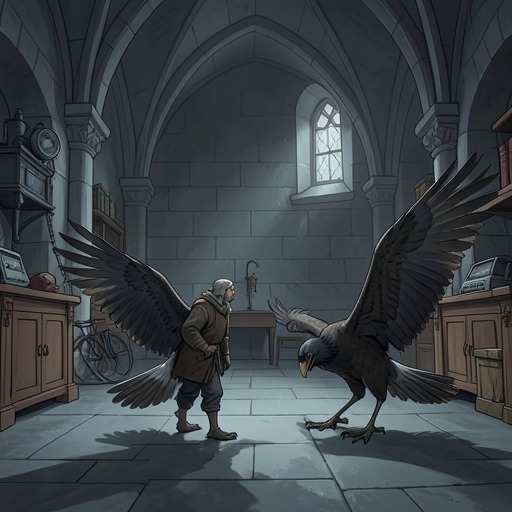
Piranesi first sees the bird while gathering cold, wet seaweed in a strong wind. Above the grey waves, a white shape approaches, at first so dazzling that he mistakes it for a cross; as it comes closer, he understands that it is an albatross. Its wings exceed the width of the doorway between the Halls. Piranesi raises his arms in greeting, imagining for a moment that bird and man might merge into a new being, but the vision gives way to an ungainly landing: the albatross swings past his shoulder, tumbles onto the pavement, and scrambles upright. The contrast between its effortless flight and its clumsy arrival makes the encounter both numinous and ordinary.
Piranesi welcomes the bird and explains that he is one of the House’s inhabitants. He adds that there is another inhabitant, The Other, who is not fond of birds and may not see the visitor. The albatross answers with a clacking, whirring sound, spreads its wings, and walks about the Hall while Piranesi returns to his work. The bird’s presence does not remain a private marvel: when Piranesi returns the next day, it has gone up the staircase to the Forty-Third Vestibule, where a second albatross has joined it. Piranesi cannot tell which bird is male or female, but distinguishes the newcomer by pale flecks scattered across its wings like silver rain, unlike the star-shaped markings on the first bird.
Recognizing the Need
A few days later, the pair seem subdued. One bird repeatedly gathers cold, wet seaweed from the Lower Hall, heaps it in one place, then moves it elsewhere, trying one arrangement after another. Piranesi reads the repeated effort as a sign that the birds have come to nest but lack suitable material: seaweed is available, but it is too wet to make a warm, comfortable nest for an egg. His response begins with observation rather than command. He sees the problem in the birds’ actions and offers the resource they cannot find themselves.
Piranesi says he has dry seaweed and will bring it immediately. The star-marked bird spreads its wings, stretches its neck, and points its beak toward the ceiling with a harsh clacking sound; he takes this display as enthusiasm. His interpretation remains tentative, but his offer is not. He leaves to prepare the material, treating the birds’ apparent need as a reason to act rather than a spectacle to watch.
The Gift and the Nest
In the Third Northern Hall, Piranesi lines a fishing net with heavy-gauge plastic and fills it with what he judges to be an adequate amount of nesting material for two enormous birds. The load approximates three days’ fuel. Giving it away may leave him colder, a cost he recognizes rather than overlooks. He nevertheless decides that a few cold days matter less than the possibility of a new albatross in the World.
He adds two things that carry a different kind of value: clean white feathers he had kept simply because he liked them, and an old woollen jumper, now so full of holes that it is scarcely useful as clothing but may serve as a soft lining for a precious egg. The gift thus combines fuel with objects preserved for pleasure and a garment repurposed for shelter. Piranesi drags the net to the Forty-Third Vestibule, where the male albatross immediately takes up a beakful of dry seaweed and tests it in different places. The birds’ use of the offering confirms the purpose of his journey: the materials he assembled become part of their work.
A Year Marked by New Life
Soon afterward, the albatrosses build a nest about a metre wide at its base and lay an egg. Piranesi describes them as devoted parents, first attending closely to the egg and then diligently caring for the chick. The chick grows slowly and has not yet shown signs of being ready to fledge. His account does not end with the provision of materials; it follows the consequences of that intervention into the continuing life of the birds and their young.
Piranesi names the year the Year the Albatross Came to the South-Western Halls. The title records the birds’ arrival, but the event it commemorates includes the pair’s nesting and the care of their chick. In a House where Piranesi sees beauty and life in creatures and natural forces that The Other dismisses, the episode makes reverence visible as labor: he observes, interprets, gives up warmth, and helps make a place for new life. The albatrosses are not merely emblems in his account; their particular needs and slow-growing chick give his response its concrete measure.