Dicky Cable
Dicky Cable appears in Charles Decker's memory as a squat, aggressive boy who embodied the casual cruelty of adolescence. Charlie recalls him as a "squat kid who always somehow reminded me of a lawn mower, a big Briggs & Stratton self-propelling model with the choke stuck open." His defining physical feature was a "big square grin" filled with "big white square teeth that fitted together on the top and bottom like the teeth in two meshing cogs." This mechanical, predatory image—teeth that seemed to "gnash and fume between his lips like revolving mower blades"—made him seem to Charlie as though "he ate patrol boys for supper." Dicky was a fixture of the local social scene, known for his oiled hair and a swagger that made him seem "daring" and "wild" to girls like Carol Granger, who admitted to having a crush on him after the eighth-grade picnic.
The Birthday Party Fight
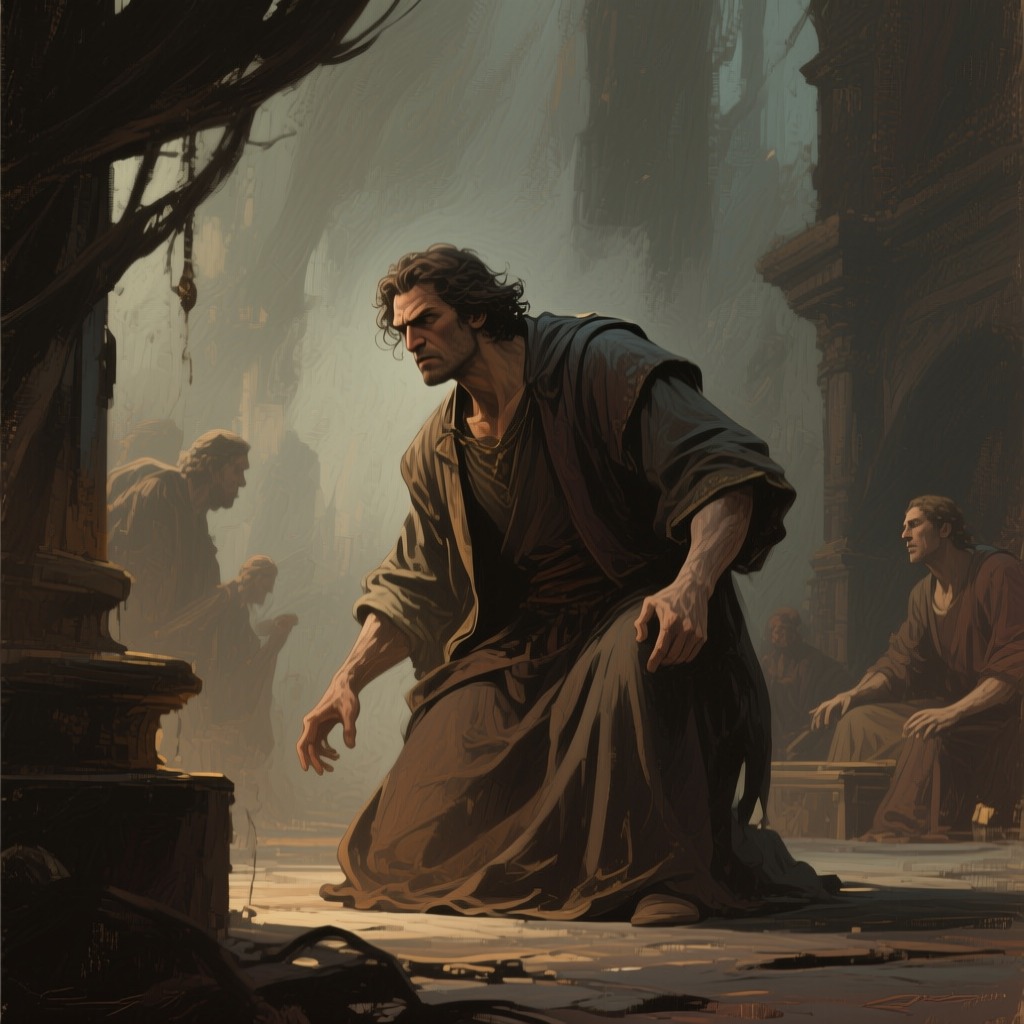
The central incident involving Dicky Cable occurred at Carol Granger's twelfth birthday party, a day Charlie remembers as "three hours of unadulterated hell." Forced by his mother to wear a corduroy suit with a bow tie and brass buttons, Charlie arrived to find everyone else in casual clothes. Dicky immediately targeted him, greeting him with a back-slapping "Son of a gun, you look slick!" and the repeated, mocking refrain "slicker than owl shit." When Charlie tried to leave, Dicky blocked his path. Charlie told him to shut up, and Dicky swung, hitting him on the shoulder with a force that "just about paralyzed the big muscle in my arm." A fight ensued, during which Charlie felt a strange dissociation—"It was like being outside myself. Someone else, some other me, was in the driver's seat." Dicky overpowered him, got on top of him, and slammed his head into the ground repeatedly, laughing and taunting, "Hey, pretty boy, don't you look nice?" Charlie was rescued by his friend Joe McKennedy, who dragged Dicky off. The humiliation was complete: Charlie lay crying, picking up the buttons that had ripped off his ruined suit, while Dicky calmly combed his hair, "as if he might like to comb his hair again."
Death and Aftermath
Years later, during the hostage crisis in Room 16, Charlie learns of Dicky Cable's fate. When Carol Granger mentions her old crush on Dicky, Dick Keene flatly states, "Placerville Cemetery." The news gives Charlie "a nasty start" and a "strange, almost dreamy terror." Dick Keene recounts the story: Dicky got his driver's license the previous October and drove "like a fool." He owned a 1966 Pontiac, painted bottle green with an ace of spades on the passenger side, which he had souped up with a four-barrel carburetor and fuel injection. Keene describes a terrifying ride up the Stackpole Road in Harlow at ninety-five miles per hour, where the car began to slide around Brissett's Bend. While Keene hit the floor, Dicky just kept grinning and repeating to himself, "I can hold 'er, I can hold 'er." A couple of months later, Dicky was hit by a delivery truck while crossing Lisbon Street in Lewiston. Keene emphasizes that Dicky "wasn't even drunk or stoned" and that the accident was "the truck driver's fault entirely." The driver went to jail for ninety days, but Dicky was dead. The randomness of his death—a violent end that had nothing to do with his own reckless driving—echoes the novel's central theme of a universe governed by chance, where the "roulette wheel" of fate can spin out destruction at any moment.
Narrative Role and Significance
Dicky Cable functions as a key figure in Charlie Decker's personal mythology of victimization. The fight at the birthday party is one of the formative humiliations that Charlie catalogs as evidence of a world that grinds down the weak. Dicky's mocking voice—"Well, that's just woonderful, Charlie. Woooonderful"—is the exact tone Charlie later hears in the voice of Mr. Carlson, the teacher he assaults with a pipe wrench. The connection is explicit: when Mr. Carlson mocked him at the blackboard, Charlie turned around fast, because "he sounded so much like him." Dicky Cable is thus not merely a childhood bully but a recurring archetype of casual, sadistic authority that Charlie feels compelled to destroy. His death, a senseless accident, reinforces the novel's bleak vision: the bully is not punished by any moral order but is simply erased by the same random violence that Charlie himself unleashes. Dicky Cable's legacy is the scar of humiliation that fuels Charlie's rage, a rage that ultimately explodes into murder. The character's brief, vivid presence in the narrative serves as a compressed symbol of the cruelty and meaninglessness that Charlie believes defines the adult world.