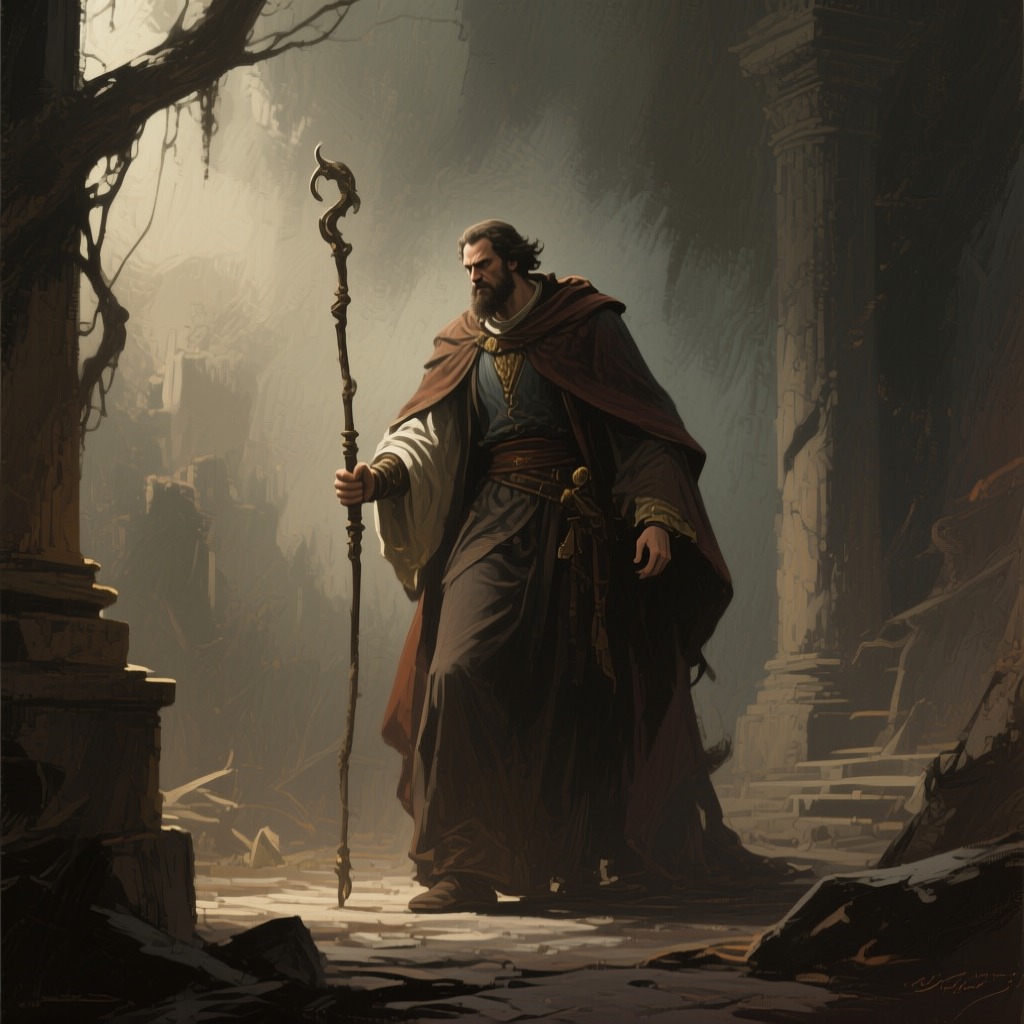
Thomas Denver
Thomas Denver, the principal of Placerville High School, is a tall, cadaverous man who looks something like John Carradine, bald and skinny, with long, knuckly hands and an overshaved, grizzled neck. He is a crackerjack grunter, and his desk is cluttered with papers and a photograph of his well-fed, well-adjusted family: a porky wife and two blond little girls as cute as buttons. Denver has been in the kid business since 1947, and he approaches Charlie Decker with the weary, paternalistic authority of a man who has seen troubled students before, including a bright boy in 1959 who beat a junior-high-school girl with a baseball bat and had to be sent to South Portland Correctional Institute. But Charlie refuses to be processed, and Denver's encounter with him becomes a decisive unraveling of institutional power.
Confrontation with Charlie Decker
When Charlie is called to the office after the shooting of Mrs. Underwood and Mr. Vance, Denver tries to engage him with a mixture of concern and bureaucratic routine, telling Charlie that Don Grace has finished his report and that he has discussed the matter with John Carlson. Charlie cuts him off, declaring that he is sick of Denver and Grace, that they used to make him afraid but now make him tired, and that Denver is not qualified to deal with him. Denver responds with the official verdict: "You are disturbed, Charlie." This phrase triggers in Charlie a memory of his father's hunting trip and the Cherokee Nose Job, and he feels the same detached, floating sensation that preceded his attack on Mr. Carlson. Charlie then launches a personal assault, accusing Denver of getting a kick out of peddling his flesh and of being the best thing that has happened to him since 1959. He tells Denver to "pull up your pants and be a principal" and mocks him with the chant "Throw us your panties!" Denver, his face bright red, reaches over the desk and bunches Charlie's shirt in his hand, demanding respect. Charlie responds by threatening to show his ass and have Denver kiss it. Denver, his vocal cords frozen, can only order Charlie to get his books, turn them in, and leave, with expulsion and transfer to Greenmantle Academy effective Monday.
Aftermath and Role in the Crisis
After Charlie leaves the office, Denver becomes a peripheral figure in the hostage crisis, reduced to relaying messages between Charlie and the police. He speaks to Charlie over the intercom, asking what is going on, and Charlie tells him, "I guess I'm going berserk." Denver asks if Charlie will let the hostages go, and Charlie refuses, saying they haven't finished getting it on. Denver tries to reason with Charlie, telling him that the police will have tear gas and Mace, but Charlie threatens to kill someone if tear gas is used. Denver, sounding angry, impotent, and frightened, asks why Charlie is doing this, and Charlie tells him it doesn't concern him. Denver then relays Charlie's message to the police, and later, when Frank Philbrick arrives, Denver is seen hobnobbing with him, but Philbrick shakes his head at whatever Denver says. When Philbrick tries to shoot Charlie and fails, Denver goes back to the office to talk to Charlie again, but Charlie dismisses him, telling him to assert himself and stop being Philbrick's errand boy. Denver's final act is to walk back across the lawn, and when Philbrick puts a hand on his arm, Denver shakes it off, a small gesture of defiance that the students notice and smile at.
Narrative Significance
Denver's role in the novel is to embody the failure of institutional authority to understand or contain Charlie's rage. He is a man who has spent nearly thirty years in the kid business, but he is utterly unprepared for a student who attacks him on a personal level, who refuses to be a file in a cabinet. Charlie's victory over Denver is a symbolic one: he has confronted the principal with exactly what Denver said was wrong with him, and Denver could not cope with it. Denver is left standing in the hall, vocal cords frozen, not a word left in his mind to say. He becomes a figure of impotence, a man who has been given a shovel and told to walk behind the ox cart, and who only belatedly, and weakly, asserts himself. His character underscores the novel's critique of a system that labels and processes disturbed individuals without ever truly engaging with their humanity.