Beginner's luck
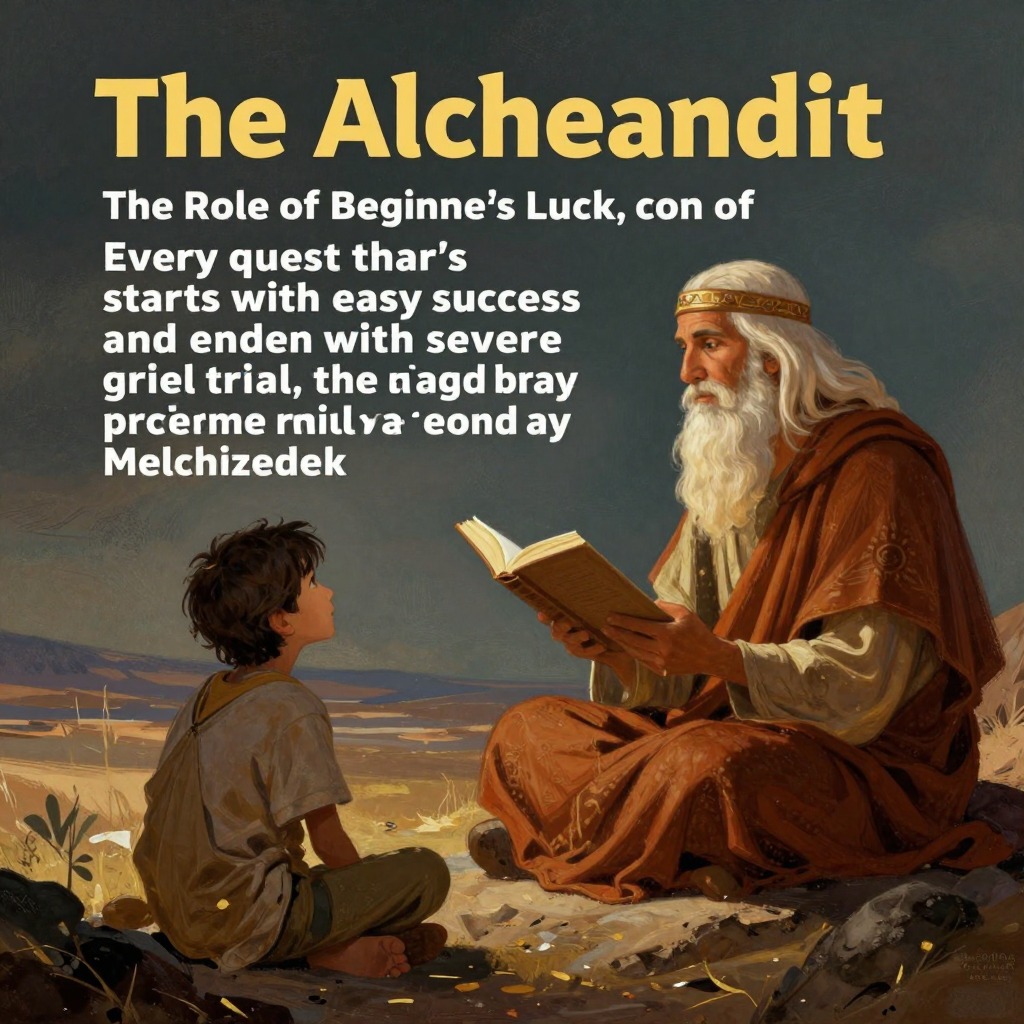
Beginner's luck, or the principle of favorability, is a central concept in Paulo Coelho's The Alchemist, introduced by the mysterious king Melchizedek as a universal law that governs the beginning of any true quest. It is the idea that when a person first decides to pursue their Personal Legend, the universe conspires to grant them an initial, almost effortless success, as if to confirm that the path is correct and to encourage them to continue. Melchizedek explains this to Santiago after the shepherd sells six of his sheep to the king in exchange for guidance toward his treasure. The king tells Santiago that his friend who bought the remaining sheep had always dreamed of being a shepherd, and that the swift sale was a good omen. "That's the way it always is," Melchizedek says. "It's called the principle of favorability. When you play cards the first time, you are almost sure to win. Beginner's luck." He adds that this luck is not random but is caused by a force that wants the person to realize their destiny, whetting their appetite with a taste of success.
The Principle in Action
Santiago later reflects on this principle during his time working for the crystal merchant in Tangier. After proposing that the merchant build a display case to attract more customers, the boy explains his reasoning by invoking the same idea: "We have to take advantage when luck is on our side, and do as much to help it as it's doing to help us. It's called the principle of favorability. Or beginner's luck." The merchant, though initially resistant to change, eventually agrees, and the display case brings a surge of business. Santiago recognizes that his own presence in the shop was itself an omen, and that the merchant's newfound prosperity was a manifestation of the same principle that had helped the boy sell his sheep so quickly. The principle thus operates not only at the grand scale of a destiny but also in the smaller, practical decisions that advance the journey.
The Counterpoint: The Victor's Test
However, the principle of beginner's luck is not the whole story. Later in the narrative, as Santiago and the alchemist approach the Pyramids, the alchemist reveals the complementary truth: "Every search begins with beginner's luck. And every search ends with the victor's being severely tested." This formulation reframes beginner's luck as the first phase of a two-part arc. The initial ease is a gift that builds confidence, but it is followed by a final, grueling ordeal that separates those who are truly committed from those who give up. Santiago experiences this directly: after the initial luck of selling his sheep and meeting Melchizedek, he is robbed in Tangier, works for a year in the crystal shop, crosses a war-torn desert, and is ultimately beaten by refugees at the Pyramids before learning that his treasure was back in Spain. The principle of favorability thus functions as both a promise and a warning: the universe will help, but it will also test.
Thematic Significance
Beginner's luck is a key element of the book's philosophy of destiny and the Soul of the World. It reassures the seeker that the decision to follow one's dream is correct, providing a concrete, observable sign of cosmic support. At the same time, it sets up the expectation that the path will not remain easy, teaching that the initial success is not the goal but the encouragement to continue. The concept also reinforces the idea that the universe is active and responsive, not indifferent: it deliberately arranges favorable circumstances for those who have taken the first step. In this way, beginner's luck is not a superstition but a narrative and thematic device that structures Santiago's journey, marking the transition from ordinary life to the adventure of self-discovery.