Frank Frink's Release
Frank Frink's Release is the sudden, unexplained liberation of the Jewish metalworker from the Kearny Street Police Station, where he had been held on a bunco charge and earmarked for remand to the German consul under Reichs law. The event, which Frink himself can only call a miracle and a fluke, is the direct result of Nobusuke Tagomi's impulsive scribble on Form 20-50, a single act of bureaucratic defiance that severs the chain of custody leading to likely extermination in Germany. It is the novel's quiet counterweight to the machinery of state violence, a moment where an individual's moral choice, however small, intercepts the fate of another human being and returns him to the world of the living.
The Arrest and the Looming Threat
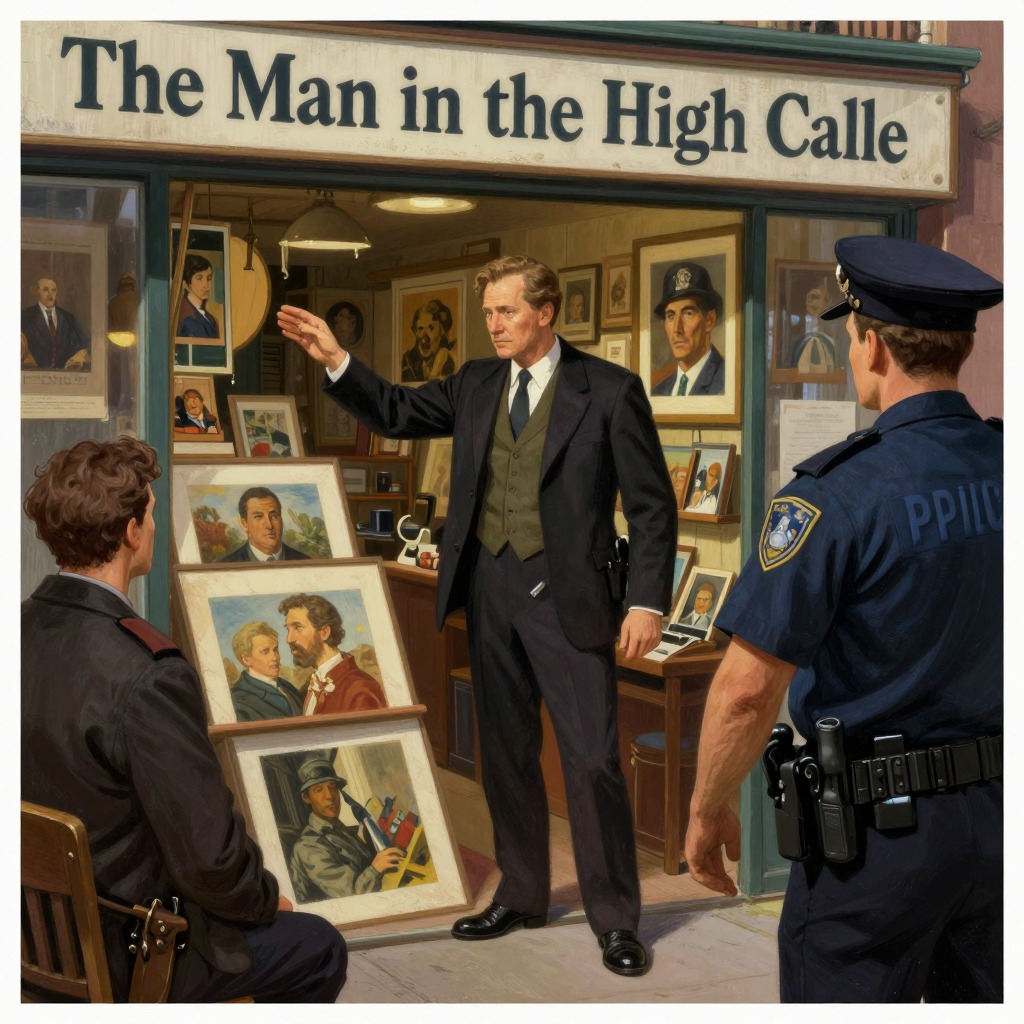
Frank Frink's arrest had come without warning. As he stood outside his basement workshop smoking a T'ien-lai marijuana cigarette, an ordinary-looking plainclothes policeman approached him, produced a warrant, and took his arm. The charge was bunco, stemming from Robert Childan's complaint at American Artistic Handcrafts Inc., and Frink was hustled into an unmarked Toyopet and driven to the Kearny Street Police Station. The interrogation took a darker turn when the cops, having learned his original name was Frank Fink, called him a kike and a refugee from Europe. When Frink protested that he was born in New York and was an American, the cop answered flatly, "You're a Jew." The threat was explicit: he would be held for the German consul, who wanted to try him under German law. Frink's terror was absolute; he broke away and ran across the garage, only to be caught at the doorway by armed police who snapped a handcuff onto his wrist, the thin metal cutting into his flesh. There was no list of attorneys, after all. The machinery of the Reich, operating through the Sacramento puppet government and the San Francisco Police Department, had reached into Japanese-controlled territory to claim him.
The Miracle of the Release
That evening, just after the dinner meal, a police officer came to Frink's cell, unlocked the door, and told him to collect his possessions at the desk. No explanation was given. He was simply handed back his sack of clothes, wallet, watch, glasses, and personal articles, and then turned out onto the sidewalk before the Kearny Street Station, among the passers-by, buses, honking cars, and yelling pedecab drivers. The release was as inexplicable as the arrest had been. Frink, standing in the cold air with long shadows before each building, could not believe it. "Miracle," he thought. "That they let me go. Fluke of some kind. By rights I should be on a plane heading for Germany, for extermination." The reader, however, knows the cause: earlier that day, Nobusuke Tagomi, in the corridor of the Nippon Times Building, had been handed Form 20-50, the Reich's request for remand of the felon Frank Fink, retroactively a citizen of Germany under Reichs law. Tagomi, already shattered by his own killing of two SD men and by the revelation of Operation Dandelion, refused to sign. Instead, he scribbled on the bottom, "Release. Ranking Trade Mission, S.F. authority. Vide Military Protocol 1947. Tagomi," and handed the carbon to the German consul, Hugo Reiss. The consul, scarcely bothering to look at the paper, bowed and left. Tagomi's act, born of his moral collapse and his refusal to be complicit in further evil, was the invisible hand that set Frink free.
Rebirth and the Return to Work
The release was, for Frink, a rebirth. "New life," he thought. "Like being reborn. Like, hell. Is." He wandered along the evening sidewalk past closed-up shops, stepping over debris blown by the wind, trying to comprehend what had happened. He wanted to understand, to know who to thank, what to pray to, but he knew he never would. His mind turned to the practical: he had to find his way back to the workshop, down in that basement, and pick up where he left off, making the jewelry, using his hands. "Working and not thinking, not looking up or trying to understand," he resolved. "I must keep busy. I must turn the pieces out." When he arrived at the basement, he found Ed McCarthy seated at the bench, eating his dinner of two sandwiches, a thermos of tea, a banana, and several cookies. Ed, who had assumed Frink was dead, greeted him with a simple "Good to see you back" and a bang on the back, then returned to his sandwich. Frink, without a word, collected a handful of half-completed silver segments, carried them to the arbor, screwed on a wool buffing wheel, started the motor, dressed the wheel with bobbing compound, put on his mask, and seated himself on a stool to begin removing the fire scale from the segments, one by one. The only sounds were the whirr of the heater fan and Ed's chewing. Frink had returned to the fixed, comprehensible place he had been, and to the creative work that defined him.
Thematic Significance: Chance, Conscience, and the Fragile Thread of Life
Frank Frink's Release is the novel's most direct demonstration that individual lives hang on the thinnest of threads, subject to the arbitrary intersection of vast political forces and the private choices of strangers. Frink's earlier consultation of the I Ching had yielded the ominous line, "The wall falls back into the moat," a prophecy of doom he had interpreted as a warning for all mankind, not just himself. His arrest seemed to fulfill that prophecy, yet his release came not through any action of his own but through the moral crisis of a man he had never met. Tagomi, who had been driven to the brink of madness by his own violence and by the revelation of the Nazi plan to annihilate Japan, found in Frink's case a small, concrete opportunity to refuse the evil that surrounded him. His scribbled "Release" was an act of conscience, a refusal to be the instrument of another's destruction, and it saved Frink's life. The event underscores the novel's existentialist current: in a world of overwhelming, incomprehensible forces, the individual's freedom lies not in controlling outcomes but in making choices, however small, that affirm life over death. Frink's return to the workshop, to the act of creation, is the novel's final statement on survival: one keeps working, keeps making, keeps living, even without understanding why. The miracle of his release, like the miracle of the oracle itself, is that it happens at all, and that it is enough.