Wu
Wu is a central aesthetic and philosophical concept in Philip K. Dick's The Man in the High Castle, articulated by Paul Kasoura in his analysis of the Edfrank jewelry. It denotes a quality of authentic, formless presence that arises from the artisan's creative act, distinct from both historicity and conventional artistic merit, and it becomes a pivotal point of moral and cultural reckoning for Robert Childan.
Definition and Origin
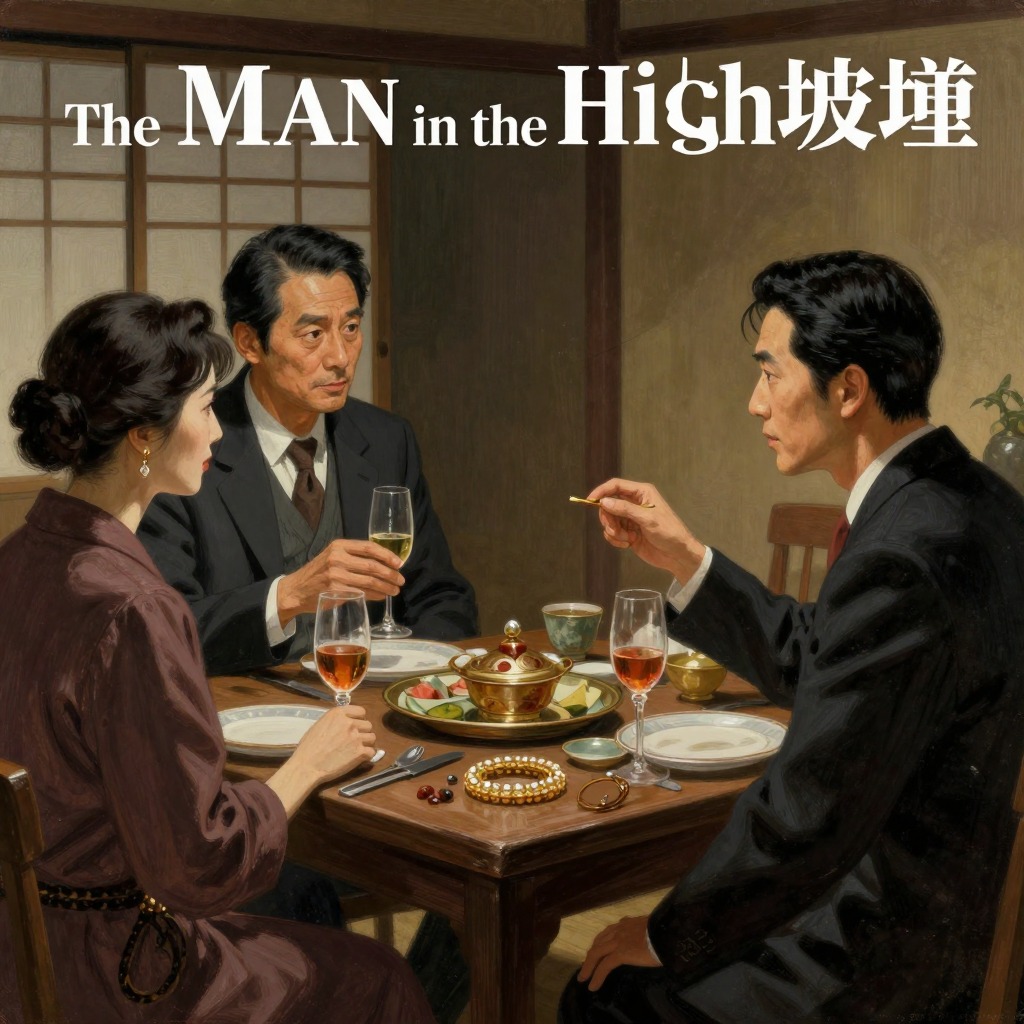
Wu is a Chinese term, not Japanese, as Robert Childan notes when he hears it from Paul Kasoura. Paul introduces the concept while examining a pin from the Edfrank Custom Jewelry line, a piece of melted metal that represents nothing and has no intentional design. He explains that the object "partakes of Tao" and is "balanced," with its forces "stabilized" and "at rest," having "made its peace with the universe." Paul distinguishes wu from wabi, the Japanese aesthetic of finding beauty in simple objects, stating that the pin does not have wabi but does have wu. He describes wu as wisdom or comprehension, a quality that flows from the hands of the artificer into the piece itself. The pin, he says, is "complete" and by contemplating it, one gains more wu, experiencing tranquility associated not with art but with holy things. Paul contrasts this with historicity, noting that the object has no historicity and no artistic or esthetic worth, yet partakes of some ethereal value—a marvel precisely because it is a "miserable, small, worthless-looking blob." He cites the Christian aphorism about "stones rejected by the builder" to illustrate that wu is customarily found in the least imposing places, such as an old stick or a rusty beer can, though in those cases the wu is within the viewer, whereas here an artificer has put wu into the object itself.
The Artisan's Role
Paul emphasizes that the wu in the Edfrank jewelry originates from the artisan's creative act. He asks Childan whether the American artisans made the piece by hand, and upon learning they did, from initial design to final polish, he reflects on the significance of this labor. The concept implies that wu is not merely an inherent property of materials but is imparted through the maker's skill and intention. Paul's analysis suggests that the jewelry represents a new kind of authentic creation, one that does not rely on historical association or formal beauty but on the direct transmission of the maker's understanding into the object. This stands in contrast to the forged artifacts that flood the market, which lack any such genuine creative input. The wu in the Edfrank pieces thus marks them as truly new, "authentically a new thing on the face of the world," as Paul declares.
Childan's Moral Reckoning
Paul's exposition of wu forces Robert Childan into a profound moral and cultural crisis. Initially, Childan is confused, unable to grasp the concept, and he reflects that Paul has "lost him." When Paul reveals that he showed the pin to business acquaintances who laughed at it, and that he himself had concealed his amusement, Childan feels humiliated. Paul then returns the pin, telling Childan he must "face reality with more courage" and take on the responsibility of promoting the jewelry. Childan perceives this as a cruel dismissal of American efforts, a subtle Japanese manipulation that leads him to agree that the products of American hands are good for nothing but to be models for junky good-luck charms. He realizes that Paul got him to say this himself, and he feels "broken" and humiliated. Yet, in a moment of defiance, Childan rejects the importer's proposal to mass-produce the pieces as charms, declaring, "I am proud of this work" and demanding an apology for the insult to the American artists. This act of resistance, though fraught with anxiety, allows Childan to reclaim a sense of dignity, and Paul responds with a bow and an apology, acknowledging the gravity of the moment.
Wu and the Tao
Wu is intimately connected to the Tao, the central philosophical principle of the I Ching that permeates the novel. Paul's description of the pin as "partaking of Tao" and being "balanced" echoes the hexagram readings that guide characters like Frank Frink and Nobusuke Tagomi. The concept of wu represents a state of harmony and authenticity that aligns with the Taoist ideal of wu wei, or effortless action. Childan, in his reflections, connects the Tao to the renewal of light in darkness, and the Edfrank jewelry, with its wu, embodies this principle as a "new life" emerging from the ruins of American culture. Mr. Tagomi, when shown the jewelry by Childan, recognizes that "the Law of Tao is borne out, here; when yin lies everywhere, the first stirring of light is suddenly alive in the darkest depths." Though Tagomi himself cannot become rapt by the pieces, he acknowledges their significance, and his eventual purchase of a silver triangle, despite his lack of faith, represents a grasping at straws that aligns with the Taoist acceptance of uncertainty.
Significance and Contrast with Historicity
The concept of wu stands in stark opposition to the novel's pervasive theme of historicity, the value attributed to objects based on their connection to the past. Wyndam-Matson, in his cynical discussion with Rita, argues that historicity is a "mass delusion," a quality that exists only in the mind, not in the object itself. He demonstrates this with two identical Zippo lighters, one of which supposedly belonged to Franklin D. Roosevelt, and asserts that a paper of authenticity proves the object's worth, not the object itself. Wu, by contrast, offers an alternative source of value that is intrinsic to the object and its creation, independent of any historical claim. This makes the Edfrank jewelry immune to the problem of forgery that threatens to wreck the historic artifacts industry, as Childan recognizes when he notes that with these pieces, "there's no problem of authenticity." Wu thus represents a potential path forward, a way to create value that is not dependent on the fragile and often fraudulent edifice of historicity. The concept suggests that true worth lies not in what an object represents but in what it is, and in the authentic creative act that brought it into being.