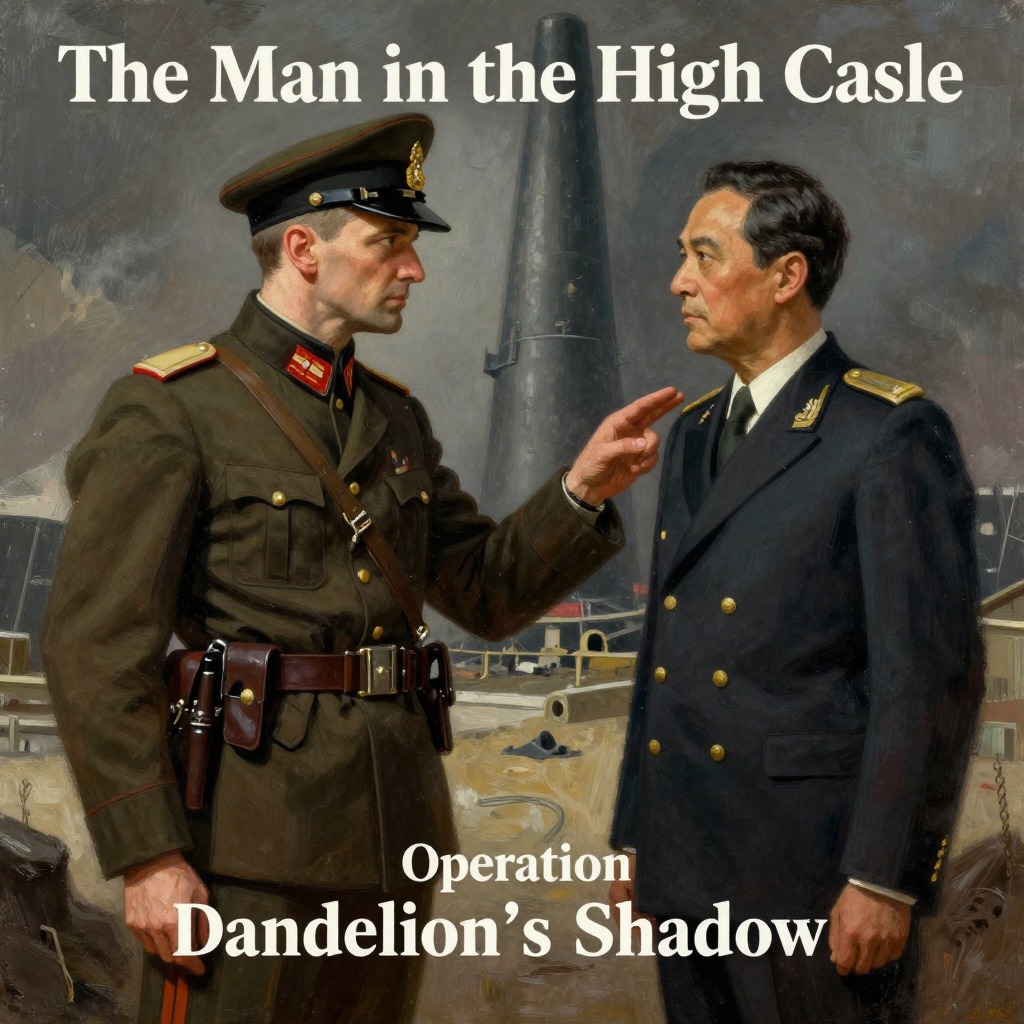
Wegener's silver cigarette case
Wegener's silver cigarette case is a deceptively ordinary object that conceals the most sensitive intelligence of the novel: each cigarette is a hollow container for microfilm documenting secret Nazi discussions about Operation Dandelion. Passed from Rudolf Wegener to General Tedeki during their clandestine meeting in Nobusuke Tagomi's office, the case becomes the physical conduit through which the warning of a planned nuclear attack on Japan is delivered, embodying the novel's central meditation on authenticity, concealment, and the material carriers of truth.
Appearance and Concealment
The case appears in the climactic meeting between Wegener and General Tedeki, where Wegener, traveling under the cover name Mr. Baynes, has finally arranged the long-delayed conference. As the discussion reaches its critical point, Wegener reaches into his coat and produces the flat silver cigarette case, explaining that each cigarette is a hollow container for microfilm. The case itself, he adds with a smile, is also part of the gift. The general, examining it, remarks that it seems too valuable an object to give away, but Wegener insists, and the case, with its hidden cargo, is placed in the general's topcoat pocket.
The case's power lies in its perfect ordinariness. It is the kind of object a businessman might carry, unremarkable in appearance, yet it holds the fate of nations. This duality—the mundane exterior and the explosive interior—mirrors Wegener's own situation: he is a German naval counter-intelligence officer posing as a Swedish plastics salesman, and the case is his most dangerous possession. The microfilm inside contains photostats of notes from bitter disputes among Nazi principals over the administration of the East, evidence that the police were denied authority and instead given the space colonization program as their domain. This documentation is what General Tedeki requests as proof of objective nature, and the case delivers it.
The Gift and Its Significance
The case is more than a simple transfer of intelligence; it is a carefully staged act of trust. Wegener, who has spent two weeks waiting in San Francisco for the old gentleman to arrive, has risked everything to make this meeting happen. The case represents the culmination of his mission, the tangible proof that he is not a fabricator or a double agent. When General Tedeki accepts it, the gesture seals an alliance between a faction of the German Abwehr and elements in Tokyo who oppose Operation Dandelion. The case's silver surface, like the cigarettes it contains, is a shell protecting something far more valuable than its material worth.
The case also resonates with the novel's broader exploration of objects and their meanings. Throughout the book, characters grapple with the concept of historicity—the idea that an object's value derives from its connection to the past. Wyndam-Matson demonstrates this with two Zippo lighters, one supposedly carried by Franklin D. Roosevelt when he was assassinated, arguing that the historicity is all in the mind, not the object. The silver cigarette case inverts this logic: its value lies not in its history but in its future, in the potential catastrophe it might prevent. It is a contemporary object, not an antique, and its worth is measured by the information it carries, not by its provenance.
Connections to Other Objects
The case belongs to a constellation of significant objects in the novel, each with its own hidden depths. The Mickey Mouse wristwatch that Tagomi gifts to Baynes upon his arrival is a genuine 1938 artifact, one of perhaps ten in the world, a token of American popular culture that the Japanese have come to treasure. The Colt .44 revolver that Tagomi later uses to shoot the SD men is a treasured collector's item from his personal collection, an object of historicity that becomes an instrument of violence. The Edfrank silver triangle that Childan sells to Tagomi is a new creation, devoid of historicity, yet it partakes of wu, a quality that Paul Kasoura identifies as a kind of spiritual balance. Each object carries meaning beyond its physical form, and the cigarette case is the most extreme example: its surface is silver, but its substance is information.
The case's journey also parallels that of the fountain pen transmitter that Juliana Frink discovers in Joe Cinnadella's suitcase. That pen, which she initially mistakes for a weapon, is actually a two-watt transmitter and receiver, allowing Joe to maintain radio contact with his handlers. Both objects are tools of espionage disguised as everyday items, but they serve opposite purposes: the pen is used to coordinate an assassination, while the case is used to prevent a war. The contrast underscores the novel's moral complexity, where the same techniques of concealment can serve either destruction or salvation.
The Case and the Novel's Themes
The silver cigarette case is a microcosm of the novel's central concerns. It is an object that is not what it seems, just as the world of the novel is not what it seems: the Axis powers have won World War II, and the characters live under Japanese and German domination. The case's hidden microfilm represents the possibility of change, the idea that the present order might be altered by secret knowledge. It is also a symbol of the fragile connections between people who oppose the status quo, the delicate network of intermediaries and coded messages that Wegener has painstakingly assembled.
In the end, the case's fate is uncertain. General Tedeki takes it back to Tokyo, and Wegener returns to Germany, where he is met by Waffen-SS men who take him to see SS General Heydrich. The information in the case may or may not change the course of events, but its delivery is an act of hope, a refusal to accept the inevitability of destruction. Like the Edfrank jewelry that Childan champions as the new life of his country, the case is a seed of possibility, carried in a pocket, waiting to be opened.