Jorge of Burgos
Jorge of Burgos, the blind, ancient monk of the abbey, is the story's hidden master and its most formidable antagonist. More than a librarian, he is the living memory and the absolute will of the library, a figure whose authority over the community is so complete that even the abbot defers to him. His physical blindness is a paradoxical emblem of his power: he sees nothing, yet he perceives everything, moving through the abbey with uncanny certainty and hearing what others whisper. He is the keeper of the library's deepest secret and the architect of the murders that unfold over seven days, driven by a fanatical conviction that he must protect the faith from a single, dangerous book.
Identity and Authority
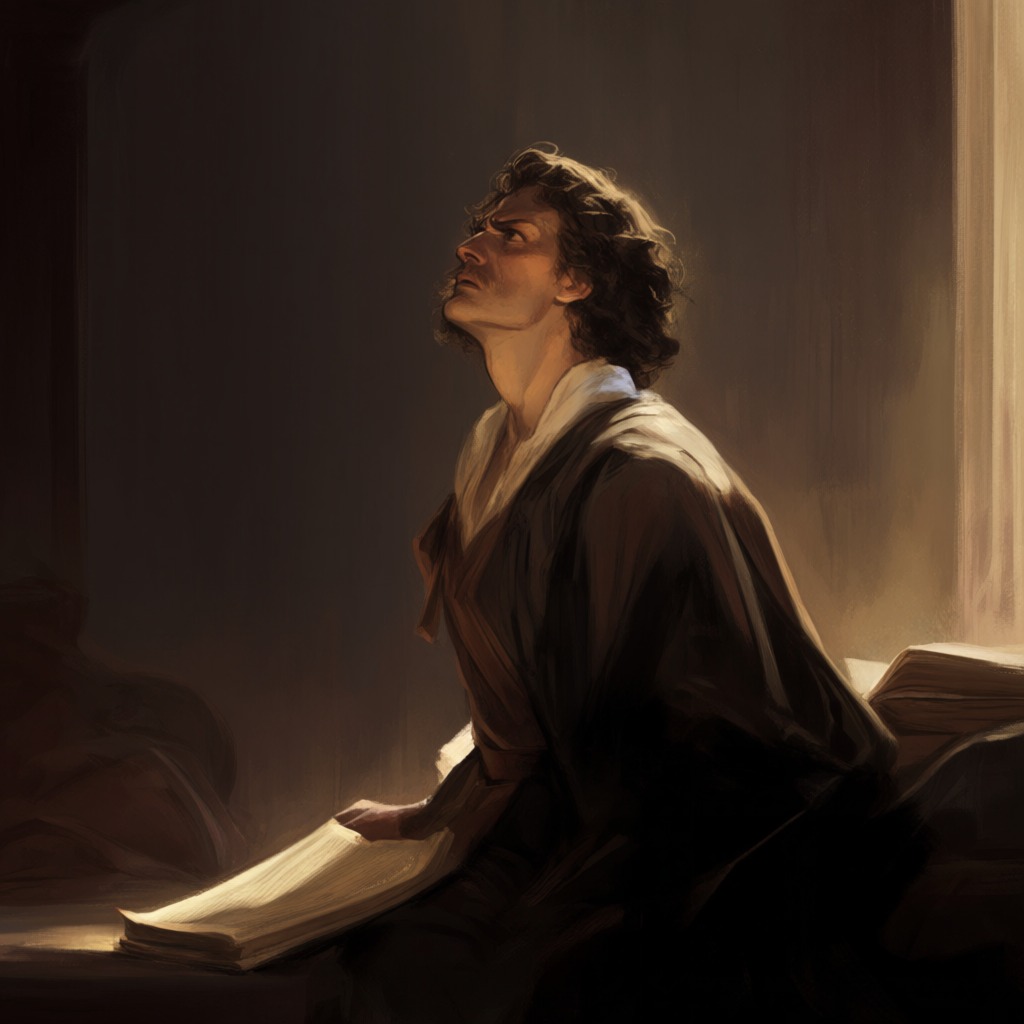
Jorge is introduced as a monk "bent under the weight of his years, an old man white as snow, not only his skin, but also his face and his pupils." He is blind, yet he moves and speaks "as if he still possessed the gift of sight." His voice is "majestic" and his limbs "powerful, even if the body was withered by age." He is the oldest monk in the abbey, save for the senile Alinardo of Grottaferrata, and serves as the confessor for many of the brothers. His authority is not merely institutional; it is moral and intellectual. In the scriptorium, he is the final arbiter of knowledge, consulted on glosses, interpretations, and the very location of books. He is, as Adso observes, "the library's memory and the soul of the scriptorium." This authority is rooted in a past that predates the current abbot. Jorge was once the assistant to the voracious reader Paul of Rimini, and it was he who was sent to Silos in Spain to acquire the finest manuscripts of the Apocalypse. This mission brought him the book that would become his obsession and his weapon: the unique copy of Aristotle's second book of the Poetics, which he stole and hid in the secret room called the finis Africae. For forty years, he has been the true master of the abbey, manipulating a succession of pliable librarians and abbots to maintain his control over the library's forbidden knowledge.
The Doctrine of Fear and the Hatred of Laughter
Jorge's worldview is a rigid, terrifying orthodoxy. He believes that the entire body of necessary knowledge is complete and has been defined since the beginning. The duty of a monk is not to seek new truths but to preserve and gloss the old ones. The greatest sin, in his eyes, is the pride of intellectual curiosity. This pride, he preaches, is the serpent that has coiled within the abbey, and it is the very essence of the Antichrist. His most vehement hatred is reserved for laughter. In a series of debates in the scriptorium, he argues that Christ never laughed, that laughter is a sign of the fool, and that it foments doubt. He condemns the marginal illustrations of the dead illuminator Adelmo of Otranto as a "world that is the reverse and the opposite of that established by God." For Jorge, laughter is the weapon of the simple, a base, carnivalesque release that, if elevated to philosophy, would destroy the fear of God that is the foundation of all law and order. He sees in Aristotle's lost treatise on comedy the ultimate threat: a book that would teach learned men to use laughter as a tool to dismantle every sacred image and every authority, transforming the world into a chaos of monsters and inverted hierarchies.
The Architect of Murder
Jorge is the unseen hand behind the series of deaths. When Venantius of Salvemec steals the forbidden book from the finis Africae, Jorge has already prepared a trap. He has poisoned the pages of the Greek manuscript with a lethal substance stolen years before from the infirmary of Severinus of Sankt Wendel. Venantius dies after touching the pages and ingesting the poison. Berengar of Arundel, who had revealed the secret of the finis Africae to Adelmo, later finds the book and also dies from the poison. Jorge then manipulates the jealous and confused librarian, Malachi of Hildesheim, into murdering Severinus, who had discovered the book in Berengar's possession. Finally, when the abbot, Abo, learns the truth from William of Baskerville and demands that the finis Africae be opened, Jorge lures him into a secret passage and seals him inside to die. Jorge does not see himself as a murderer; he is an instrument of God, a necessary hand to protect the divine order from a blasphemy that would unleash the Antichrist.
The Final Confrontation and Self-Destruction
In the climactic confrontation within the finis Africae, Jorge awaits William of Baskerville. He admits to his actions, justifying them as a holy duty. He reveals the book—Aristotle's Poetics II—and offers it to William, knowing its pages are poisoned. When William, having deduced the trap, refuses to touch it, Jorge performs a final, terrible act. He tears the pages from the book and devours them, consuming the forbidden knowledge to ensure it is lost forever. As he does so, he laughs for the first and only time, a sound of triumph and madness. In the ensuing struggle, a lamp is knocked over, and the library is engulfed in flames. Jorge, his face "deformed by hatred of philosophy," is the portrait of the Antichrist William had been seeking—a figure of absolute, loveless truth who would rather destroy the world than see it changed. He perishes in the fire he has started, his final act a testament to his fanatical, self-immolating faith.
Thematic Significance
Jorge of Burgos is the embodiment of a terrifying paradox: a man of immense learning and piety who becomes the Devil's most effective servant. He represents the danger of a truth so absolute that it justifies any crime. His hatred of laughter is a hatred of doubt, of inquiry, and of the human capacity for joy and freedom. He is the ultimate guardian of a dead orthodoxy, a figure who prefers a world of silent, fearful obedience to one of questioning and life. In his final confrontation with William, he is revealed not as a saint, but as a grim, prideful tyrant of the spirit, whose victory is the destruction of the very thing he sought to preserve. He is the living proof of William's dictum that the Antichrist can be born from "excessive love of God or of the truth."