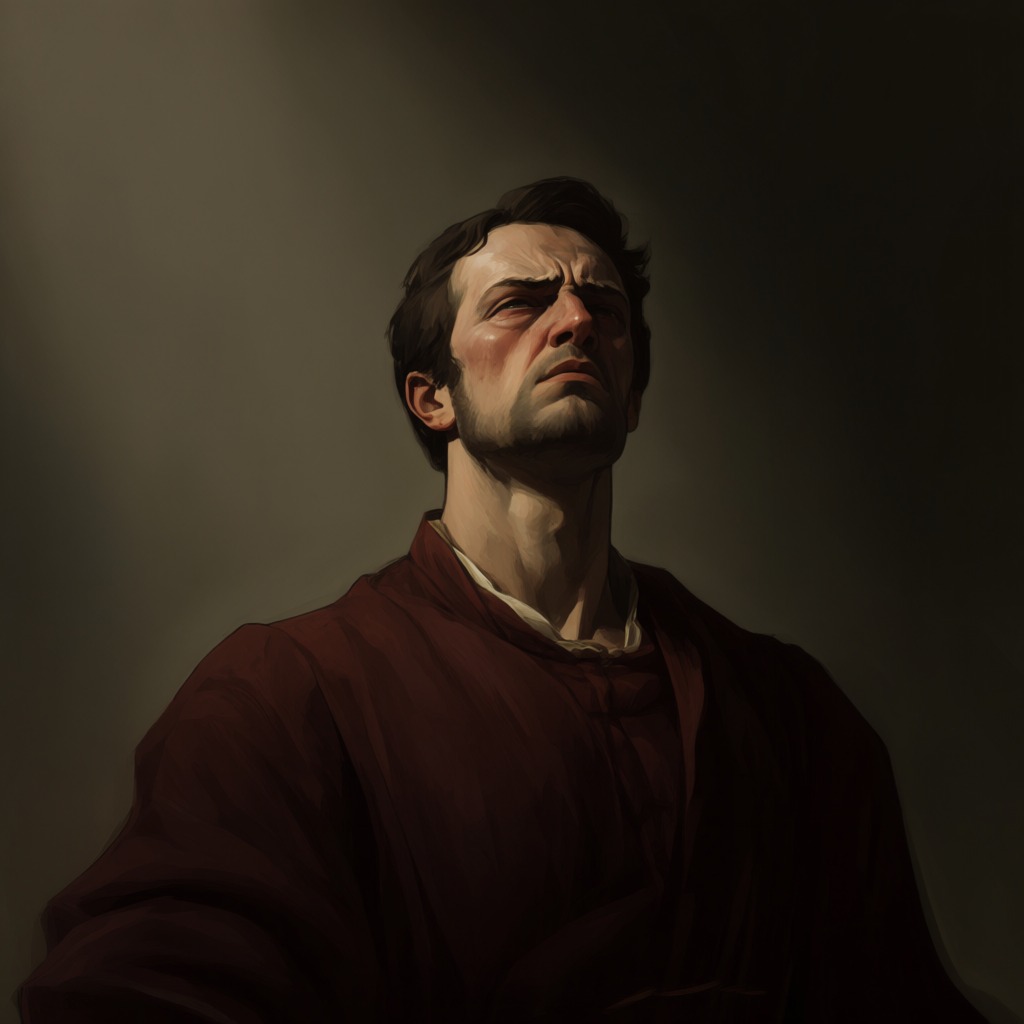
Roger Bacon
Roger Bacon, the thirteenth-century Franciscan philosopher and scientist, is the intellectual master whom William of Baskerville most venerates. Though dead long before the events of the novel, Bacon's ideas about experimental science, natural magic, and the prolongation of human life provide the philosophical foundation for William's investigative methods and his faith in the power of human reason to uncover the secrets of nature. Bacon's teachings are repeatedly invoked by William as a counterweight to the apocalyptic mysticism of Jorge of Burgos and the theological rigidity of the abbey's other scholars, and they ultimately shape William's own tragic understanding of the limits of knowledge.
Identity and Intellectual Legacy
Roger Bacon is introduced not as a character but as a revered authority whose works William carries in his memory. William explains to Adso that Bacon taught that the divine plan will one day encompass the science of machines, which he calls "natural and healthy magic." Bacon foresaw self-propelled wagons, flying apparatuses, and vehicles that could travel on the bottom of the sea. William tells Adso that Bacon believed these machines had already been made in ancient times and that some exist in their own era, though he has never seen a flying instrument. Bacon's vision of a future transformed by applied knowledge is the core of William's intellectual optimism.
Role as William's Master
William explicitly declares his veneration for Bacon on multiple occasions. When Ubertino of Casale accuses William of idolizing reason and drying up the prophetic capacities of the heart, William replies that among his masters he venerates Roger Bacon more than any other. He defends Bacon against Ubertino's dismissal, noting that Bacon spoke clearly and calmly of the Antichrist and was aware of the corruption of the world and the decline of learning. Bacon taught that the only way to prepare against the coming of the Antichrist is to study the secrets of nature and use knowledge to better the human race. William tells Ubertino that Bacon advocated studying the curative properties of herbs, the nature of stones, and even planning flying machines as a holy preparation for the final conflict.
Influence on William's Methods and Beliefs
Bacon's ideas directly inform William's investigative practices. When William demonstrates his reading lenses to Nicholas of Morimondo, he explains that the aim of learning, as Bacon said, is also to prolong human life. William's faith in the possibility of a magnetic compass to navigate the library labyrinth is grounded in Bacon's writings on the properties of the lodestone. William tells Adso that Bacon studied the stone and described its many uses. Bacon's conviction that the secrets of science must not always pass into the hands of all, for some could use them to evil ends, is echoed in William's own cautious approach to revealing dangerous knowledge. William tells Nicholas that often the learned man must make seem magic certain books that are not magic, but simply good science, in order to protect them from indiscreet eyes.
Bacon's Vision of the Simple and the Learned
Bacon's social philosophy also shapes William's understanding of the relationship between the learned and the simple. William explains to Adso that Bacon believed in the strength, the needs, and the spiritual inventions of the simple. Bacon thought that the poor, the outcast, idiots and illiterate often speak with the mouth of our Lord. The simple have a sense of the individual, but this sense by itself is not enough. Bacon held that the experience of the simple has savage and uncontrollable results, but the works of wisdom are fortified by certain law and effectively directed toward their proper end. Bacon believed that the new natural science should be the great new enterprise of the learned: to coordinate, through a different knowledge of natural processes, the elementary needs that represented the heap of expectations, disordered but in its way true and right, of the simple. William tells Adso that Bacon thought this enterprise was to be directed by the church, but William believes that in his own time learned men grow up outside the monasteries and the cathedrals, even outside the universities.
Thematic Significance and William's Final Doubts
Bacon's legacy ultimately becomes a source of tragic irony. William's faith in Bacon's program of natural magic and the possibility of a unified science is undermined by the events at the abbey. After the library is destroyed and Jorge's plot is revealed, William confesses to Adso that he has never doubted the truth of signs, but what he did not understand was the relation among signs. He arrived at Jorge through an apocalyptic pattern that seemed to underlie all the crimes, yet it was accidental. He pursued a semblance of order when he should have known that there is no order in the universe. This final disillusionment stands in stark contrast to Bacon's confident vision of a science that could coordinate the needs of the simple and reveal the hidden order of creation. William's intellectual journey from Baconian optimism to a recognition of the universe's fundamental disorder is the philosophical arc of the novel.