Emma's readmission to the psychiatric ward
UpEmma's readmission to the psychiatric ward turns on a dangerous mismatch between how she understands herself and what her actions reveal to others. She believes she has reached a lucid, almost liberating certainty, while Rajid sees enough risk in the medication she has gathered to insist that she be admitted. The ward is not simply a return to a familiar institution: it is the place where Emma's conviction that nothing is wrong is confronted by the need to keep her alive and understand what is happening.
Background and the decision to admit
The admission follows months of depression and Emma's collection of pills with the intention of taking them all. By the time the crisis becomes visible to her clinicians, Emma does not describe herself as actively suicidal in the ordinary sense. Looking back, she explains that on the morning before admission, while making breakfast, an idea arrived with absolute force: the time had come, and she had to die. She describes the thought as something that simply had to happen, not as a plan she experienced as emotionally charged or debatable. In her account, death appeared to be a way to remove herself and the suffering attached to her, so that she could turn to what she considered important: work, productivity, and action without feeling.
That understanding helps explain why Emma resists the response to her stockpile. When Rajid presents the choice between going home and surrendering all her medication and prescriptions or being admitted, Emma laughs at what she considers an absurd solution. Some pills at home have already been partly crushed, she says, and one prescription is waiting at the pharmacy. Rajid answers that he will handle those complications; the question is whether she is willing to hand over the pills. When she continues to treat the danger as unreal, he tells her that this is precisely the problem and that she will be admitted that day. The decision brings the disagreement into sharp focus: Emma sees a misunderstanding, while Rajid regards immediate protection as necessary.
Admission and entry into the PAAZ
Rajid explains that admission will give the clinicians time to work out what is happening while keeping Emma safe. He acknowledges how distressing it is to be admitted again and tells her plainly that he does not want her to die. Emma breaks down as he arranges the admission, crying while he makes the call and enters the details on his computer. The procedure is practical and brief, but its consequence is immense for her: what had seemed to her like a plan for clarity becomes an enforced return to the psychiatric ward.
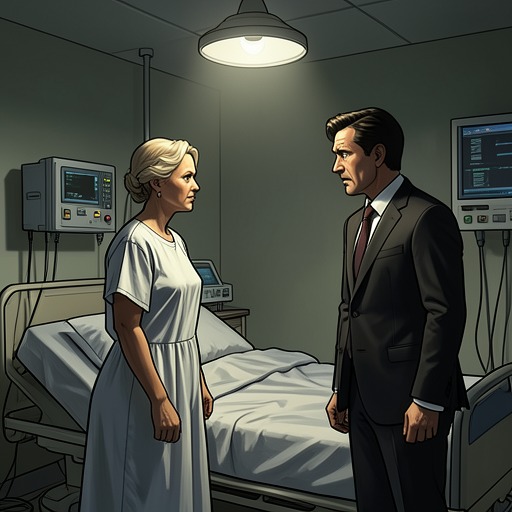
Sergei has already left when Rajid tells Emma they are ready to go downstairs. She pauses beside her bright orange bag and looks toward the corridor where Sergei disappeared. For a moment, leaving seems only a few steps away. Instead, she takes the bag and walks ahead of Rajid, telling herself that twenty-four hours in the PAAZ will provide evidence that her supposed illness is a delusion. She frames the walk downstairs as humiliating, yet insists that it no longer affects her. This confidence is itself part of the divide between her inward certainty and the danger others are responding to.
The ward's familiarity makes the return more unsettling. At its entrance Emma recognizes worn linoleum, patients murmuring in the hall, and the characteristic smell of dust, dryness, disinfectant, and fear. Recognition does not reassure her: she turns back toward Rajid and pleads that nothing is wrong and that she is not mad. He takes her hand and tells her she is not mad, but may have lost her way for a while; if she lets them help, they can find the way back together. The gesture offers companionship without pretending that the admission is a mistake.
What Emma's experience reveals
In conversations after the admission, Emma describes a state in which the prospect of death had ceased to register as a decisive consequence. She recalls feeling nothing when Rajid told her that Dokter Visser's husband had died; what surprised her was learning that Dokter Visser had children. Emma says that her thoughts and emotions seemed to have been absorbed by one enormous idea. She could intellectually acknowledge that taking the pills would kill her, yet at the time that fact had somehow disappeared from the force of her belief. The idea brought what she experienced as universal equality, sudden enlightenment, and profound calm. She thought that dying would preserve this clarity rather than end her life in the way others understood it.
Rajid helps distinguish hallucinations from delusions: hallucinations alter perception, while delusions attach an unfounded conclusion to what is perceived. Emma recognizes that her experiences have included both kinds of disturbance. She has known that certain things were not real while still believing them; she says she knew there were no snakes on the bike path, for example, but believed that there were. In another discussion, she explains that believing she could fly did not feel like entertaining an unlikely thought. It felt like becoming normal at last, as though the world had finally become what it should have been. She describes a delusion as a belief that makes itself feel true and then draws the rest of reality into its explanation. These accounts give the readmission meaning beyond the act of entering a ward: they show why Emma's apparent calm cannot be taken as evidence that the risk has passed.
The ward, time, and patient identity
The return also brings back an earlier memory of depression. During a night round, after trying not to feel, think, or remember, Emma begins to cry. The memory she has been resisting is the sense of being emptied by depression until only fragments of the self remain, clinging to life while being pulled downward. It takes her back to the edge of a balcony. Her readmission therefore holds two crises in the same frame: the present conviction that death is a revelation and the older, recurring experience of depression as a descent toward death.
The ward's routines make Emma's patient status visible even when she feels well. A staff member explains that during Emma's previous admission, her severe depression had been obvious: she wanted nothing and barely spoke. Now she looks as though she might go home the next day and seems ordinary, which makes it easy for staff to forget that her leave is restricted. Emma insists that she is normal; the exchange exposes how appearance can obscure the condition that prompted admission. At a group discussion about work, she recalls how her first admission disrupted a planned four-week vacation after only one week. Her employer told colleagues she was at home with burnout, a concealment intended to help but one that left others without a clear account of why she was absent. The discussion identifies stigma not only with hostile intent but also with silence and decisions made without consulting the person concerned.
The admission also interrupts Emma's return to work. On the Tuesday when she had expected to get up, make a sandwich, and take the train to the office, she instead has to call her employer to say she cannot come because she has been admitted to a psychiatric institution, probably for the rest of the week. She is ashamed that she has been hospitalized for symptoms she never told Lars about, though he had supported her through her first PAAZ admission and more than two years of appointments and treatment. Later, she tells Rajid that depression makes time seem to disappear: in mania, only the immediate present matters, while depression lets the past swallow the future. These altered experiences of time deepen the event's significance. The admission starts as a decision made to manage immediate danger, but it also forces Emma to confront recurrence rather than treat this episode as a brief interruption that can simply be disproved.
Consequences and significance
The return to the ward does not resolve the conflict between Emma's sense of self and the care others believe she needs. When she later asks to be allowed to leave, she recognizes that Rajid sees her as a patient for whom he is responsible, someone who may need protection from herself. She understands the weight of that view but insists that this is also her life and that she must live it herself. Her quiet request to be let go is met by Rajid's fear that her condition will worsen; Emma answers that it will worsen again. The exchange replaces a promise of permanent recovery with an acknowledgement of recurrence and the difficult question of how to live with it.
The outcome is not permanent confinement. When Emma encounters Dokter Visser at the ward, she explains that she is going home that day to collect her prescriptions and will again be an outpatient. That departure does not erase the reasons for the admission or turn the episode into a simple cure-and-return story. Readmission interrupts Emma's attempted return to work and her hope that she can settle the question of illness through a single day of observation. It also gives her experiences a setting in which they can be described: the emptiness around the suicidal idea, the certainty that death was a beginning, the belief that she could fly, and the difference between knowing something is unreal and believing it. The event's decisive significance lies in that collision between Emma's felt clarity and the risks that make protection necessary.