College of the Surf
VinelandThe College of the Surf is a rocky coastal campus whose intended role as a docile, privately useful institution is overturned when students discover the interests it serves and proclaim an independent state. It becomes the setting for the People’s Republic of Rock and Roll and the government operation that brings the experiment to an end. The college’s physical position—between the Pacific and a military reserve—gives that political conflict a literal boundary, while its history exposes the gap between education offered in the name of the public and the private plans behind it.
Setting and Design
In Trasero County, the campus occupies a narrow coastal strip between the sea and the fence of a military reservation. The county’s coastline is described as a small-scale counterpart to the larger curve of the inlet between San Diego and Terminal Island. The reservation resembles a smaller Camp Pendleton, extending from the coast toward the inland desert; the college sits at its edge. Its rocky grounds include pale arcades and columns, madroño hedges, and wind-shaped cypresses. That setting places the college’s open-air campus immediately beside military property, a proximity that becomes decisive when state forces surround it.
The surrounding county combines conservative political influence with wealth tied to oil, construction, and film. Rich residents gather near golf courses and marinas, live in broad, low houses, and use private airfields. The college was supposed to serve this population as a private technical institution, training people who would eventually work for local employers. Its landscape therefore marks two adjacent worlds: a campus presented as an educational community, and a region organized around wealth and military power.
An Institution Built for Compliance
The planned curriculum included law, political science, business, and up-to-date computer science. Admission was conditioned on students’ promise to be docile, and they were expected to adopt haircuts and clothing styles considered suitably conventional. The institution was thus not imagined as a site of political dissent; its intended purpose was to prepare a compliant workforce for the interests that had established it.
That purpose is later exposed as a real-estate scheme. As students begin investigating the college, they learn that it was never genuinely intended as a center of learning. It had been presented as a public gift while serving a development plan: after five years of amortization, the rocky coast was to be turned into vacation facilities. The revelation changes the meaning of the campus. Its educational language conceals a plan for the land, and the students’ claim to take it back follows from their discovery that the state and the courts are implicated in the arrangement.
From Campus Protest to PR3
The dissident movement begins without the familiar signs of organized political analysis. Visiting movement coordinators find students drawn instead to a backward-looking personality cult around Weed Atman, a mathematics professor who had become famous by accident and was not especially charismatic. The campus’s abrupt political shift is therefore presented as both a challenge to official expectations and an uncertain departure from them: student rebellion has arrived, but it has not yet developed a clear understanding of its own situation.
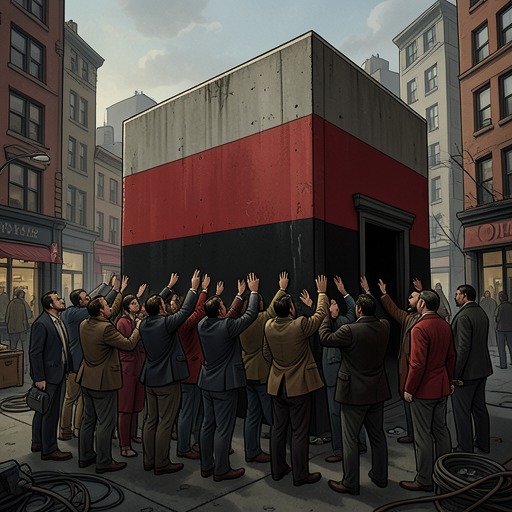
An early turning point comes during an ordinary lunch break on Dewey Weber Plaza. About a thousand students are eating, listening to the radio, talking, and commenting on a thirty-metre marble monument to Nixon. The smell of marijuana smoke interrupts the scene. Later accounts question how innocent the student body’s relationship to the drug really was, since many students were already breaking rules that prohibited being present where marijuana was being smoked. The episode becomes an origin point for the campus’s transformation, though the narrative preserves uncertainty over who supplied the joint and how deliberate the breach was.
The protest grows rather than being quickly suppressed. Students’ newly awakened interest in learning leads to research around the clock and, eventually, to the discovery of the real-estate plan. After an all-night, tumultuous assembly, they decide to separate from California and establish the People’s Republic of Rock and Roll. The 24fps film collective arrives the next day. Signs and graffiti identify the new political experiment as PR3, while helicopters begin visiting the area. The college has changed from a planned training ground into the center of a declared independent community, but it remains exposed to the military reservation next door and the authorities beyond it.
The Siege and the Cameras
The final confrontation develops as a prolonged, dispersed operation rather than a single assault. At the college, access roads are blocked; Marines take positions on the coastal side, troops from a neighboring base arrive on the other side with tanks, and highway patrol officers and the Trasero County sheriff are also present. After a final surrender offer over loudspeakers, possible routes out—including roads, waterways, sewers, and bike paths—are closed. Telephone service is cut, and news media remain at a distance. With the campus isolated, the 24fps crew has exclusive access to the event, provided that anyone survives to carry the footage out.
The collective films the operation as a record of the republic’s last hours. During the night, the conflict takes the form of scattered clashes, gunfire, tear gas dropped from above, and fires in buildings and vehicles. Electricity and water have been shut off; fog and darkness make it difficult to distinguish who is where. The crew works with a Mole-Richardson generator behind the Film Arts building, sensitive 7242 stock taken from a refrigerator, and whatever lamps and equipment it can use. Its cameras keep recording as soldiers move through the darkness and turn toward the lights. The filming is not a detached record of events: the crew itself is trapped in the place it is documenting, and its equipment is both a means of witness and a practical risk.
Aftermath and Significance
By morning, dozens are injured, hundreds have been detained, and several people are missing. No deaths are officially reported. The missing students’ fate remains unresolved in the public account; Brock Vond describes them as having gone underground, and a journalist who presses him on the absence of arrest warrants is escorted out. The official explanation converts disappearance into a suggestion of voluntary flight, while the lack of reliable information leaves the question suspended.
The college’s fall becomes a professional success for Vond, who later treats the operation as a career-making achievement. Its political consequences extend beyond the campus: the account of Vond’s PREP program identifies the college operation as the experience against which his political-reeducation project is positioned. The College of the Surf is therefore more than the setting of a student revolt. Its intended function, its land-development scheme, and its forcible isolation form a sequence in which education, public authority, and surveillance converge. The surviving record is itself part of that conflict: the state supplies an official explanation, while the 24fps cameras attempt to preserve what happened at the place where the official story began.