Gordita Beach
VinelandGordita Beach is the Southern California coastal community where Zoyd Wheeler first shared a home with Frenesi Gates and their shifting circle of companions, and where he later raises Prairie alone. Its defining setting is a ramshackle house looking toward the Pacific: at once a communal refuge, a precarious family home, and the site of a law-enforcement operation that turns ordinary childcare into a matter of immediate danger. From the beachside dwelling, the novel links the relaxed surface of coastal life to the pressures of surveillance, arrest, and political pursuit.
Setting and the Shared House
Shortly after Ronald Reagan was elected governor of California, Zoyd lived at Gordita Beach in a house shared with the members of the surf band the Corvairs and various friends who came and went. Zoyd had played keyboards with the band since high school. The house was so dilapidated that its termite and zoning violations had effectively been waived on the assumption that the next moderate natural disaster would finish it off. Instead, its construction proved sturdier than its appearance suggested.
The building’s worn surfaces register both age and exposure. Its plaster showed successive layers of pastel paint, eaten away by salt air and summer petrochemical haze. The haze drifted inland over sandy slopes, past Sepulveda and, at times, beyond still-undeveloped fields toward the San Diego Freeway. A long screened veranda faced roofs descending toward the beach, while a Dutch door opened onto the street. In one early image of the neighborhood, the upper half of that door frames Hector Zuñiga in a battered broad-brimmed leather hat and dark glasses, with the Pacific already dark behind him. His colleague Melrose Fife waits in a cramped patrol Plymouth outside; Zoyd, unlucky enough to answer the knock, is left trying to understand what the conspicuously dressed officer wants.
Home, Separation, and Care
Gordita Beach remains important after Frenesi leaves. About a year later, Zoyd returns to his house with Prairie after a midday walk to the pier. By then the communal setting has contracted into a home organized around the needs of a small child. The contrast is stark: the house once held a surf band and transient friends, but now Zoyd’s immediate responsibility is to carry his sleeping daughter inside and put her safely in her cot before facing the adults assembled in the living room.
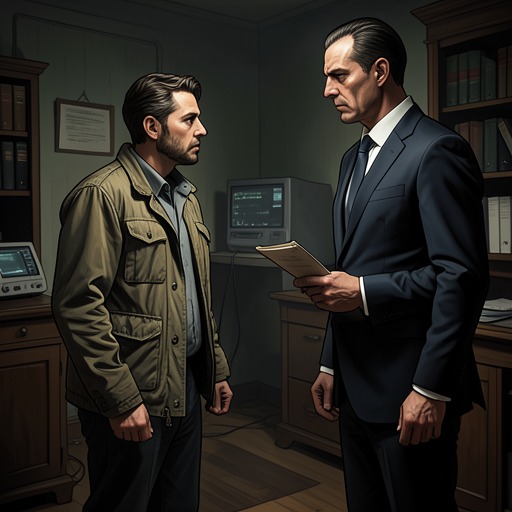
The return from the pier becomes the threshold to an apparent police setup. Hector is standing beside an immense compressed block of marijuana, so large that it seems unable to have passed through the house’s door and rises nearly to the ceiling. Zoyd leaves Prairie in the adjoining room with her bottle and teddy bear, then returns to confront the contraband. The absurd scale of the block makes the domestic interior look less like a plausible hiding place than a scene arranged for effect. Zoyd suspects that the operation is a frame intended to take Prairie from him; the novel later connects Brock Vond’s interest in the child with efforts to remove Zoyd from the way.
Hector Zuñiga’s Operation
The marijuana block transforms the house into a police theater. Hector’s presence is not a new intrusion: his first appearance in Zoyd’s life had occurred years earlier at the same coastal home, beginning a recurring relationship in which the officer would reappear without warning. At the later visit, the sheer impossibility of the evidence’s apparent entry into the room gives the encounter a grotesque, staged quality. Zoyd is frightened, but the first interruption he makes is practical and parental: he puts Prairie down before returning to the living room.
The commotion eventually wakes Prairie. When Zoyd and Sasha both rush toward the door, they collide, trade insults, and then recognize the more serious problem: the adults appear to be carrying out an operation around a baby. In the bedroom, Zoyd changes Prairie, rinses the soiled diapers, and notices that he needs to take the full plastic laundry bin to the laundromat. He also attends carefully to the diapering, making sure Sasha sees that he is cleaning and fastening it properly. The small, repetitive work of care acquires new weight precisely because the authorities are active in the next room and Zoyd fears that his daughter may be taken from him.
Family and Displacement
The crisis draws Sasha and Zoyd into uneasy cooperation. Their relationship had been awkward, and Sasha had not regarded him as a suitable partner for her daughter. Yet the prospect of Prairie being placed with foster parents forces them to coordinate rather than let their mutual distrust decide the child’s fate. At the house, Sasha holds Prairie while the child points toward the thuds and splashes coming from the adjoining room. The gesture places the baby’s ordinary curiosity beside the adults’ alarm and the unexplained labor of getting Hector’s enormous block back out of the home.
The pressure surrounding the house contributes to Zoyd’s eventual departure from Southern California. After his arrest, he says goodbye to Sasha at a Santa Monica freeway exit, with Prairie clinging to him, and finds a ride north in a flower-painted Volkswagen bus headed toward the Sacramento Delta. That later movement does not make Gordita Beach a mere stopping point: the coastal home is where Zoyd’s shared domestic life gives way to solitary parenthood, and where a seemingly impossible piece of evidence turns the home itself into a site of state pressure. Its shabby resilience and exposed position make the house an apt setting for a family trying to hold together while forces beyond it press to rearrange their lives.