Seventh River
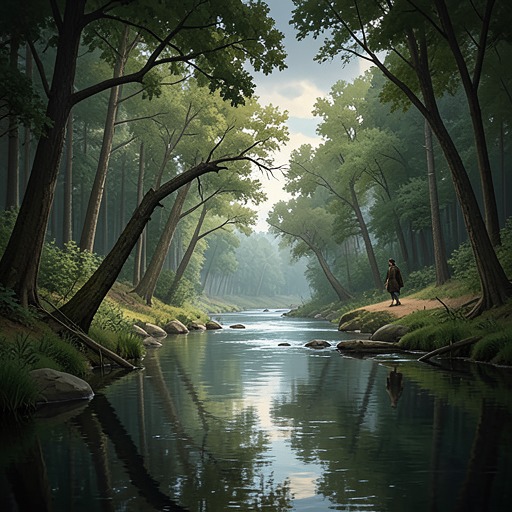
VinelandSeventh River, also called Ghost River, runs through the geography and imaginative life of Vineland County. It is a route past towns, bridges, and working landscapes, but also a river whose surroundings carry stories of displacement, spirits, and the world of the dead. The river’s double character shapes both the region’s atmosphere and the journeys people make through it.
Setting and geography
The river meets Shade Creek at the site of a Thanatoid village in Vineland County. Ortho Bob is headed there and offers to arrange lodging if his companions drive him. Elsewhere, the route follows the river from the North Spooner highway exit, past Vineland’s lights and into country where the river is identified as Ghost River. The shift in name accompanies a change in setting: beyond the town, the river seems to resume an older identity, one that precedes the modern settlement.
At its mouth, Seventh River meets the Gulf of Vineland. An 1851 atlas describes the gulf as a refuge for vessels driven north by the strong coastal winds that blow between May and October. Two narrow spits, Thumb and Old Thumb, shelter it from the open sea, with False Thumb as an island nearby. Bridges connect the spits to each other and Old Thumb to Vineland. Built in the Art Deco concrete style used across the Northwest during the Great Depression, these bridges frame the gulf as both a natural harbor and a place shaped by public works. From a wooded hill, the view gathers the gulf’s geometry, the pale bridge spans, Vineland’s harbor and town, and an airplane rising from Vineland Airport.
Indigenous memory and the spirit landscape
For the Yurok, the river is not merely a watercourse to be traversed. Its places have names: fishing and hunting grounds, groves, rocks, springs, pools, meadows, and individual trees. In the account of local tradition, each is alive and has a spirit. Some spirits are woge, beings resembling humans but smaller, who were said to have lived there before the first humans appeared. Some departed eastward or went out to sea; others withdrew into the landscape, remaining conscious as generations lived, fished, and rested around them.
The river’s passage from mouth to source is described as a journey beyond the immediately visible world. Winter presences hover in coves, birds seem to sing in almost human speech, and certain paths descend underground toward Tsorrek, the world of the dead. The novel also recounts a theory shared by local hippies: that the woge are porpoises who yielded their world to humans and live underwater near Patrick’s Point, watching to see how people treat the world. In this telling, the river landscape holds more than one account of its inhabitants and history. The uncanny is not separate from the ordinary geography; it is imagined as dwelling within it.
Crossings and working terrain
The river country is also difficult ground, navigated by people who know its back roads from repeated work. Vato and Blood, partners in business for a couple of years, can travel the county’s roads even in darkness. Their work takes them along suburban streets, grassy and sandy tracks, and muddy, hazardous passes; they have hauled vehicles with winches and pulleys and encountered things along the forest roads that are not easily discussed in local taverns.
One crossing is the old YVPA bridge over Shade Creek, needed to reach an orchard on the far bank. Though partly ruined, it always seems to retain at least one passable lane. Sections sometimes disappear, detours are marked with rough spray-painted signs, and work crews remain on site around the clock. On one night, Vato and Blood wait while an overloaded truck maneuvers across the dirt track. Figures in work clothes and helmets, possibly army engineers, do not direct the public; drivers must decide for themselves whether to proceed. Blood crosses slowly over cracked and broken pavement, with reinforcement trusses and the dark water visible through enormous gaps. Repairs have continued since a storm-swollen Seventh River damaged part of the bridge in 1964. The crossing makes the river’s force and the incomplete repair of its infrastructure part of everyday travel.
Once across, Vato and Blood turn on all the headlights and play a Bernard Herrmann cassette as they drive through the Shade valley. At the orchard, their lights reveal a Toyota among the treetops. The driver opens the front door, rocking the car and sending apples down. Vato calls up that the driver should wait until they find a ladder. The episode brings the region’s strange terrain into a practical, workaday scene: the river and its difficult crossings are not just scenery but conditions that shape what people can do.
Community and narrative significance
Seventh River also draws people together. When Hector tells Frenesi that she is free to return to Vineland, he describes her relatives gathering at a campground on the river. The river thus marks a possible point of return and family reunion, even as Hector’s invitation is entangled with questions of who has the authority to direct her movements.
A separate gathering honors the bond between Eula Becker and Jess Traverse. Their extended family, spread from Marin to Seattle, Coos Bay, and Butte, assembles for a long meal beside the river. The occasion draws together people from different generations and ways of life; Eula and Jess sit beside one another at the head of the table, where Jess performs his annual recitation of Emerson. The gathering’s repeated rituals make the river a setting for family memory as well as a route through unsettled country.
These associations resist reducing Seventh River to a single symbolic meaning. It is a gulf’s outlet, a dangerous crossing, a source of local work, a homeland layered with Yurok place-names and spirit histories, and a meeting place for relatives. The movement along it—from Vineland’s lights toward the older landscape, or from dispersed family homes toward a riverside gathering—repeatedly brings the novel’s present into contact with histories that remain active in the place.