Security Services Reservation
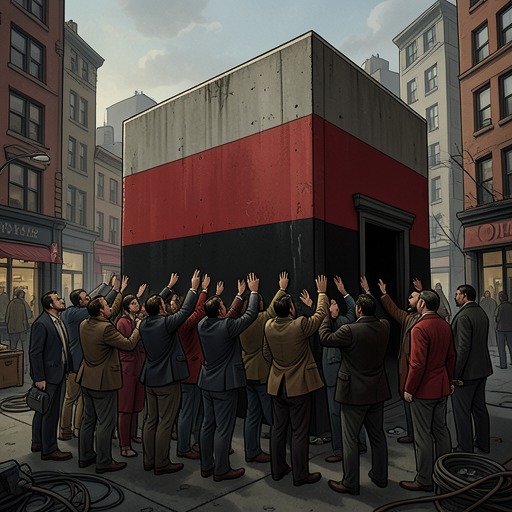
VinelandThe Security Services Reservation is a remote detention complex hidden inside a former emergency-evacuation project. Conceived as a refuge for displaced civilians, it is repurposed under Brock Vond’s Political Re-Education Program (PREP) as a place to hold political detainees and prepare selected prisoners for covert federal work. Its guarded perimeter and uncertain location make it more than a collection of buildings: it is a space designed to remove people from public view while leaving the machinery of government difficult to see.
Planned Refuge, Concealed Destination
The Reservation lies in a secluded northern valley once used by the Air Force for experiments in dispersing fog. Earlier planners had imagined a vast receiving zone capable of housing as many as half a million evacuees, should cities need to be emptied. The proposal remained largely unrealized. Only a few dozen model dwellings had been built along the edge of the planned settlement, enough to suggest the project’s scale without bringing it into existence as a functioning city.
Its roads and buildings preserve the double purpose of the site. The Federal Emergency Evacuation Route, or FEER, follows a coastal mountain ridge beneath camouflage netting and weatherproof plastic. Conceived in the 1960s as a road intended for a single, extraordinary use, it becomes the concealed approach for a convoy of unmarked gray trucks leaving a university by its rear entrance. The vehicles evade the checkpoint and reach the FEER by secondary roads. Maps offer little help: they disagree about the region and leave the irregular area at the route’s end blank, identified only as the Security Services Reservation. At Berkeley, estimates of the hidden camp’s population range from ten to a hundred, a measure not of reliable intelligence but of how readily political fears have become plausible.
The built environment combines domestic provision with institutional control. Some units are intended for families; others are barracks for individuals whose relatives are classified as temporarily unavailable. The settlement also has a dining hall, washrooms and showers, billiard and ping-pong tables, a film projector, and softball and basketball fields. Running water and ordinary recreation sit within a remote, guarded enclosure. The contrast makes the Reservation legible as a model community and a prison at once: its amenities support life inside the boundary, while its separation determines who may leave.
PREP and the Uses of Confinement
The Reservation is tied to Vond’s projected political-reeducation scheme, an institutional design that treats dissent not simply as a threat to suppress but as a resource to redirect. In his plan, people detained for disturbing the peace could be sent to Justice Department reserves and assessed for possible recruitment as informants. Those deemed suitable would face a choice between criminal prosecution and covert federal employment. After training that included weapons, they could be transferred to the FBI and placed, sometimes repeatedly, inside university campuses, radical organizations, and other centers of dissent.
The camp’s intended residents are therefore not merely hidden from public scrutiny; they are also evaluated for possible use by the apparatus holding them. Vond’s theory is that young radicals can be brought back into a national order because, beneath their revolt, they still desire the security of a larger family. His program recasts political opposition as a condition to be corrected and recruits detainees by offering conditional freedom, impunity, and even the prospect of returning to student life. The Reservation gives that theory a physical form: a bounded population, organized housing, routine assembly, and a chain of movement from detention toward federal service.
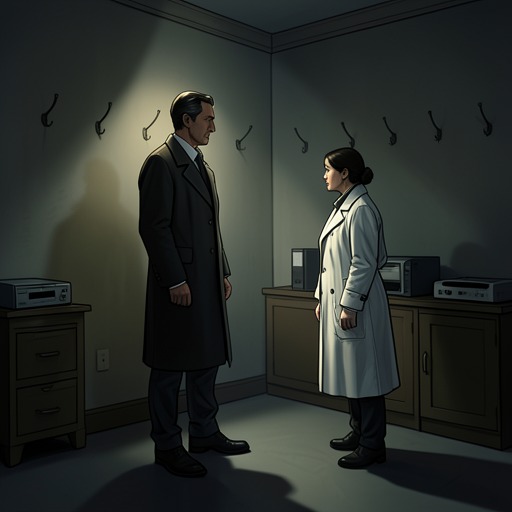
Vond visits the Reservation in an official capacity to inspect its facilities and population, arriving in a government Mercedes driven by his aide Roscoe. His purpose, however, is also personal and political: at the morning assembly he wants to see Frenesi Gates among the other detainees. The scene places her within the visible order of the camp while Vond observes from a position of authority. The Reservation thus serves not only as infrastructure for a proposed program but as a stage on which control can be demonstrated to the person it targets.
DL’s Entry and Frenesi’s Escape
The Reservation’s secrecy does not make it inaccessible. After learning that Frenesi was taken away in the convoy, DL and two companions follow the trail north in a modified 1957 Chevrolet Nomad. Their maps show the blank region but cannot reveal what lies inside it. A perimeter estimated at one hundred miles gives the search a scale of its own: the facility can move or conceal its detainees long before an ordinary approach reaches them.
DL reaches the fence before dawn, dressed in black and wearing a ski mask. Drawing on a technique taught by Inoshiro Sensei, she passes a sentry without being registered as a presence, then moves along the fence and enters the main building through a side door. She uses an ivory needle to open the lock and finds a dormitory containing several dozen sleeping people. Among them is Frenesi, whom DL recognizes from their earlier life in Berkeley. The room’s government mattresses and crowded sleeping arrangements bring the Reservation’s classification system down to the scale of bodies housed together, apart from the world that knows where they are.
DL leads Frenesi out, restores the sentry to awareness, and takes a jeep equipped with a radio. Once they have left the concealed settlement behind, she releases the guard from the effect of her technique. Frenesi’s first confused response is to say that Brock Vond is no longer there: he had left hours earlier. The escape therefore succeeds without confronting the official who has made the camp an instrument of personal as well as governmental power. The Reservation’s guards and buildings remain, but DL has made its boundary permeable long enough to recover Frenesi.
A Geography of Visibility and Control
The complex is revealed through routes, gaps, and partial knowledge rather than through a public map. A convoy disappears from the university’s rear entrance; the FEER runs beneath camouflage; maps omit the destination; and those trying to follow the trucks lose their way among secondary roads and prohibited turns. At the same time, the camp contains recognizable civic arrangements—housing, meals, recreation—whose normal appearance cannot undo the coercion of confinement. The design lets the state present a managed settlement where its political purpose is detention and surveillance.
The Reservation also belongs to a wider landscape in which government power is registered through movement and access. When Frenesi later returns to Vineland, the airport has become a military staging area: arrivals are stopped and questioned, names and numbers entered at a keyboard, and some passengers directed into an enclosure. The airport is not the Reservation, but its procedures echo the camp’s logic of classifying people and controlling passage. Against that system, DL’s crossing of the Reservation’s fence is both a rescue and a demonstration that concealed spaces depend on people remaining unseen—and that their borders, however carefully planned, can be crossed.