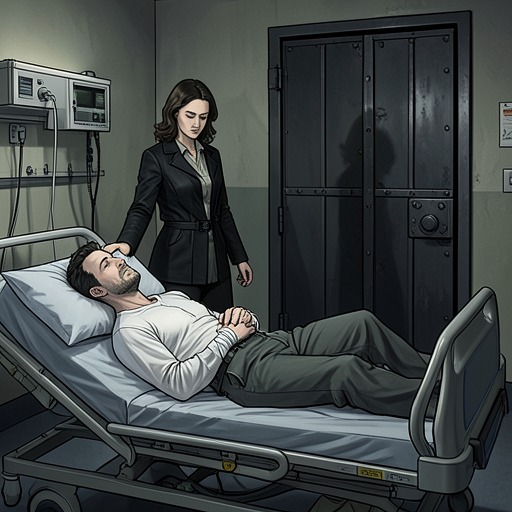
Thanatoid Village
VinelandThanatoid Village is a residential and commercial center a few miles from Shade Creek, set higher on the surrounding hills. It gives a place and an everyday economy to the Thanatoids who began settling in Vineland County after the Vietnam War. Its significance turns on a stark conjunction: it is both a destination for precarious day labor and the center of an unprecedented awakening, when music carried through electronic devices stirs the Thanatoids from their long condition of sleeplessness.
Setting and Origins
Shade Creek is remembered as a strange, supposedly lost town, evacuated after a flood long ago and later unexpectedly repopulated by inhabitants who apparently did not sleep. Frenesi Gates had explored the area as a child and returned with reports of rivers running where they should not, lights on opposite banks, and distant voices—many voices, neither festive nor quite warlike. She also described immense stones thudding down around her at night, unusually large luminous trout in the streams, and abandoned industrial works emerging through the brambles. Her childhood account places the later Thanatoid settlement in a landscape already marked by dislocation, uncanny sounds, and remnants of vanished activity.
The population of Thanatoids grew considerably after the Vietnam War. Thanatoid Village, located a few miles from Shade Creek at a higher elevation, became a residential and commercial center for them. The village thus extends the strange geography of the creek into a settled community: what had seemed an abandoned place is associated with an expanding population and a functioning local center.
Work and the County Economy
The village is also associated with the county’s day-labor market. Before dawn, workers gathered in the dark outside the Vineland courthouse, where buses waited with their engines idling and signs in their windows silently listed jobs and pay. The arrangement, called a shape-up, resembled labor contracting. Zoyd Wheeler sometimes boarded one of the buses with other newcomers to the workforce.
Those workers included former artists and spiritual pilgrims who had become lumberjacks, waiters and waitresses, shop clerks, cashiers, truck drivers, framers, and laborers. The transition registered in small bodily and practical adjustments: long hippie hair got in the way, so some workers cut it, while others tied it back or greased it behind their ears. Some former partners found work as dishwashers or waitresses, or tended the tired muscles of lumberjacks at the Shangri-La Sauna. Others returned south; some persisted, took evening classes at Vineland Community College or Humboldt State University, or worked for public and private aid agencies. This is the broader labor world around Thanatoid Village, not a claim that every displaced worker lived there. It connects the village to the altered lives and employment patterns of the county.
The area around Shade Creek and the village remains active even during a weekend exodus. People who had finished work early—sometimes days early—made practical arrangements with refrigerators and nearby electrical hookups. Some were sent to Thanatoid Village for last-minute purchases and to see what pleasures and diversions its sleepless community offered. The errand makes the village a point of contact between ordinary weekend life and a community whose habits are markedly different.
The Awakening
One morning, the area experienced an exceptional event: the Thanatoids had slept during the previous night, and now wristwatches, clocks, and personal computers began sounding together. Their chips carried a lilting, melodic passage from Johann Sebastian Bach’s Wachet Auf. The recording had been prepared long before and released through obscure commercial battles; Takeshi Fumimota had helped foment those battles as part of an arrangement with the equivocal import-export company Tokkata & Fuji. The devices’ coordinated music therefore joined a deliberate history of commercial maneuvering to a result that none of the ordinary functions of the devices could explain.
The passage was not the usual electronic music. Its percussion-adapted rhythm seemed to reach the troubled memories of the Thanatoids: they blinked, rolled their eyes, and appeared, perhaps for the first time, to seek one another’s gaze. The awakening is described as unprecedented, like the sudden end of a court case prolonged across generations. The narration asks what a Thanatoid is, after such a long ordeal, if not a memory; the music gives those memories a shared occasion to stir. The change is not presented as a routine improvement in mood, but as a brief, powerful suggestion of resurrection.
Signal and Narrative Significance
The awakening’s sound travels far beyond the village. Instead of the familiar call of the Thanatoids, a long, desolate howl repeats through dark valleys, follows storms, and intrudes into sensors belonging to more than one kind of life in the lower countryside. Takeshi and DL cannot ignore it. They tune in to Radio Thanatoide, broadcasting on the unusual frequency band from 6200 to 7000 kilohertz, and play the transmission for Prairie Wheeler. She listens and responds sadly; DL says they must answer the call and asks whether she will come with them.
Thanatoid Village is therefore more than a setting for the Thanatoids’ residence. It is the center from which an awakening becomes a signal, and from which that signal draws Takeshi, DL, and Prairie toward a response. The village’s two functions remain in deliberate contrast: a place integrated into the county’s practical circuits of work and shopping, and the source of an event that unsettles the boundary between memory and renewed life.