Economy
WaldenEconomy, the opening chapter of Walden, proposes a measure of wealth in which money is only one part of the account: a thing costs the life and labor exchanged for it, immediately or over time. The chapter tests ordinary ideas of necessity against the work required to sustain them, while the book’s later encounters with land, water, farming, and household labor extend the same question beyond the narrator’s own purchases. Its governing contrast is between what can be priced and what gives life value without becoming a commodity.
A measure of life, not merely money
The chapter begins from the narrator’s circumstances: when he wrote most of it, he lived alone in the woods, a mile from any neighbor. From this removed position, he asks readers to reconsider the troubles and anxieties over which people spend their lives. His question is not simply how to save money, but how much care and labor are genuinely required, and whether people mistake inherited habit for necessity.
Necessity is defined by human exertion and by what, through long use, has become important to human life. This definition makes the test practical rather than abstract: a need is not established merely because it is customary, respectable, or readily available for purchase. Against that standard, luxuries and many purported comforts may be positive hindrances to human elevation. Their apparent benefits must be weighed against the labor they demand and the life surrendered to obtain them.
The chapter’s most portable accounting rule follows from that inquiry: the cost of a thing is the amount of life required in exchange for it, at the moment of purchase or in the long run. The measure includes the time spent earning, making, maintaining, and replacing what is acquired. A cheaper object may therefore be expensive in lived effort, while something not bought at all may have a value no market calculation can capture.
The Walden experiment and subsistence
The narrator presents his move to Walden Pond as a way to conduct private business with as few obstacles as possible, not as a contest to live at the lowest or highest expense. The experiment is meant to make the terms of living visible: by reducing the claims made on his time, he can examine what supports a life and what merely sustains a complicated routine. The economic question is thus also a question of freedom and attention.
Subsistence is considered through the different material requirements of food, shelter, clothing, and fuel. The narrator argues that, with food supplied and shelter already secured, trade and barter could be avoided for food; clothing and fuel would still remain to be obtained. His own clothing and furniture offer examples of a mixed arrangement rather than a claim that every need can be met without others. Some furniture was made by him, while the rest cost him nothing for which he had not rendered an account.
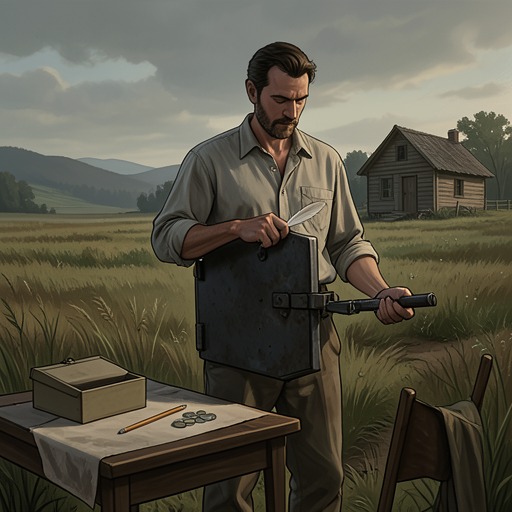
That inventory includes a bed, table, desk, three chairs, and a looking-glass only three inches in diameter. The small mirror gives the accounting an exact, domestic scale: the household is not an abstraction but a set of objects, each with a history of acquisition and labor. The narrator’s point is less that every possession is inherently wasteful than that its real cost must be brought back into view.
Work hidden inside comfort
The discussion of clothing shows how an apparently ordinary convenience can generate ongoing work. Clothes, the narrator observes, introduced sewing, which he calls a kind of endless labor; a woman’s dress, in particular, is never done. The remark connects material consumption to the maintenance work that it creates, rather than treating finished garments as though they arrived without time or effort behind them.
That question becomes more complicated when the book depicts other households. At John Field’s home, the narrator sees a hard-working but shiftless man and a wife who bravely cooks successive dinners in the recesses of a large stove. The scene places food preparation and the daily work of keeping a household alongside the narrator’s arguments for simplifying life. It makes visible labor that a bare list of purchases would conceal, while also exposing the limits of treating domestic economy as an individual calculation detached from who performs the work.
The ideal of minimizing trade and material dependence therefore meets a social reality of tasks, capacities, and household arrangements. The narrator’s own examples help show how a reduced household might work; the lives of others prevent that ideal from standing as a universal description of how labor is distributed. Economy concerns not only the amount consumed, but also the work required to reproduce ordinary life and the people on whom that work falls.
Price, land, and nonmarket value
The book repeatedly applies the distinction between price and value to landscapes. A spring is called a gem in Concord’s coronet: its worth lies in its beauty and presence, not in a stated commercial return. This language shifts the account from what a resource can produce or sell to what a place means as part of a shared landscape. The spring’s value is presented as something the language of exchange can recognize only imperfectly.
The discussion of Flint’s Pond makes the conflict sharper. Its name is dismissed as poor nomenclature, and the narrator questions the authority of the farmer whose property adjoins it to name a body of water whose shores he has laid bare. The argument is not merely about taste in names: ownership and productive use do not, in his view, grant an owner complete moral command over a landscape or exhaust its significance.
The farmer’s relation to the pond is measured by utility: it did not turn his mill, and seeing it was no privilege to him. The narrator opposes that valuation with an image of a person willing to carry the landscape, even God, to market if a price could be obtained. In this contrast, a landscape reduced to profit loses precisely the value that makes it worth attending to. Economic judgment is necessary, but the book refuses to let market price become the sole standard for land and water.
Beauty, cultivation, and the limits of the ledger
The narrator’s October trip to the river meadows supplies a quieter counterexample to useful harvest. He gathers clusters of grapes, valuing their beauty and fragrance more than their food. He also admires other grapes without gathering them. The episode distinguishes enjoyment from possession: attention to a natural abundance need not become an attempt to extract or consume all of it.
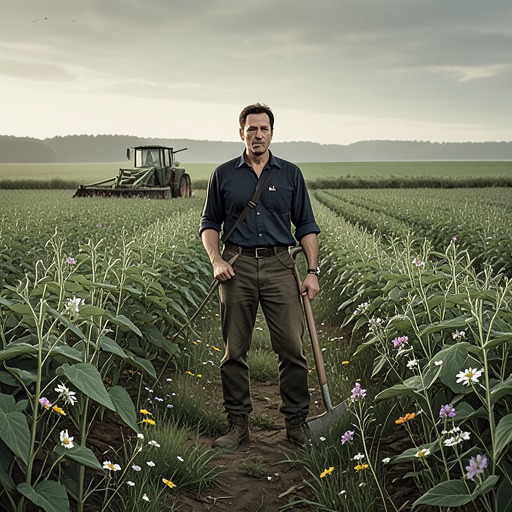
A later account of farming gives the question a commercial edge. The narrator sees recently introduced cattle and, because he sees no manure, judges that the farmers intend to skim the land, as he had done while assuming the soil was deep and had lain fallow long enough. He hears that a gentleman farmer behind the operation wants to double his already half-million-dollar fortune. The contrast sets immediate profit against the land’s capacity to sustain cultivation over time; what looks like an economic gain may depend on drawing down the ground that makes future gain possible.
Across these examples, Economy is not a rejection of material needs or an arithmetic of deprivation. It is a discipline of accounting that restores hidden labor, duration, dependence, and nonmarket worth to decisions about what to own, make, consume, or exploit. Its most demanding implication is that no price tag settles the question: a sound account must include the life spent earning a thing, the labor sustaining a household, the condition of the land, and the beauty that remains valuable even when it is neither gathered nor sold.