Self-exploration
WaldenSelf-exploration is the practice of treating the mind as an undiscovered country, and it gives inward inquiry the scale and urgency of a voyage. The book turns the language of expeditions away from distant geography and toward the self: its uncharted regions are not a metaphor to admire from afar, but a terrain each person must enter, map, and explore.
The Uncharted Interior
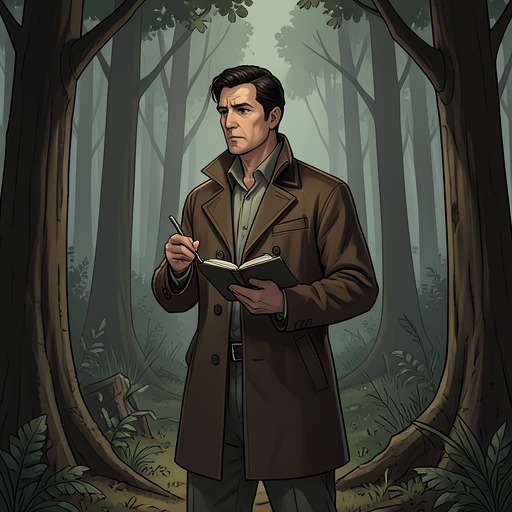
A poem calls for the eye to be directed inward, where a thousand regions of the mind remain undiscovered. Its imperative is practical: travel those regions and become expert in home-cosmography. The contrast is not between knowledge and ignorance in the abstract, but between the familiar surfaces of ordinary life and an inner world left unexplored. A person can inhabit that world without knowing its extent; self-exploration begins by recognizing that the chart is incomplete.
The book presses the image further by asking what Africa or the West stands for and whether a person’s own interior might remain white on the map. That interior could prove black, like an unexplored coast. The comparison keeps discovery uncertain: inward travel does not promise that the territory will confirm prior expectations, only that it has yet to be encountered. The unknown is close at hand, but it is not therefore already understood.
Turning Exploration Inward
The vocabulary of travel repeatedly supplies a model for this work. The explorer of the self is urged to become the Mungo Park, Lewis and Clark, and Frobisher of his own streams and oceans, and to explore his own higher latitudes. The passage carries the equipment and scale of expedition into the interior, even imagining shiploads of preserved meat and empty cans piled high as a sign. Yet it immediately challenges a merely literal purpose for such supplies: preserved meat is not invented only to preserve meat. Material equipment can support a voyage, but the journey’s destination is discovery of thought.
That redirection becomes explicit in the call to be a Columbus to whole new continents and worlds within oneself, opening channels not of trade but of thought. The familiar figure of overseas discovery is repurposed: the prize is not possession or commerce, but new routes through the mind. In this image, inward exploration is active and expansive. It does not simply contemplate a private interior; it opens channels through which thought can move into previously unknown territory.
The book also invokes Franklin’s search and the question of whether Mr. Grinnell knows where he himself is. The juxtaposition turns the search for a lost person into a question about the searcher’s own location. Seeking someone else does not by itself settle the seeker’s relation to himself. The explorers most needed, the passage suggests, are not only those who cross oceans, but those who can recognize that their own position remains uncertain.
A Realm Beside the World
The inward territory is represented not as a small refuge from public life but as a realm beside which the earthly empire of the Czar is petty. That scale reverses the usual measure of power: an empire may dominate visible land, yet it is less consequential than the vast domain each person has within. The claim elevates self-exploration without making it passive. The realm must be discovered; its size alone does not mean its possessor knows how to travel it.
This reversal also clarifies why the book’s images of exploration are directed at individuals. An expedition to remote places can reveal territory, but no one else can substitute for the person undertaking the inward journey. The final injunction, associated with the old philosopher, is to explore oneself, a task demanding both the eye and the nerve. Observation must be joined to courage: seeing the extent of the unknown is not enough if the explorer will not venture into it.
Natural Observation and the Work of Knowing
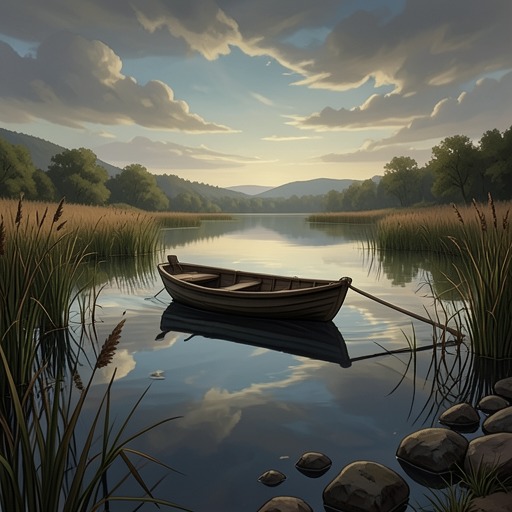
The book’s own attention to place offers a concrete analogue for learning to see. Walden’s scenery is described as humble rather than grand, and its beauty does not necessarily concern someone who has not frequented the lake or lived by its shore. Intimacy here is a condition of perception. What matters is not simply that a landscape exists, but that sustained attention discloses qualities unavailable to a passing glance. The same distinction underlies self-exploration: proximity to oneself is not the same as knowledge of oneself.
The shore, with its smooth, rounded white stones and short sand beaches, makes observation specific to form and location. Elsewhere, the narrator surveys the long-lost bottom of Walden Pond before the ice breaks, using a compass, chain, and sounding line early in 1846. The measured survey differs in method from the inward voyage, but it illustrates a shared discipline: curiosity becomes knowledge through deliberate attention, instruments, and an effort to discover what is hidden from ordinary view.
Seasonal change supplies another lesson in close observation. Thawing sand and clay assume forms as they flow down the sides of a deep railroad cut, and this phenomenon gives the narrator unusual delight. He imagines the earth’s maker still at work, scattering fresh designs, and describes the sandy overflow as resembling the vital substance of an animal body. The observed forms are concrete; the image of the earth’s vitals is an interpretive extension. Together, they show how attention can move from what is directly seen toward a larger conception without making the two identical. Inward inquiry, too, requires both the patience to observe and the care to distinguish discovery from the meaning attached to it.
Knowledge, Judgment, and the Explorer’s Position
Self-exploration is framed as an undertaking, not a guarantee of triumph. The call to begin on the farthest western way follows a warning that only the defeated and deserters go to the wars, cowards who run away and enlist. The language makes avoidance a failure to face the journey, but it does not promise that every inward discovery will be easy or flattering. The demand is to start, to bring eye and nerve to the work, and to accept that the interior remains unknown until it is explored.
The book’s account of other people’s conditions also exposes a limit that inward discovery cannot erase by itself. The narrator considers Concord farmers who have spent twenty, thirty, or forty years toiling, asks how the poor fare, and points to shanties bordering the railroads as evidence of degradation. He also describes John Field, an Irishman living with his wife and several children in a cabin, and names Cato Ingraham and Brister Freeman in the histories of enslavement and local life. These portraits make social circumstances part of the book’s field of attention. They do not establish that the people described are themselves on a journey of self-exploration; rather, they show that an inquiry into the human interior occurs alongside encounters shaped by work, poverty, race, and unequal power. The method’s promise of inward discovery therefore sits beside a question of perspective: who is being observed, and who gets to interpret?
Taken together, the book’s images make self-exploration a double discipline. One must attend closely enough to detect what has been hidden in plain sight, as a surveyor finds the bottom of a lake or an observer follows thawing earth; one must also venture beyond inherited maps, opening channels of thought rather than routes of commerce. The journey’s decisive destination is neither a remote continent nor an imperial possession, but the uncharted country within, where discovery begins only when the explorer turns inward and has the nerve to proceed.