Walden Pond as a mirror
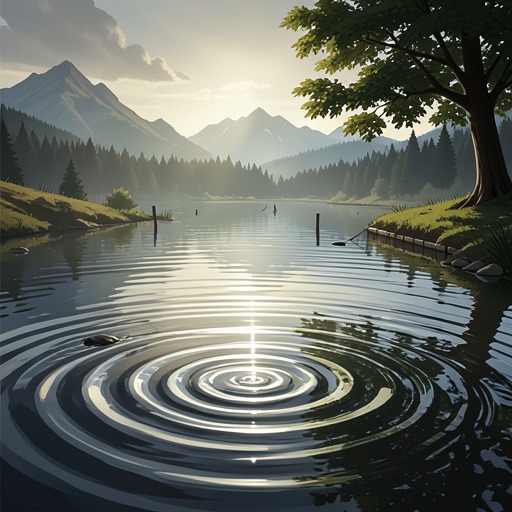
WaldenWalden Pond as a mirror is both a feature of the landscape and a way of understanding inward life. Its reflective surface gives the beholder an image of the world, but the deeper measure is the observer’s own nature; meanwhile, the lake’s apparent constancy throws into relief the histories of clearing, work, and renewal on its shores.
A Humble Landscape, Closely Known
Walden’s scenery is described as beautiful but modest in scale, without the grandeur that might impress a passing observer. Its particular force belongs to those who have frequented it or lived beside it: intimacy, not spectacle, makes the place legible. The lake’s significance accumulates through duration and repeated attention, so that knowing its shore becomes a form of knowing the landscape from within.
Its shoreline gives that intimacy a precise physical edge. A belt of smooth, rounded white stones resembles paving, interrupted by one or two short sand beaches. The bank is steep enough that in many places a single leap carries a person into the water. The lake is therefore not a distant view alone: its reflective expanse is bordered by a tangible, sharply defined shore.
The Lake as an Eye and a Mirror
The image of the lake as an eye joins landscape to self-examination. The water is called the earth’s eye, and looking into it becomes a way for the beholder to measure the depth of his own nature. Trees growing beside the shore form the lake’s eyelashes; wooded hills and cliffs hang over it like brows. This analogy does not make the lake merely a backdrop for human feeling. It gives the landscape its own expressive form, while making the act of looking reciprocal: the observer sees the lake and, through that encounter, reads himself.
The mirror is especially vivid in a September or October day, when Walden reflects the surrounding forest. Stones ring the water like precious settings, though their value rests in the observer’s regard rather than their rarity. The lake’s surface gathers sky and land into a single image, and the text stresses its unusual conjunction of purity and largeness. Nations may come and go without defiling it: human history moves around the water, while the lake’s reflective presence exceeds any one generation’s claim upon it.
That persistence is figured through the mirror’s material qualities. No stone can crack it; its quicksilver will not wear away, and Nature continually repairs its gilding. Storms and dust do not keep its surface from becoming fresh again. These are images of renewal rather than a claim that the surrounding landscape never changes: the mirror’s durability gives the account a standard against which damage and succession can be seen.
Remembered Woods and Altered Shores
The lake’s apparent endurance sharpens the contrast with the woods beside it. After the narrator leaves the shore, woodchoppers cut down more of the surrounding trees. The former paths through wooded aisles, with occasional openings toward the water, become unavailable; the loss reaches even the conditions of perception, since the birds’ groves are cut down. The silence of the Muse is linked to this material change. The landscape’s beauty depends not just on a view of water but on the living woods that frame and lead toward it.
The altered scene is made concrete by what has disappeared: trunks of trees from the lake bottom, an old log canoe, and the dark woods around the pond are gone. Villagers who scarcely know where Walden lies now bathe elsewhere. These losses mark a change both in the place and in the relationship people have with it. The mirror remains an image of continuity, but it reflects a landscape from which familiar features and habits of attention have been removed.
Yet the pond is encountered again as the same woodland lake. More than twenty years of repeated seeing do not exhaust the force of recognition: the moment of seeing Walden anew makes duration visible, while a forest cut down the previous winter is already giving way to another springing up beside the shore. The scene holds destruction and regeneration together. The mirror’s sameness is not an escape from ecological change; it makes succession newly perceptible.
Observation, Season, and the Living Ground
Walden’s reflective character belongs to a wider practice of attending to natural processes. The narrator carefully surveys the pond’s long-lost bottom before the ice breaks up, early in 1846, using a compass, chain, and sounding line. The wish to recover what lies below the surface turns the lake into an object of patient investigation as well as contemplation: its visible mirror has a hidden depth that must be measured by instruments.
Seasonal observation also discovers persistence at a smaller scale. In midwinter, a warm, springlike swamp may still be found where skunk-cabbage keeps its perennial green, and a hardier bird may wait for spring’s return. These observations complicate any simple opposition between frozen surface and dormant life. The landscape continues to act and renew itself beneath winter’s appearance, just as the lake’s polished surface invites attention to what its image cannot disclose.
A different kind of close observation attends to thawing sand and clay. In a deep cut on the railroad, the narrator watches the materials take flowing forms as they run down the sides. The phenomenon delights him because earth seems to display fresh designs in motion. He describes the experience as feeling nearer to the globe’s vitals, comparing the sandy overflow to a foliaceous mass like the vital tissue of an animal body. The lake’s mirror is thus one part of a landscape understood through both visual analogy and material change: water reflects, while earth flows and exposes its own processes.
Persistence, Value, and Human Measure
The language of reflection also belongs to a wider questioning of value. In discussing the cost of a thing, the text defines cost as the amount of life exchanged for it, immediately or over the long run. Set beside that measure, Walden’s worth cannot be reduced to a price or to the practical uses made of its shore. Its value lies in the attention it rewards, the inward measure it offers, and the continuity of its natural processes—forms of wealth that do not depend on ownership or exchange.
Walden Pond as a mirror therefore gathers several tensions without resolving them into a simple picture of untouched nature. The lake is beautiful on a humble scale, altered by human cutting and changing use, yet repeatedly renewed in perception and in the returning forest. Its surface reflects sky and woods; its depths invite surveying; its banks register both intimacy and loss. Looking into it becomes an encounter with a world that persists beyond a single observer, and with the observer’s own capacity to notice what endures, what disappears, and what begins again.