Nature’s language
WaldenNature’s language is the knowledge made available by alert, direct attention to the world: a discipline of looking that can begin with a lake’s stones or a changing patch of thawing ground and open onto questions of time, perception, and human place. In Walden, observation is not merely a store of scenic impressions; it is a practice that resists the idea that books, schedules, or prescribed routines can do the work of seeing.
Attention Beyond Books
The text places natural understanding against confinement to books, even select and classical ones, and to particular written languages. No method or discipline can replace being continually alert to what is actually before the observer. Reading remains valuable, but the passage asks the reader to distinguish between receiving knowledge secondhand and seeing for oneself; it urges a movement from reader or student toward seer, whose attention can interpret present circumstance and face the future.
That emphasis gives looking an ethical dimension. A history, philosophy, poem, or admirable routine cannot stand in for the discipline of attending to what can be seen. Nature’s language is therefore not presented as a code learned once and mastered by instruction. It requires continuing readiness: the world’s significance may be missed when the mind is elsewhere, even if it has been trained by books.
The Lake as a Particular Place
This way of knowing depends on familiarity with place. Walden’s scenery is described as beautiful but humble in scale, and unlikely to mean much to someone who has neither frequented the lake nor lived beside its shore. Its meaning grows through residence and repeated encounter rather than through grandeur alone. The account makes local attention, not spectacular scale, the condition for noticing what the lake has to disclose.
The shore offers concrete matter for that attention: a belt of smooth, rounded white stones, like paving stones, interrupted by one or two short sand beaches. It is so steep in many places that a single leap carries a person into the water. The description records texture, shape, and access to the lake; such particulars show how reading nature begins in exact observation of a place rather than in generalized praise of scenery.
Survey and Natural History
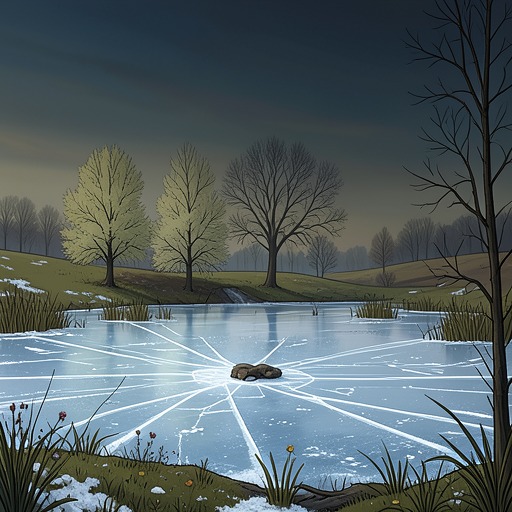
The observer also turns attention beneath the lake’s visible surface. Desiring to recover its long-lost bottom, he surveyed Walden Pond carefully before the ice broke up, early in 1846, using a compass, chain, and sounding line. The work brings instruments and measurement into a mode of close attention: nature can be encountered through practical inquiry as well as contemplation, and the lake’s obscured form becomes an object of deliberate investigation.
Seasonal observation extends that inquiry from a single body of water to recurring processes. The phenomena of a year, the text says, occur every day on a small scale in a pond. In the morning, shallow water generally warms faster than deep water, though that pattern is qualified rather than made absolute. The pond becomes a compact setting in which change can be watched closely, connecting daily observation to larger seasonal rhythms without confusing a small-scale comparison with a complete explanation of nature.
Thaw and Interpretation
The thawing of sand and clay provides another scene of close observation. The observer delights in the forms the earth assumes as it flows down the sides of a deep railroad cut. What might pass as disturbed ground becomes a visible process, where water and soil continually reshape their contours. Attention discloses movement in material that might otherwise appear inert.
From this observed overflow, the writing moves toward a metaphysical interpretation: the fresh forms seem like designs strewn by the maker of the world, and the sandy mass recalls the vital substance of an animal body. The comparison is an imaginative extension of what has been seen, not a demonstrated natural-history conclusion. That shift reveals a characteristic reach of Nature’s language: description can prompt reflection on the relation between earth and life, while the concrete phenomenon remains the ground—and the limit—of the interpretation.
A Discipline of Lived Time
This attention also changes the experience of a day. Morning is not defined solely by clocks or by other people’s attitudes and labors; it arrives when the observer is awake and an inner dawn has begun. Moral reform is figured as throwing off sleep. Such language makes wakefulness both a condition of perception and a moral practice, binding the reading of nature to the quality of the observer’s life.
The same principle appears in the desire to keep a broad margin in life rather than sacrifice the present moment to work of either head or hands. Nature’s language asks for time that is not wholly preassigned: observation needs room, patience, and a readiness to receive what is present. Its force lies in joining humble particulars to inward renewal, without allowing either inherited learning or routine to replace the act of looking.