Voluntary poverty
WaldenVoluntary poverty is a deliberate reduction of material dependence, not simply the condition of having little. In Walden, it serves as a vantage point from which to judge the comforts and institutions that consume human effort: simplicity can make room for independence and wisdom, but the practical work that sustains a life, and the unequal burdens through which it is performed, complicate the ideal.
Poverty as a Vantage Point
Thoreau argues that most luxuries, and many things commonly called comforts, are not indispensable and can hinder human elevation. The point is not only to own less. Luxury reproduces itself across agriculture, commerce, literature, and art, shaping what people produce and value; a life organized around abundance may therefore make clear judgment harder rather than easier.
Against this, voluntary poverty offers a position from which to observe human life impartially and wisely. Thoreau connects that position to philosophy as a way of living: wisdom is not merely subtle thought or the founding of a school, but a life of simplicity and independence that follows its own dictates. The contrast is between professing a principle and arranging one’s life so that the principle can be practiced.
His criticism also turns on misused wealth. He describes a class that appears wealthy but is impoverished in a deeper sense: its members have accumulated dross without knowing how to use it or rid themselves of it. Material possession, on this account, is not equivalent to freedom or well-being; accumulation can become another form of dependence.
The Material Practice of Simplicity
The ideal is tested through the ordinary requirements of life. Thoreau says that, with shelter already secured, he could avoid trade and barter for food; clothing and fuel would remain. That accounting makes self-reliance concrete, while also showing its limits: a life without exchange is not presented as an abstraction detached from bodily needs, but as a practical question of what must still be obtained or made.
His furniture gives the same principle a domestic scale. Some pieces he made himself; the remainder, he says, cost him nothing for which he had not rendered an account. The inventory begins with a bed, table, desk, and three chairs. Such objects are neither hidden nor romanticized: their number and origin matter because they show how a reduced household can be described in terms of actual use and labor, rather than prestige or display.
Clothing, too, reveals work that a simple account of possessions might overlook. Thoreau observes that the introduction of clothes brought sewing, which he calls a kind of endless work, adding that a woman’s dress is never finished. The remark makes the ideal’s household economy visible: material independence depends not only on what is owned, but on the recurring labor required to keep people clothed.
Poverty, Labor, and Unequal Conditions
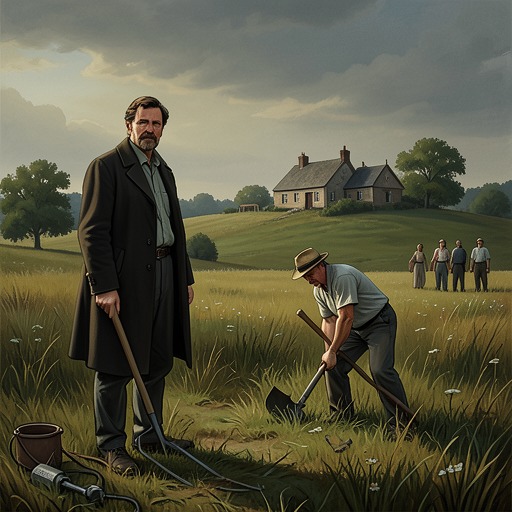
The description of John Field brings the ideal into contact with a neighbor’s hardship. Thoreau calls Field honest and hard-working but shiftless, and describes Field’s wife as bravely preparing successive dinners in the recesses of a tall stove. This domestic scene makes work tangible, but it also exposes a tension in Thoreau’s comparisons: a chosen experiment in having less is not the same as poverty imposed by circumstance, and the household’s labor does not fall evenly into view.
Elsewhere, Thoreau imagines a household in which washing is not put out and the fire, mistress, furniture, and utensils are all part of the work and setting of domestic life. Together with his account of the endless sewing associated with women’s clothing, this emphasis complicates any equation of simplicity with effortless self-sufficiency. A household may depend on labor that is constant precisely because it is ordinary, repetitive, and easy to treat as part of the background.
Voluntary poverty thus works as both a proposal and a critical standpoint. It asks what comforts are genuinely necessary and what accumulation costs in independence, while the portraits of work and poorer households prevent that question from becoming purely abstract. The ideal is strongest as a discipline of attention: it directs scrutiny toward possessions, exchange, and labor alike, without making every experience of deprivation equivalent to a freely chosen life.