Commerce, railroads, and industrial modernity
WaldenCommerce, railroads, and industrial modernity is the book’s double-edged account of economic exchange: commerce can embody courage and enterprise, yet the transport and consumption it enables bind households to distant markets and alter the land that supplies them. The railroad’s whistle carries groceries and rations into the countryside, while its iron horse muddies a spring and consumes woods. Thoreau sets that noisy circulation against the work hidden in clothing, domestic life, and poverty, and against his own attempt to reduce dependence on trade.
Exchange, enterprise, and dependence
Thoreau does not dismiss commerce as mere corruption. He finds in it enterprise and bravery, a readiness to act rather than wait passively. Its confidence, alertness, and endurance seem natural beside enterprises founded on fantasy or sentiment. That respect, however, does not erase his criticism of the system’s reach: the commercial network arrives in the countryside as something no individual farmer can simply refuse.
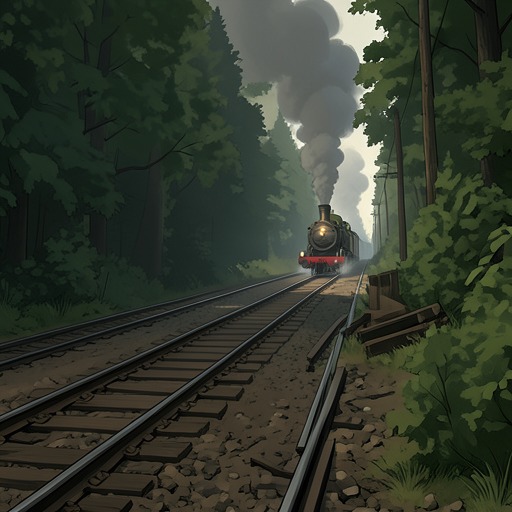
The railroad makes that reach audible. Its locomotive whistle penetrates the woods in summer and winter, sounding like a hawk’s scream, and announces that merchants in the city are on the move. The train speaks, in effect, for the country’s dependence: it brings groceries and provisions, and the whistle answers with the payment sent back from rural life. Exchange is not an abstract principle here; it is a recurring material traffic between city and farm, announced across the landscape by a machine.
The countryside pays in resources as well as money. Timber becomes walls and chairs for the city, while the country’s huckleberry hills are stripped and its cranberry meadows raked over for urban consumption. Cotton travels up the line and woven cloth comes down; silk moves in the same exchange. Thoreau’s image of the country handing a chair to the city gives commerce a civil, even helpful appearance, but the scale of extraction complicates that civility. The traffic supplies comfort while turning local ground and labor into the furnishings and goods of elsewhere.
The cost hidden in ordinary life
The critique extends from transport to the apparently commonplace work of getting and keeping possessions. Clothing, Thoreau argues, introduces sewing, an endless labor: a woman’s dress is never finished. A garment is therefore not only an article bought or worn but a continuing demand on time and work, much of it domestic. The example makes visible a cost that commercial accounting can obscure: the repeated labor required to maintain the forms of comfort that consumption presents as completed goods.
Thoreau tests the possibility of opting out by considering what his own life would require. With shelter already secured, he imagines avoiding trade and barter for food, leaving clothing and fuel as the remaining needs. The clothes he wears are part of that calculation, and his furnishings offer a related inventory: he made some himself, and for the rest he claims to have rendered an account of their cost. Among them are a bed, a table, a desk, three chairs, and a small looking-glass. The point is not that material life can be abolished, but that its costs should be named, traced, and measured against the life spent obtaining it.
The domestic setting also exposes an uneven distribution of work. In the household Thoreau visits, washing is not put out, and neither are the fire nor the mistress; cooking and maintaining the home remain part of the scene’s material economy. The comparison sharpens the difference between a principle of self-reliance and the labor that makes a household function. Independence cannot be evaluated only by the possessions a man lists or the trade he avoids; it also depends on who performs the recurring work of care and maintenance.
Poverty beside the promise of progress
Thoreau sets the visible signs of civilization against the lives of those who do not share its rewards. He considers the farmers of Concord, who have labored for twenty, thirty, or forty years, and turns from their toil to the poor minority: some people may be raised above the material condition of the savage while others are degraded below it. His argument shifts the measure of progress from aggregate prosperity to its distribution. A society’s improvements do not establish that its inhabitants are all better housed or less burdened.
The shanties bordering the railroads give that disparity a local and pointed form. The railroad is praised as the latest improvement, yet poor dwellings line its route. The infrastructure that signifies progress thus passes beside evidence of deprivation. Thoreau does not treat the track as proof that poverty has been overcome; its presence makes the contrast harder to ignore. The same system that circulates goods and generates commercial activity coexists with people whose circumstances may be worse than those of people outside its promised civilization.
His portrait of John Field brings the argument down to one household. At Field’s cabin, Thoreau finds the Irishman, his wife, and several children sheltered beneath a roof that leaks least in one part while rain and thunder continue outside. Field is presented as honest and hard-working but shiftless; his wife is seen cooking successive meals at the stove. The scene gives poverty a roof, a family, and repeated labor, rather than leaving it as a general category. At the same time, the account is filtered through Thoreau’s judgments about the household, a reminder that his social criticism often relies on an observer’s interpretation of neighbors whose own explanations are not fully heard.
Industrial change and the altered landscape
The railroad is not only a channel for commerce but an agent of physical change. In another pointed image, the iron horse muddles the Boiling Spring with its foot and browses away the surrounding woods. The language makes the machine seem like a grazing animal, but its appetite belongs to industrial expansion: the spring and forest bear consequences that do not appear in a tally of goods delivered. The railroad’s repeated presence is therefore both practical and ecological, carrying supplies while leaving damage in the landscape it crosses.
These passages hold two valuations of modern commerce together without resolving them into a simple condemnation. Thoreau recognizes its boldness and activity, yet follows the exchange beyond the moment of purchase to the labor that makes clothing, the household work that sustains comfort, the dependence built into rural supply, the poverty beside the tracks, and the woods and water altered by transport. Industrial modernity promises connection and convenience; his account asks who performs the work, who receives the benefit, and what places are made to pay for it.
The counterpoint is not a claim that Thoreau can live without material needs. His own inventory of shelter, clothing, fuel, and furniture shows that even a deliberate reduction of trade requires choices about what to make, use, or retain. Rather, he treats dependence as something to examine instead of accepting commerce’s terms as natural or inevitable. The railroad’s whistle, sounding through the woods in every season, gives that examination its recurring emblem: a call that promises provisions, announces obligation, and makes the costs of modern exchange audible.