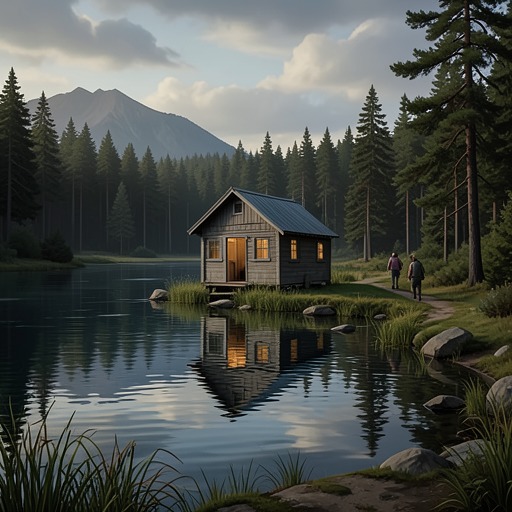
Solitude in Walden
WaldenSolitude in Walden is a chosen condition of attention rather than mere separation from other people. In the narrator’s account, being alone can open a form of companionship with Nature: the pond, its changing seasons, and even the patter of rain become occasions for perception and renewal. Solitude is therefore both an inward practice and a way of inhabiting the natural world, distinct from loneliness and from the measurable distance between a person and society.
Solitude and human company
The narrator presents solitude as a preference grounded in experience, not a complaint about having no companions. He finds it wholesome to spend most of his time alone; even the best company soon becomes wearisome and dissipating. His formulation makes solitude an affirmative choice, one that protects the attention and energy that social engagement can disperse. It is not a claim that human relationships have no value, but a judgment about how much company a person can sustain without losing inward space.
Physical isolation, however, is not the measure of solitude. A person may feel lonelier abroad among other people than while staying in a room, and anyone thinking or working is alone in an important sense, wherever that work takes place. The diligent student in a crowded college may thus be as solitary as someone at a distance from a town. By separating solitude from geography, the narrator makes it a condition of inward attention rather than a simple count of nearby bodies.
Nature as companionship
The solitude of Walden is not empty. The narrator finds that the sweetest, most tender, innocent, and encouraging society can be present in a natural object, even for someone who is melancholy or misanthropic. This companionship does not depend on conversation or human recognition. It emerges through attention to what is already around him, allowing the natural world to answer isolation without pretending to be human company.
That relation becomes especially vivid in a gentle rain. The narrator describes a mood in which he recognizes a slight instability and anticipates that it will pass; amid the rainfall, he becomes newly sensible of Nature’s beneficent society in the pattering drops and in the sounds and sights around him. The scene joins emotional change to close perception: companionship is not bestowed by another person but discovered through a shift in how the immediate world is apprehended.
The account also distinguishes this ordinary natural consolation from a diseased imagination. Bodily weakness can surround a person with grotesque visions believed to be real; bodily and mental health, by contrast, may continually cheer a person with a more normal and natural society, confirming that one is not alone. Solitude in this sense depends partly on the condition of the observer. Nature’s presence is not presented as an identical experience in every state of mind, but as a companionship that health and strength can help make perceptible.
Lived time and deliberate attention
Solitude also alters the experience of time. Each morning offers an invitation to make life as simple and innocent as Nature, and the narrator rises in a spirit of reverence for Aurora. Morning is not defined only by clocks or by the labor and attitudes of other people: it is the moment when a person is awake inwardly and a dawn takes place within. Moral reform, in this account, begins as an effort to throw off sleep. The day’s significance depends less on its official hour than on the quality of awareness brought to it.
This inward measure permits an unhurried life. The narrator sometimes cannot bear to sacrifice the bloom of the present moment to work, whether intellectual or manual, because he values a broad margin in life. On a summer morning, after his accustomed bath, he may sit in a sunny doorway from sunrise until noon, absorbed in reverie. The scene makes leisure an exercise of attention rather than mere idleness: time is left open so that experience need not be reduced to productive tasks.
The same principle appears in the narrator’s response to the natural processes of the pond. He observes that the phenomena of a year recur every day on a small scale in a pond, where shallow water generally warms more rapidly than deep water. His delight in the forms made by thawing sand and clay, and his feeling of being nearer to the globe’s vital forces when fresh designs spread across the earth, show how patient observation can turn solitude into active engagement. The natural world supplies both the rhythm and the subject of attention.
Walden as a field of attention
The narrator cautions that Walden’s scenery is on a humble scale. Though beautiful, it does not approach grandeur, and it may mean little to someone who has not frequented the pond or lived by its shore. Its significance is therefore cumulative and relational: sustained acquaintance, rather than spectacular scenery, teaches the observer to notice what the place contains. The quiet setting rewards familiarity, making solitude less an escape to dramatic wilderness than a discipline of return and perception.
That familiarity includes exact physical details. The shore is edged by smooth, rounded white stones resembling paving stones, except for one or two short sand beaches; it is so steep in many places that a single leap carries a person into the water. Such particulars give the contemplative setting a definite material shape. The pond is not merely a symbol of inward life: its steep shore, stones, and water are encountered through the same close observation that makes solitude meaningful.
Before the ice broke up early in 1846, the narrator carefully surveyed Walden Pond with a compass, chain, and sounding line because he wished to recover its long-lost bottom. The episode makes inquiry part of his solitary relation to the place. Attention is at once reflective and practical: he does not only contemplate the pond but measures it, using instruments to investigate what its surface conceals.
His observations extend beyond the pond’s depths to the visible work of seasonal change. Few phenomena give him more delight than the forms assumed by thawing sand and clay as they flow down the sides of a deep railroad cut. In that movement he feels nearer to the globe’s vital forces, as if the earth’s fresh designs disclose something like the living body’s inner substance. The comparison is an imaginative extension of observation, not a detached scientific conclusion; it shows how solitude allows a material process to become a source of wonder.
Significance
Across these scenes, solitude joins inward independence to responsiveness. The narrator withdraws from the fatigue of constant company, but he does not describe withdrawal as a severing of relation: Nature’s objects, rain, seasonal water, and thawing earth furnish forms of society accessible through attention. His account also makes this access conditional and embodied, distinguishing healthful perception from visions produced by bodily weakness and locating daily renewal in an inwardly experienced dawn.
Solitude consequently changes both what counts as company and what counts as time. A crowded place need not end inward aloneness; a natural object can make a solitary person feel accompanied; and a morning measured by awakening can matter more than one measured by clocks or labor. The pond’s modest shores and repeatedly observed changes give these ideas their ground. The narrator’s solitude is not a retreat from the world so much as a way of meeting it without surrendering the broad margin needed to see it.