Agriculture as moral cultivation
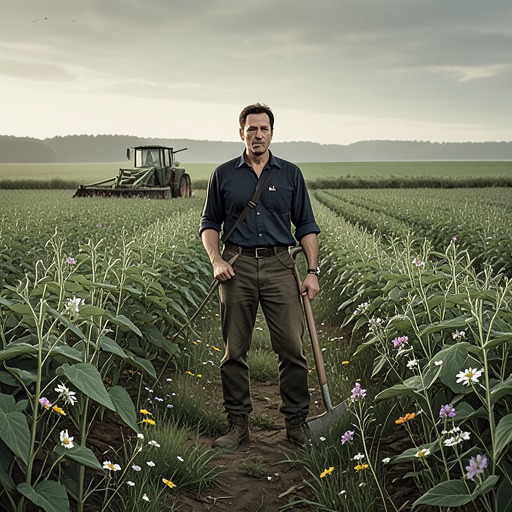
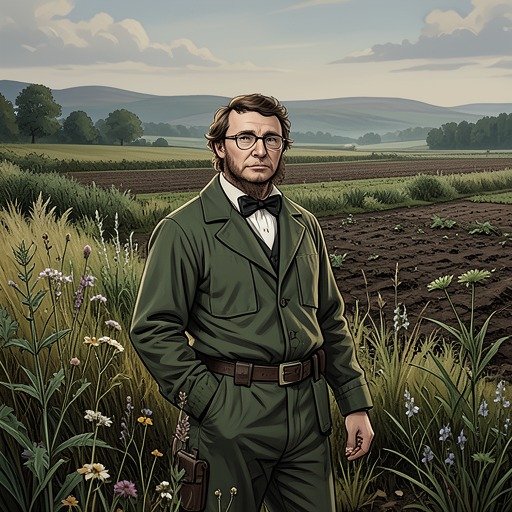
WaldenAgriculture as moral cultivation names the passage from working the soil to asking what kind of life that work should produce. In Walden, the bean rows first bind the cultivator to the earth through repeated labor; their deeper harvest is the turn from crops toward sincerity, truth, and the moral growth of human beings. The field is neither simply a source of food nor a badge of improvement: it becomes a place to test attention, measure the cost of effort, and question whether cultivation serves life or merely enlarges possession.
Labor, attachment, and the field
Thoreau’s beans demand sustained work, and their quantity exceeds his own need. Yet he comes to love the rows. Their value lies partly in what their care makes possible: they attach him to the earth, and he draws strength from that attachment. The crop’s practical surplus does not cancel this inward consequence. Instead, the mismatch between how much he grows and how much he wants sharpens the question of why he cultivates at all.
The physical act of hoeing also opens the field onto a human past. As he draws fresher soil around the rows, he disturbs ashes and small implements associated with people who lived there in remote times. Cultivation is therefore not an uncomplicated claim to new ground: the turned earth bears traces of earlier lives. The hoe moves through present labor while uncovering material reminders that the ground has a history older than the farmer’s use of it.
From crop to character
The decisive turn comes in Thoreau’s reflection on what he will plant in another summer. He resolves not to labor so industriously over beans and corn, but to sow seeds such as sincerity and truth. The agricultural vocabulary remains, but its object changes: the hoped-for yield is no longer principally food. Farming becomes an image for tending the qualities by which people might live more generously and honestly.
That change of scale leads him from his own plot to the next generation. He asks why people take such care with bean seed while giving so little attention to the qualities of future human beings. The question makes moral cultivation a social concern, not just a private metaphor. A meeting with another person could itself offer a kind of harvest if people reliably encountered qualities they prize; Thoreau sets this imagined nourishment and cheer against the more ordinary concern for crops and their saleable yield.
The contrast also governs his account of agricultural purpose. Ancient poetry and mythology suggest to him that husbandry was once treated as sacred, while contemporary farming proceeds with haste and heedlessness, aiming at large farms and large returns. His criticism is not that a field has no use, but that acreage and output can become ends that displace reverence and thoughtful care. Cultivation loses its moral dimension when its success is reckoned only by scale.
The cultivated field among other landscapes
Thoreau challenges the assumption that cultivated land holds a privileged place in nature. The sun looks upon fields, prairies, and forests without distinction; all reflect and absorb its rays. The cultivated plot is thus part of a larger landscape, not nature’s chosen form. This comparison checks the farmer’s tendency to mistake human labor and ownership for a special status in the natural world.
The idea is grounded in attention to particular places, not only in a general argument about farming. Thoreau describes Walden’s scenery as beautiful but humble in scale, most fully meaningful to someone who has frequented the pond or lived by its shore. He records its belt of smooth, rounded white stones, interrupted by short sand beaches, and its steep edge, where a single leap can bring a person into the water. Such details make place an object of sustained acquaintance rather than an abstract resource to be improved.
His wish to recover the pond’s lost bottom leads him to survey it before the ice breaks up, early in 1846, using a compass, chain, and sounding line. That measured inquiry complements the practical knowledge of cultivation: both require close attention to the ground, but neither turns the land into a mere possession. In observing how thawing sand and clay flow down the side of a deep railroad cut, he finds delight in forms made by movement itself. The earth is not only worked; it has processes and patterns worth noticing on their own terms.
Material independence and its limits
The ideal of self-reliance is also material. Thoreau considers how far he could avoid trade and barter for food, given that he already had shelter, and concludes that clothing and fuel would remain to be obtained. This qualification matters: independence is not presented as a life without material needs, but as an effort to identify which needs require dependence on exchange and which can be met through direct work. His account of clothing also notes that sewing introduces what he calls seemingly endless labor, especially in maintaining a woman’s dress. The ideal of simplicity therefore sits alongside the continuing work needed to sustain everyday life.
That practical inquiry gives the agricultural metaphor a material edge. The cultivation of character cannot be separated entirely from food, labor, shelter, and the demands of keeping a household. Yet the existence of necessary work does not justify treating more production as its own reward. The relevant question remains what labor sustains and what it asks people to give up.
Moral harvest and public action
The distinction between material yield and ethical purpose extends into Thoreau’s political argument. He names a nation in which one-sixth of the population is enslaved and which has sent its army to conquer Mexico. In those circumstances, he argues that honest people should rebel and revolutionize; the duty is especially urgent because the country subjected to military force is not the speaker’s own, while his country is the invading power. The contrast makes moral responsibility a question of what one participates in, not merely what one personally produces.
Thoreau pushes the argument beyond objection in principle. He says that the people must cease both to hold slaves and to make war on Mexico, even if doing so costs them their existence as a people. He also identifies opposition to reform in Massachusetts not only with distant politicians but with local merchants and farmers whose interests are implicated. His proposed response is practical withdrawal: those who call themselves abolitionists should remove their support, in person and property, from the government of Massachusetts. In this political register, moral cultivation is not a decorative virtue added to productive life; it requires changing the actions and allegiances by which injustice is sustained.
Across field, shoreline, and public life, agriculture as moral cultivation asks what a person is actually tending. Beans can attach a worker to the earth, and attention to land can disclose histories and natural processes beyond human plans. But the more important harvest is a life formed by careful attention and moral choice: one that values character above acreage and will not keep supporting injustice simply because doing so is convenient.