Simple living
WaldenSimple living in Walden is an ethical and practical discipline: the narrator seeks to reduce the demands of earning, owning, and maintaining so that life can be lived with greater attention and freedom. It is not simply frugality. It joins material economy to a different experience of time, proposing that a day becomes richer when fewer of its hours are surrendered to unnecessary labor. Yet the account also exposes a tension between a chosen simplicity and poverty endured by others, a tension made concrete in the narrator’s conversation with John Field.
Economy and the Shape of Daily Life
The principle begins with a test of necessity. The narrator says that faith and experience have convinced him that life can be sustained without the usual dependence on trade and barter, at least where food is concerned. His household arrangements give this claim material form: he made some of his furniture himself, and the remainder cost little. The point is not that all needs disappear, but that their satisfaction need not require an elaborate chain of purchases, work, and obligations.
Clothing, too, complicates any simple accounting. The narrator notes that clothes introduce sewing, another kind of work. A possession therefore has costs beyond its price: it may call forth time and labor to make, maintain, or replace it. This attention to household labor is important to the ideal’s practical logic. Simplicity is not merely a smaller list of objects; it asks how the work of keeping those objects and arrangements in place takes up a life.
The narrator’s comparison with the farmers of Concord brings the argument into the surrounding community. He considers their lives as a contrast to his own effort to discover how little is required, but his observations also carry an interpretive risk: an economic arrangement that he treats as a matter of choice may be, for another person, a constraint. That distinction becomes sharper when simplicity is put beside actual hardship rather than discussed only as an individual experiment.
Time, Attention, and Reduction
Simplicity is also a way of recovering the day. Each morning, the narrator says, offers a cheerful invitation to make his life of equal simplicity with nature itself. Morning is not merely a point on the clock; it names a condition of wakefulness. The day’s quality depends on being awake to it, not simply on completing its scheduled tasks. Natural recurrence supplies a measure different from the routines by which people organize work and social life.
Against that possibility stands a life frittered away by detail. The narrator imagines an honest person reduced to counting on ten fingers and lumping everything else together: the comic image makes a serious point about the burden of proliferating concerns. His emphatic prescription, “Simplify, simplify,” is not an instruction to calculate more efficiently within the same crowded life. It calls for reducing the demands themselves, so that attention is not continually divided among details that do not deserve it.
The proposed cure is a rigid economy, described as stern and wise. The phrase joins restraint to judgment: economy matters not as a display of deprivation but as a deliberate refusal to let avoidable wants dictate the shape of a day. The narrator wants a broad margin in life, whether in work of the head or of the hands. That margin is time and room not already claimed by necessity as society defines it; without it, reflection, observation, and independent activity have nowhere to take hold.
The ideal consequently alters the felt passage of time. The seasons may recur, and the phenomena of the year may be found each day in a pond on a small scale, but noticing such patterns requires attention. A simplified life makes room for repeated observation; it lets natural rhythms become present experience rather than background to an overfilled schedule. The measure of the day shifts from how much has been managed to how fully it has been inhabited.
John Field and the Limits of the Ideal
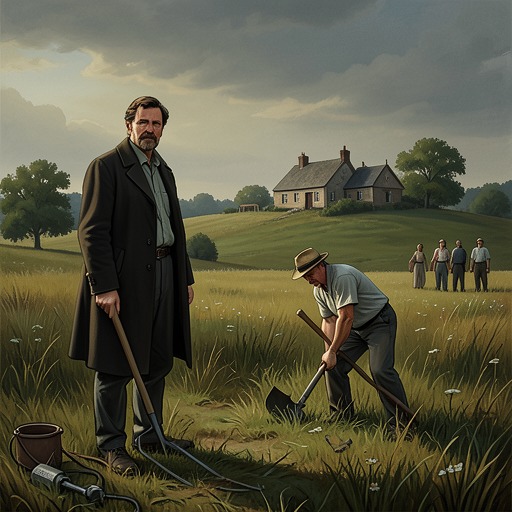
The visit to John Field’s hut tests the argument in a human encounter. The narrator tells Field from experience that he is one of his nearest neighbors and imagines that, within a month or two, Field could build himself a palace of his own. He deliberately speaks as if Field were capable of choosing a different arrangement, urging him to recognize that many things treated as necessary are not in fact needed. This is meant as an invitation to self-direction, not merely a judgment about possessions.
But the description of Field makes the difference between chosen economy and material deprivation difficult to ignore. The narrator calls him honest and hard-working, yet shiftless, and applies the same judgment to Field’s wife. He also records that Field was discontented and was wasting his life. In that account, the problem appears to be not only scarcity but the habits and expectations that keep a person’s effort from becoming a satisfying life. The narrator’s diagnosis supports his belief that a simpler arrangement could bring freedom, but it also shows how readily his own standard becomes a verdict on people living under circumstances he does not share.
His advice turns from shelter and possessions toward the use of time and the shape of family life. If Field and his family lived simply, the narrator argues, they might all go huckleberrying. The prospect matters because it imagines time spent together outside the cycle of labor and expense: simplicity would not only remove burdens, but make a different kind of activity possible. Still, the scene does not establish that Field accepts the counsel or that his circumstances change. The narrator’s proposal remains a contrast between two interpretations of a good life, not proof that poverty can be overcome by attitude alone.
Poverty, Wealth, and Self-Cultivation
In the later reflections, the narrator asks the reader to cultivate poverty like a garden herb, naming sage as his example. Poverty here is redefined as a deliberate discipline that can make a person less dependent on possessions and more able to exercise thought. He warns against seeking development so anxiously that a person spends life trying to become something, and he argues that a restricted range need not prevent inner cultivation. Even when money cannot buy books and other advantages, thought need not be surrendered.
That argument distinguishes material resources from intellectual agency, but it does not erase the real limits of poverty. The passage’s force depends on holding both ideas in view: the narrator treats reduced means as a possible source of independence, while John Field’s circumstances show the distance between choosing fewer needs and struggling to meet them. Simple living is most persuasive as an account of what a person may refuse to let govern attention; it is less secure when offered as a universal explanation of another household’s hardship.
The narrator’s conclusion is that superfluous wealth can purchase only superfluities. The claim reverses the ordinary equation between accumulation and freedom: wealth beyond need does not necessarily enlarge life, and limitation may leave space for forms of value that money cannot supply. Throughout Walden, simplicity therefore joins economy to wakefulness. It asks not only how little a person can live with, but which demands consume the time, effort, and thought that make a life genuinely one’s own.