Spring as moral renewal
WaldenSpring as moral renewal is Walden’s figure for the way a change in the natural world can alter moral perception: a brighter prospect is not merely scenery but the beginning of a renewed capacity to see and act. Thoreau connects a greener landscape with better thoughts, the forgiveness of sin, and the possibility that even a seemingly hardened person may begin another year of life. Renewal remains momentary rather than guaranteed, but its brief opening makes another way of living imaginable.
Seasonal Change and Moral Perception
A single gentle rain makes grass many shades greener; by analogy, an influx of better thoughts brightens human prospects. The comparison does not reduce nature to decoration. Rain and new growth supply a tangible pattern for a change in outlook: as the grass responds to water, people may respond to thoughts that alter how the present and their obligations appear. The passage urges living in the present and taking advantage of time, rather than treating duty as belated compensation for neglected opportunities.
Spring disrupts the assumption that the season’s moral promise lies only ahead. People loiter in winter while spring is already present. The image makes delay itself a failure of attention: renewal may have arrived before anyone recognizes it. The season thus joins perception to action. To notice spring is to discover that the opportunity for change belongs to the present, not to an indefinitely postponed future.
A Truce to Vice
In a pleasant spring morning, all people’s sins are forgiven; the day becomes a truce to vice, and while its sun shines, even the vilest sinner may return. The language is deliberately expansive, but the forgiveness described is not a legal judgment or proof that wrongdoing has vanished. It is a temporary opening in which condemnation gives way to the possibility of return. Spring changes the conditions under which a person is seen and perhaps under which that person can see himself.
The passage makes this shift reciprocal. Through their own recovered innocence, people discern the innocence of their neighbors. A neighbor known as a thief, drunkard, or sensualist may have been pitied or despised when the observer despaired of the world. On the first warm, bright spring morning, however, that same person can be encountered at serene work. The change does not erase the neighbor’s past; it revises the observer’s relation to it, replacing a fixed verdict with attention to a present act and a still-open future.
The Green Shoot in the Hardened Person
The spring scene culminates in an image of human renewal drawn directly from plant growth. The neighbor’s exhausted and debauched veins expand with joy; an expression, perhaps blind and ineffectual, resembles a new-born instinct, while the hillside echoes to no vulgar jest. From a gnarled rind, innocent shoots prepare to burst forth and try another year of life, tender and fresh as the youngest plant. The person is not declared perfected: the expression may be ineffectual and the new impulse may last only an hour. What the image grants is the possibility of renewal without pretending that change is complete or permanent.
That qualification gives the metaphor its force. Spring does not offer an abstract assurance that everyone has already been remade; it makes a fragile beginning perceptible in a person whom habit or reputation might otherwise render fixed. The emerging shoot is both an image of life and evidence of a possibility still in progress. Renewal appears not as a clean escape from history but as a fresh attempt within it.
Nature as More Than Emblem
The moral image belongs to a book that treats natural observation as experience in its own right. Walden’s scenery, Thoreau acknowledges, is on a humble scale: it is beautiful but does not approach grandeur, and its significance depends on long familiarity with the shore. Its meaning accrues through close attention rather than spectacular display. The spring passage extends this habit of attention into ethical reflection, keeping the physical arrival of rain, warmth, and growth present even as it reads them symbolically.
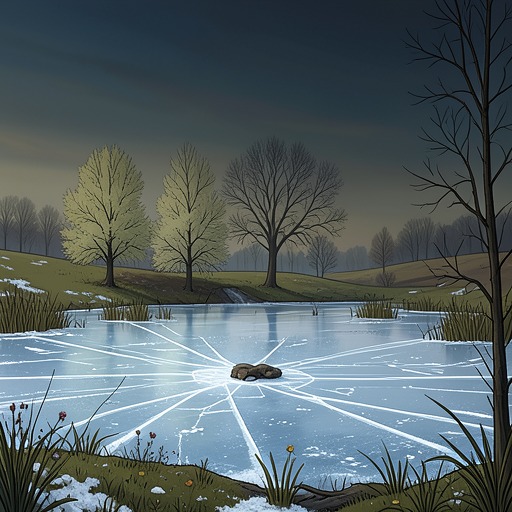
Elsewhere, Thoreau records distinct signs of seasonal change: even in midwinter he finds a warm, springlike swamp where skunk-cabbage puts forth perennial green, and a hardier bird awaits spring’s return. His observation makes renewal less like a sudden transformation than a process with early, local signs. In his account of thawing, forms of sand and clay flow down the sides of a deep railroad cut; he delights in their shapes and imagines the earth’s creative energy at work. The natural world is thus not simply a painted background for a human moral lesson: its processes have their own material forms, which the writing attends to before carrying them into analogy.
Renewal and a Changing Landscape
Spring’s promise sits within a landscape subject to human alteration. Thoreau recalls that woodchoppers have further laid waste the woods by Walden’s shores; the trunks on the bottom, an old log canoe, and the surrounding dark woods are gone. He mourns the loss of rambling through wooded aisles and glimpsing water, asking how birds can be expected to sing when their groves have been cut down. The contrast complicates any easy picture of nature as eternally available for moral consolation: a season may return, while particular habitats and remembered places are damaged or lost.
His careful survey of the long-lost bottom of Walden Pond, undertaken with compass, chain, and sounding line before the ice broke up in early 1846, reflects another mode of attention to the place. The material detail of measurement stands beside the book’s more figurative reading of seasonal change. Together, these passages place moral renewal within a landscape that is observed, remembered, altered, and sometimes mourned. Spring may disclose the possibility of beginning again, but it does not undo environmental loss or make attentive care unnecessary.
The concept’s decisive tension is therefore between renewal and recurrence. Spring offers a truce, not a permanent settlement: the warmth may last for a day, the neighbor’s new impulse for an hour, and the tender shoot must still try another year. Yet that brief interval matters because it loosens the grip of despair and fixed judgment. The world appears capable of recreation, and a person regarded as spent may be seen again as unfinished.