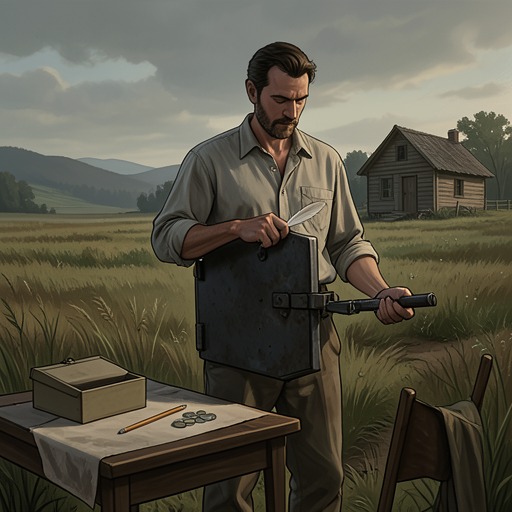
The true harvest of my daily life
WaldenThe true harvest of the narrator’s daily life is an inward, nearly intangible yield: not what can be weighed or sold, but what attentive living gathers from the world. The passage sets this harvest against ordinary measures of value and gives it images of changing light, stardust, and a rainbow fragment—fleeting perceptions that resist possession even as the narrator tries to hold them in memory.
Definition and Value
The expression names the immaterial return of a life spent observing and experiencing the world. The narrator distinguishes this return from material gain: the greatest gains and values are the ones least appreciated, and they are easily doubted or forgotten. Yet they are described as the highest reality. The paradox is central to the phrase: what matters most may be least visible, least communicable, and hardest to keep.
This valuation belongs to the book’s broader question of what a thing costs. Elsewhere, cost is measured not simply in money but in the amount of life exchanged for an object, immediately or over time. Against that calculation, the daily harvest is not a commodity bought with labor and then possessed. It is a quality of experience that accrues through attention, while remaining resistant to the market’s language of price.
The Image of an Intangible Yield
The narrator calls the harvest as intangible and indescribable as the tints of morning or evening. The comparison makes its value perceptible through its very evanescence: the colors can be seen, but cannot be stored in the way a crop or possession can. Their daily recurrence does not make them ordinary; it provides repeated occasions for noticing what is otherwise easily passed over.
The passage then shifts from light to two images of attempted capture. The harvest is a little stardust caught, and a segment of the rainbow the narrator has clutched. Both images hold together abundance and incompleteness. Stardust suggests something scattered and minute; a segment of rainbow is only a portion of a whole, and its beauty is not the kind that can be secured as an object. The narrator’s verb of clutching gives the moment a human desire to retain experience, while the images themselves insist on how partial and elusive such keeping must be.
Attention in the Landscape
The phrase gains force from the narrator’s sustained attention to particular places and natural processes. Walden’s scenery is described as beautiful but humble in scale, with a beauty that may matter most to someone who has lived by its shore or frequented it over time. This is not a claim that the landscape must impress every observer at first sight. Rather, the value grows through familiarity, the repeated act of being present to a place.
Even the shore becomes legible through close looking: a belt of smooth, rounded white stones, interrupted by one or two short sand beaches, falls steeply enough that in many places a single leap reaches the water. The exactness of such observation shows one way the harvest is made. A landscape that might be summarized as merely beautiful opens into distinctions of surface, shape, and access; attention turns scenery into lived knowledge.
That attention can also become deliberate inquiry. Early in 1846, before the ice broke up, the narrator carefully surveyed the long-lost bottom of Walden Pond with a compass, chain, and sounding line. The act joins practical measurement to a wish to recover what had not been known. In the book’s terms, observation does not have to choose between precision and wonder: the measured lake bottom and the inward value of encountering the lake belong to different but compatible kinds of harvest.
From Observation to Interpretation
Natural processes provide another form of this daily return. The thawing sand and clay along a deep cut on the railroad are observed as flowing forms, a phenomenon that gives the narrator particular delight. The notice begins in physical detail—the material shifting under thaw—but expands into an interpretation of the earth’s living power. The narrator imagines the maker of the world still at work on the bank, scattering fresh designs, and feels nearer to the globe’s vitals. The passage moves from what can be seen to what that sight makes imaginable, without making the imaginative reading identical to a scientific finding.
The same movement from surface to significance appears in the narrator’s response to water and place-names. Concord’s pond is called a gem in the town’s coronet, a figure that grants a local body of water a value no price can exhaust. By contrast, the name Flint’s Pond is treated as evidence of impoverished naming. The narrator objects to a farmer who has laid its shores bare and to a view of the place in which the pond matters only for the mud at its bottom. The complaint is not merely about words: it opposes an extractive appraisal, which asks what can be carried to market, to an attention that recognizes landscape as valuable in itself.
A Harvest Beyond Possession
The expression therefore gathers the book’s contrasts between exchange and experience, use and attention, physical labor and inward reward. A farmer’s calculation may seek to double money; a pond may be reduced to mud; a house may be assessed by its cost in life. The narrator’s harvest answers none of these measures with another price. Its evidence is instead a sequence of acts of noticing: returning to a shore, reading the forms of thawing earth, sounding a pond, collecting grape clusters for their beauty and fragrance more than their food value.
The phrase does not promise that such gains are easy to explain or permanently secured. The narrator insists that the most astonishing and real facts may never be communicated from one person to another, and that the highest values are soon forgotten. The rainbow fragment is thus both a modest possession and an emblem of the limit of possession. What the narrator can carry away is partial: a moment’s perception, the trace of attention, a little of what the world offered. That partial, elusive return is precisely what makes the daily harvest different from a material yield—and what gives it its enduring worth.