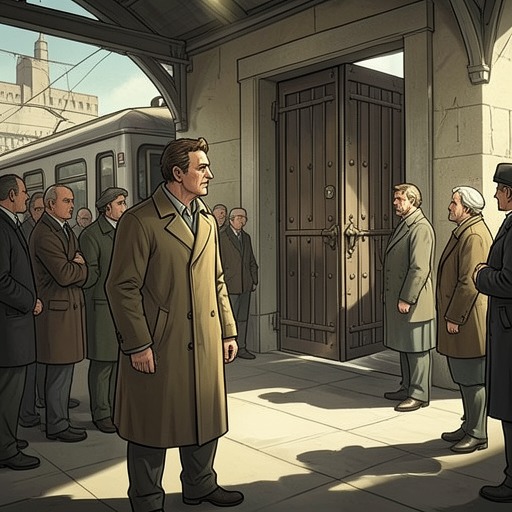
“Keep on your own track, then”
Walden“Keep on your own track, then” is Henry David Thoreau’s concise counsel for self-direction: a person should continue along an individual course even when other paths appear to offer safer or more conventional passage. In the surrounding image, invisible bolts fly toward particular points of the compass, yet do not interfere with anyone’s business; the children simply go to school by another track. The line turns this multiplicity of routes into an ethical principle, not a demand that everyone follow the same road.
The image of the track
The advice follows the narrator’s observation that people are educated to be “sons of Tell,” with the air full of invisible bolts. The allusion makes each path seem fated from the perspective of anyone choosing it: every road but one’s own belongs to someone else’s course. Yet the competing tracks do not prevent ordinary life from proceeding. Children attend school on the other track, and people are steadier for this arrangement. Individual direction and shared space are presented as compatible rather than mutually exclusive.
The sentence’s force comes from its plain imperative. It does not prescribe a detailed destination or claim that an independent choice will be easy; it tells the reader to keep to a chosen way. The trailing “then” makes the advice sound like a practical conclusion drawn from the preceding image of diverging courses, rather than an abstract maxim detached from experience.
Self-direction in practice
The narrator’s own course gives the counsel a concrete counterpart. Having to shift for himself, he turns more exclusively toward the woods, where he says he is better known, and decides to go into business at once instead of waiting to acquire the usual capital. He proceeds with the slender means already at hand. This choice embodies the line’s preference for action along one’s own route over delay while preparing to meet conventional expectations.
The book also places this independence alongside an acknowledgment of commerce’s enterprise and bravery. The image of different tracks therefore does not reduce the choice to a simple opposition between solitary life and all social activity. Rather, it leaves room for different courses to coexist while insisting that a person need not abandon his own direction merely because another route is available.
Wider social contrast
Elsewhere, the narrator measures social arrangements by the lives they produce. He considers Concord farmers who have spent twenty, thirty, or forty years toiling, and contrasts people whose outward circumstances exceed those of the savage with poor people who may have been degraded below that condition. He points to shanties along the railroads as places where the condition of the poor can be seen. These observations give the track image a sharper context: the paths available to individuals are not all equally free, and economic position shapes what a person can do.
His encounters with particular residents make that contrast local rather than merely theoretical. At the cabin he visits, John Field lives with his wife and several children; elsewhere, Cato Ingraham is identified as enslaved to Duncan Ingraham, and Brister Freeman as once enslaved to Squire Cummings. These circumstances distinguish self-direction as an ethical ideal from a claim that everyone possesses the same power to choose. The maxim offers no resolution to those inequalities, but its insistence on an individual course sits within a book attentive to labor, poverty, and coercion.
A principle of attention
The book’s recurring observations of landscape show what keeping to one’s own track can mean as a practice of attention. The scenery of Walden is beautiful on a humble scale, its appeal becoming apparent to someone who has frequented the lake or lived by its shore. Its steep shore, formed largely of smooth rounded white stones, brings that familiarity down to a physical detail. The narrator also surveys the pond’s long-lost bottom with compass, chain, and sounding line, turning sustained attention into deliberate inquiry.
That attention extends beyond the water. On a journey by a railroad cut, the narrator delights in the forms taken by thawing sand and clay as they flow down its sides; he reads the fresh patterns as designs scattered by the maker of the earth and himself. The observation moves from a visible natural process to a metaphysical interpretation, illustrating how the book’s chosen path joins careful looking with reflection. In that larger pattern, “Keep on your own track, then” is both practical advice and a description of the narrator’s method: follow experience closely, use the means at hand, and let one’s own attention determine where the road leads.