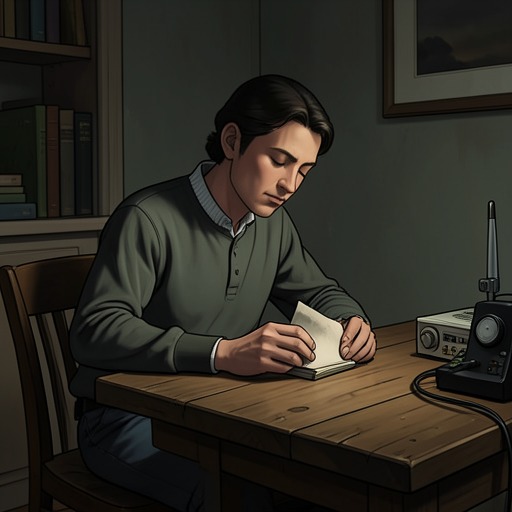
Rather than love, than money, than fame, give me truth
WaldenThe expression “Rather than love, than money, than fame, give me truth” gives a stark priority to truth over three powerful social goods. In Walden, that choice is not an abstract maxim: it follows a scene of material plenty and obsequious service in which sincerity and truth are absent, making the contrast between outward abundance and inward value the expression’s decisive force.
The Table and the Choice
The narrator places the declaration at a table laden with rich food and wine and surrounded by obsequious attendance. Yet the scene lacks sincerity and truth, and he leaves. The movement from abundance to departure gives the phrase its force: he does not reject these goods merely as possessions but refuses to treat them as substitutes for what the gathering cannot provide. Truth is named as the necessary value, not as one more luxury among the others.
The sentence’s parallel list—love, money, fame—sets intimate attachment, material wealth, and public recognition side by side, then places truth above all three. Its compact, escalating rhythm makes the preference sound less like a balanced calculation than a governing standard. The surrounding action supplies the standard with a consequence: faced with a sumptuous setting that lacks sincerity, the narrator goes away.
Truth Against External Measures
Elsewhere, the book tests the same opposition between outward condition and inward worth against the lives of people around the narrator. Considering Concord’s farmers, he observes that many have spent twenty, thirty, or forty years toiling. His account asks what such long labor yields when people devote so much of life to obtaining necessities and comforts. The expression’s rejection of money and fame belongs to this wider scrutiny of what conventional measures of success can demand and whether they answer to the value of a person’s life.
The narrator also turns toward those left beneath the apparent gains of civilization. He points to poor households in shanties along the railroads and distinguishes their hardship from that of the degraded rich. These comparisons make the preference for truth more than a private taste: the book weighs social conditions against human dignity, while resisting the assumption that visible prosperity proves a life well lived.
A Lived Test of Value
The narrator’s own experiment at Walden gives this standard a practical dimension. He turns to the woods, where he is better known, and decides to begin without waiting to acquire the usual capital, relying instead on the slender means already at hand. Later, he assesses the experiment in light of the importance of a person’s soul and of the present day, even noting that its short duration partly informs his judgment. The choice to live with limited means thus becomes evidence in an inquiry into value, not merely a declaration against wealth.
After two years’ experience, he concludes that obtaining necessary food would require remarkably little trouble, even in that latitude. The conclusion is specific and provisional: it comes from lived experience, and it challenges the presumed necessity of laboring indefinitely for comforts. The truth he prefers is therefore connected to what the experiment can show about the actual cost of living and the life consumed in acquiring its necessities.
The Book’s Moral Measure
The expression also resonates with the narrator’s account of the poor, whose circumstances complicate any easy equation between civilization and well-being. His attention to farmers’ decades of toil, railroad-side shanties, and his own deliberately modest experiment joins moral judgment to concrete conditions. In that context, truth means seeing past display and received standards to the actual relation between work, material comfort, and human life.
The book frames the Walden experience as an experiment whose two years can be described as one account, and it treats its short duration as relevant rather than disqualifying. The expression condenses that method into a rule of preference: sincerity and truth matter more than the rewards that society makes conspicuous. Its meaning is carried both by the table the narrator leaves and by the practical test of living with less.