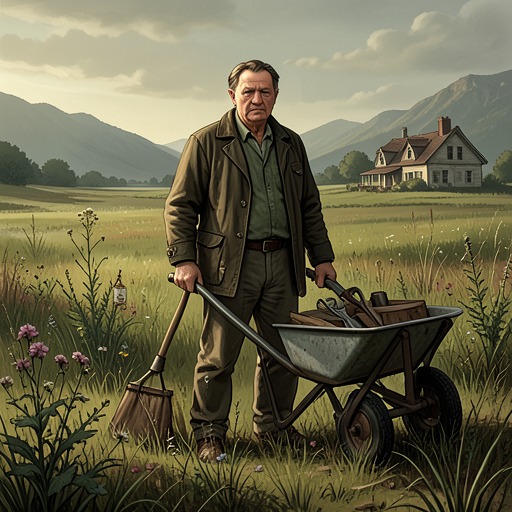
A man is rich in proportion to the number of things which he can afford to let alone
WaldenThe expression “A man is rich in proportion to the number of things which he can afford to let alone” recasts wealth as freedom from demands rather than abundance of possessions. Its clearest illustration is Thoreau’s decision to leave farms, trees, trade, and unnecessary household goods unclaimed; its social context, however, complicates that ideal by showing people whose poverty and labor are not simply matters they can choose to set aside.
The Measure of Wealth
The maxim appears as a conclusion to an episode of imagined ownership. Thoreau pictures himself deciding what fine oaks or pines should remain before a farmhouse and from which place a blasted tree might be seen to best advantage. Yet he lets the imagined estate lie fallow. Possession is not the prize: the refusal to take up the burden of owning and managing the land is itself the form of abundance.
The phrase therefore makes wealth a measure of available attention and action. To afford to let something alone is to have enough freedom not to organize one’s life around acquiring, improving, maintaining, or displaying it. Thoreau’s imagined choice turns restraint into agency: the land can be enjoyed in thought without being converted into property and labor.
A Life Kept Free of Trade
The principle has a practical counterpart in Thoreau’s account of subsistence. With shelter already secured, he considers how far he could avoid trade and barter in providing food, and says clothing and fuel would remain to be obtained. The point is not merely that fewer purchases cost less; reducing dependence on exchange also reduces the work and obligations needed to sustain a life.
His description of household possessions makes the argument tangible. Some furniture he made himself; the remainder had cost him nothing for which he had not rendered an account. The inventory includes a bed, table, desk, three chairs, and a looking-glass only three inches wide. Such details translate the maxim from an abstract definition into a domestic scale: a small number of useful things can serve a life without becoming a demand for continual accumulation.
The Social Limits of the Maxim
The surrounding discussion sets this chosen simplicity against hardship that is not freely chosen. Thoreau considers farmers in Concord who have labored for twenty, thirty, or forty years, and asks how the poor fare when some people’s circumstances rise above those of the so-called savage while others are degraded below that condition. He directs attention to the shanties bordering the railroads, where poverty appears not as a tranquil refusal of possessions but as deprivation within a society that calls itself civilized.
His portraits of local residents sharpen the contrast, though they remain filtered through his own descriptions. At Baker Farm, a trivial cabin sheltering John Field’s family becomes the setting for Thoreau’s encounter with an Irish laborer he judges honest and hard-working but shiftless. East of the bean-field, Cato Ingraham is identified as enslaved by Duncan Ingraham, who built him a house and permitted him to live there. Farther down the road, Brister Freeman is described as formerly enslaved by Squire Cummings; the apple trees Brister planted still grow on Brister’s Hill. These lives make clear that land, shelter, and labor are structured by unequal power, not simply by an individual’s preference for having less.
The maxim’s force thus depends on distinguishing voluntary restraint from imposed poverty. Thoreau can imagine declining farms and limiting possessions because the expression concerns what a person can afford to leave alone. The poor households and enslaved residents around him expose the sharper question beneath that formulation: who has the freedom to refuse acquisition or work, and who remains constrained by conditions they did not choose?