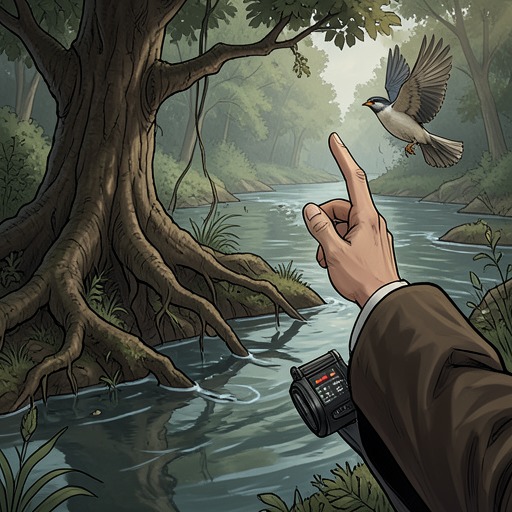
The Maker of this earth but patented a leaf
Walden“The Maker of this earth but patented a leaf” is a reflection on a hillside where thawing sand and clay flow into intricate forms. The sentence compresses a moment of natural-history observation into an image of creation: the earth’s maker seems to have devised the leaf as a design that nature repeats on a larger scale. Its force lies in the movement from something directly observed to a suggestive, unfinished question about how the world may be read.
The hillside as a natural design
The thought follows the narrator’s observation that thawing sand and clay take shape as they flow down the sides of a deep cut beside the railroad. Rather than treating the flowing earth as mere debris, he sees fresh designs scattered across the bank and feels close to the globe’s vital processes. The hillside becomes a small-scale illustration of how natural forms emerge through movement and material conditions.
That analogy is deliberately more expansive than the observation itself. The flowing sand is compared to the foliaceous mass of an animal body, and the hillside is said to illustrate the principle of all Nature’s operations. The leaf supplies the compact model: a distinctive form that seems at once particular and generative. The claim is poetic and interpretive, not a report that the hillside has been shown scientifically to reproduce every natural process.
From patent to interpretation
The word “patented” gives the image an unexpected, almost legal precision. It makes the leaf seem like a design claimed by the maker of the earth, while also connecting organic form to human systems of invention and ownership. In the surrounding passage, however, the leaf is not simply a possession or a finished artifact: it becomes a pattern that the observer encounters again in the shifting earth.
The passage then asks who will decipher the hillside’s hieroglyphic, so that people may “turn over a new leaf at last.” The question extends the image from resemblance to reading. The hillside does not deliver a complete explanation; it presents forms that invite interpretation, while leaving open who can read them and what such reading might change. The phrase’s significance therefore rests not only in its confident image of design but also in the uncertainty that follows it.
Observation, change, and loss
This attention to fleeting forms belongs to a book shaped by repeated observation of Walden’s shores, waters, woods, and seasonal changes. The narrator surveyed the pond’s lost bottom with compass, chain, and sounding line, and describes delight in the forms made by thawing sand and clay. Careful measurement and imaginative analogy coexist: observation gives the reflection its material footing, while metaphor carries it beyond what the instruments alone could establish.
The passage’s pleasure in fresh designs also contrasts with the changing landscape elsewhere in Walden. The woods around the pond have been cut down, removing the former aisles of trees, vistas of water, and trunks and canoe on the bottom. Against that documented loss, the thawing bank offers a renewing scene: earth still makes forms, even as human alterations change the setting in which they are seen. The line thus holds together attention to nature’s generative activity and awareness that particular landscapes can be diminished.
Significance
The expression captures a characteristic movement in Walden: from a specific, situated observation toward a larger reflection, without erasing the difference between what is seen and what is inferred. The hillside is not merely scenery, because its shifting material becomes an active source of thought; yet its symbolic reach does not turn it into a settled explanation of the universe. Nature appears both legible and unfinished, offering patterns that the observer can notice but not conclusively exhaust.