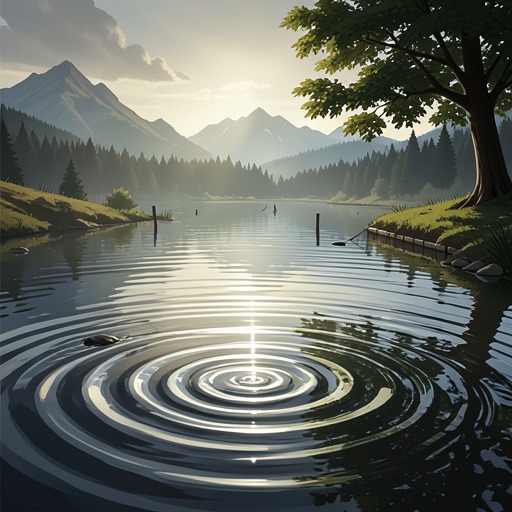
“Walden is a perfect forest mirror”
WaldenThe expression “Walden is a perfect forest mirror” describes more than the pond’s appearance: it makes Walden Pond a meeting place for sky, water, forest, and the observer’s attention. The reflection is continually renewed by what moves above it, while the changing shore and woods show that this beauty belongs to a particular landscape and can be diminished by human alteration.
The Pond as Mirror
In September or October, on a fair day, Walden appears as a forest mirror framed by stones. Its beauty depends not on grandeur but on close acquaintance: its scenery is humble in scale, and its loveliness may mean little to someone who has not frequented the pond or lived beside it. The image therefore joins visual description to a form of sustained attention. Walden becomes expressive through familiarity with its particular shore and surroundings.
The mirror is not inert. The water receives new life and motion from the air above it, and the surface carries what it receives into reflection. Elsewhere the narrator calls it “sky water”: a field that takes the spirit of the air and reflects it back. The pond’s apparent stillness is thus an exchange between elements, not a fixed picture.
Light, Surface, and Observation
The reflected scene is made vivid by small motions. An oar or an insect can produce a flash of light, and a falling oar gives back an echo. Such details bring sound and movement into an image usually understood as visual. The pond is a mirror that registers passing events, so its beauty lies partly in its capacity to respond.
Its shoreline gives that reflective surface a sharply defined edge. A belt of smooth, rounded white stones surrounds much of the water, like paving stones; only one or two short beaches are sandy. The shore is steep enough that in many places a single leap carries a person into the water. The stones are not merely a frame for the mirror: they make the pond’s boundary tangible and place the observer at the immediate threshold of its depths.
A Landscape That Changes
The mirror image also depends on the continued presence of the forest around it. Looking back after leaving the shore, the narrator notes that woodchoppers had further laid waste the woods. The rambling paths and occasional openings through which the water could be seen would no longer be available for years; with the groves cut down, he wonders how birds could be expected to sing. The loss of woodland changes not only the scenery but the conditions that made the pond a forest mirror.
That change is made concrete in what disappears: tree trunks on the bottom, an old log canoe, and the dark woods surrounding the pond are gone. The villagers, meanwhile, scarcely know where Walden lies, and their relation to it differs from the narrator’s close attention to its shore and water. The phrase thus holds an environmental contrast: the pond reflects a living landscape, but that landscape is neither timeless nor protected from human use.
The Mirror as a Record of Attention
The narrator’s careful survey of Walden’s long-lost bottom, made before the ice broke up early in 1846 with compass, chain, and sounding line, extends this attentive relation from surface to depth. The mirror metaphor does not mean that the pond is knowable by appearance alone. Its visible face invites observation, while measurement and repeated acquaintance disclose features not immediately seen.
The expression’s force lies in holding beauty and vulnerability together. Walden’s water receives light and motion from the world above, reflects the woods that enclose it, and gives the observer a way to perceive a particular place. When those woods are cut down, the image changes with them: the mirror remains, but the forest that gave it its defining character has been diminished.