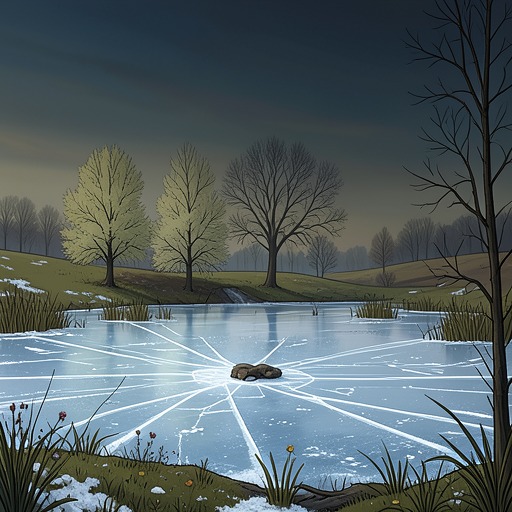
Heaven is under our feet as well as over our heads
Walden“Heaven is under our feet as well as over our heads” names a spiritual vision grounded in direct observation: the world below the surface of Walden Pond is not a barren opposite to the sky but a place of life, light, and serenity. The expression turns an opening cut through winter ice into a threshold, joining physical attention to a larger claim about where the sacred may be encountered.
The winter opening
In winter, Walden Pond appears dormant for three months or more, its surface concealed beneath snow and ice. The narrator cuts first through a foot of snow and then a foot of ice, making a window underfoot. Kneeling at this small opening, he looks down into the water rather than toward the distant sky. The downward gaze does not diminish the scene: it makes the pond’s hidden interior newly accessible.
The opening is at once practical and figurative. It lets the observer look into the water, but its window-like form also frames a world normally screened from sight. The passage moves from the plain, bodily acts of cutting and kneeling to an expansive image of heaven present on both sides of the human body. The expression’s force depends on that movement: an abstract spiritual proposition becomes legible through a particular encounter with ice, water, and light.
A living world beneath the ice
Below the opening, the water is pervaded by softened light, as though seen through ground glass. Its bright, sanded floor remains the same as in summer, while a stillness reigns there like the amber twilight sky. The scene does not treat winter as the disappearance of nature. The frozen surface hides a continuing aquatic world, whose familiar floor and inhabitants persist beneath the seasonal barrier.
The narrator describes that underwater calm as corresponding to the cool and even temperament of its inhabitants. This is an interpretive analogy, not a separate supernatural claim: the visible quiet of the water and the composed quality attributed to its fish reinforce one another in the description. By giving the submerged space the character of a quiet parlor, the passage makes it intimate without making it human. It presents a world with its own order, light, and continuity, encountered through close looking rather than imagined at a distance.
From observation to spiritual meaning
The expression gathers the scene’s two directions into one statement. Heaven is not reserved for what lies overhead; the world at one’s feet can also disclose beauty and serenity. The phrase therefore resists a division between elevated spiritual meaning and material nature. Here the claim is supported by particulars: the cut in the ice, the softened illumination, the bright sand, and the still water all make the unseen depth available to perception.
That emphasis fits the narrator’s recurring account of awakening. He calls morning the moment when he is awake and there is a dawn within him, regardless of clocks or other people’s routines; moral reform, in this account, is an effort to throw off sleep. The winter opening enacts a comparable attentiveness in space: looking through the ice makes a hidden world present. Its spiritual implication is not that observation leaves the natural scene behind, but that sustained attention can find significance within it.
Walden’s scale and the limit of the scene
The book elsewhere cautions that Walden’s scenery is beautiful but humble in scale, and that it may not much concern someone who has not frequented the pond or lived by its shore. That qualification helps explain why this expression arises from intimacy rather than grandeur. The scene’s meaning is earned through familiarity with the place and patience before its seasonal changes; it does not depend on a spectacle that would command every observer automatically.
The line thus preserves a productive tension between the ordinary and the profound. A foot of snow and a foot of ice stand between the observer and the water, yet a small opening is enough to reveal the pond’s enduring life. The closing assertion does not merely decorate the natural description with religious language. It states the insight the observation has made possible: the ground beneath one’s feet is not spiritually empty, and the world overhead does not monopolize the possibility of heaven.