Kerak Ministry of Intelligence
WatchmenThe Kerak Ministry of Intelligence is the secretive institution through which Kerak converts information into political and military power. Headed by Kor, who is technically Major Par Odal’s superior, it operates close to Chancellor Kanus and combines surveillance, clandestine planning, coercive interrogation, and technological exploitation. Its decisive significance lies in the way it seeks not merely to know its enemies but to redesign the conditions under which they can act, using the dueling machine and psychonic research to threaten Acquatainia and extend Kerak’s reach far beyond conventional warfare.
Leadership and Institutional Character
Kor is the Ministry’s quiet head of Intelligence and the formal superior of Major Par Odal. In the political room where Chancellor Kanus discusses rearmament and expansion, Kor sits apart from the other officials, saying little but making his few words carry an atmosphere of terror. His capacity for cruelty is described as unfathomed, and his authority rests less on public rhetoric than on secrecy, calculation, and the ability to determine who becomes a target.
The Ministry functions within the dictatorship under Chancellor Kanus, but it is not simply an administrative office carrying out openly stated policy. Kor keeps major plans to himself, sharing them only with Kanus until disclosure becomes necessary. This hierarchy makes secrecy itself a form of command: even Major Par Odal, the Ministry’s operative, is denied the full design behind his missions. Personal motives are explicitly subordinated to institutional objectives. When Major Par Odal wants another encounter with the Star Watch operative to correct an earlier failure, Kor dismisses that desire and identifies Dr. Leoh as the real target because the scientist has disrupted Kerak’s primary plan against Acquatainia.
Intelligence, Surveillance, and Covert Action
The Ministry’s work is conducted through hidden observation and controlled spaces. After Major Par Odal’s return, he remains inside the Kerak embassy, while an inquisitor stands ready beside the dueling machine to administer another session. The procedure is clinical and impersonal: the meditech fits neurocontacts to Major Par Odal’s head and torso, then leaves him enclosed in the machine while a sergeant guards the doorway. Intelligence gathering therefore operates through both human agents and technical apparatus, placing the body under examination while concealing the larger purpose of the investigation.
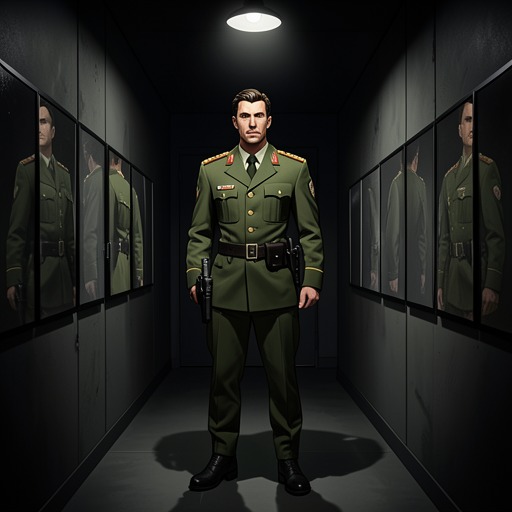
The Ministry also turns its facilities into environments of uncertainty. Major Hector H. Hector, pursuing Major Par Odal through a corridor, enters a dark room filled with life-sized tri-di viewscreens, control desks, and monitoring equipment. He understands that it may be a tape-viewing or editing room, but the uncertainty is part of the danger: the room is built for watching, recording, and manipulating appearances, yet it offers no visible watcher. When the door closes and darkness takes over, surveillance becomes an unseen presence. Later, in the dueling-machine chamber, apparently inactive scanning cameras line the corridors, and empty guard stations and blank viewscreens make the castle seem deserted even though the facility is controlled and defended.
The Ministry’s coercive power becomes explicit when Major Hector H. Hector is captured. After a stun bolt knocks him against the control desk, Kor orders the arrest of every traitor who helped him and commands that resisters be killed. Major Hector H. Hector wakes confined in a small, unlit, metal-walled cubicle, immobilized by equipment strapped to his head and chest. The voices around him question whether he has any thoughts at all, reducing him from an autonomous person to a subject whose mind must be extracted. The sequence reveals an intelligence service in which interrogation, bodily restraint, and the search for usable mental information are inseparable.
The Dueling Machine as State Technology
The Ministry’s central technological interest is the dueling machine. Dr. Leoh describes it publicly as a psychonic device that lets two men share a dream world without physical or mental injury, and notes that the Acquatainian government tested and approved it more than three years earlier. In its stated civilian function, the machine provides an outlet for aggression: opponents can fight inside a jointly created dream while remaining physically safe. That promise of containment is precisely what makes its appropriation by the Ministry so threatening.
The machine’s operation is progressively reinterpreted through experimentation. Dr. Leoh and Major Hector H. Hector begin with hide-and-seek exercises in jungles, cities, glaciers, and interplanetary voids, never leaving their booths. They then conduct controlled duels with foils, pistols, sonic beams, and grenades, using imagined protective equipment. The machine does not increase knowledge or physical ability; it projects each participant’s existing capacities into a shared dream. Yet Dr. Leoh repeatedly defeats Major Hector H. Hector despite the latter’s superior training and faster reflexes, leading Dr. Leoh to recognize that the machine projects personality as well as thought.
The Ministry’s scientists see a military application in that discovery. Kor tells Chancellor Kanus that they may be able to use a telepath such as Major Par Odal together with the dueling machine to transport objects almost instantaneously across any distance. The possibility immediately raises the prospect of transporting entire armies. A device initially presented as harmless psychological relief thus becomes the foundation of a strategic weapon: it could bypass ordinary distance, borders, logistics, and defenses.
The technology’s danger is not treated as an inherent property of machinery alone. Its meaning changes according to its users and institutional setting. Dr. Leoh adds circuits that isolate duelists from the outside world and allow the chief meditech to review a complete recording if either participant claims that rules were broken. These safeguards attempt to restore the machine’s original promise of controlled, nonlethal conflict. The Ministry, by contrast, surrounds the apparatus with guards, inquisitors, hidden monitoring equipment, and secret experiments, transforming a shared dream-space into an instrument for intelligence and strategic power.
Conflict with Dr. Leoh and Major Hector H. Hector
The Ministry identifies Dr. Leoh as a more consequential enemy than Major Par Odal’s personal rival. Kor calls Major Par Odal a bungling fool who nevertheless succeeded in destroying Kerak’s primary plan against Acquatainia, and attributes that failure to Dr. Leoh’s intervention. The statement changes the apparent scale of the conflict: the duels are not isolated contests but episodes in a wider struggle over the political and military future of Acquatainia.
Dr. Leoh responds by studying the machine rather than accepting its official limits. He and Major Hector H. Hector work twelve or more hours a day, driving themselves and the regular machine staff toward exhaustion. Their experiments reveal the machine’s fidelity, its dependence on the participants’ actual skills, and its capacity to project personality. When Major Hector H. Hector learns to teleport himself from one booth to another, he makes the jump repeatedly while Dr. Leoh measures transit time and power consumption. The average transit takes four picoseconds and consumes energy approximately equal to that of a starship’s drive engines propelling a mass equal to Major Hector H. Hector’s weight.
The Ministry’s pursuit of the breakthrough gives these experiments immediate political stakes. Major Hector H. Hector eventually reaches the Kerak dueling-machine chamber, where he finds the facility apparently empty and begins setting the machine’s power. The sudden activation of the lights and his capture show that the Ministry has anticipated intrusion or retained control of the site even when its personnel are not visible. The encounter turns scientific research into a struggle over access: whoever controls the machine controls not only a laboratory device but a possible means of instantaneous transport.
Political and Narrative Significance
The Kerak Ministry of Intelligence embodies the fusion of military rearmament, political conspiracy, and scientific research under Chancellor Kanus. Kor’s concern with Acquatainia’s unstable government shows that the Ministry’s strategy includes political penetration as well as weapon development. Its agents seek favorable positions inside the Acquatainian government while scientists work toward a technology that could make conventional defense irrelevant. Intelligence, diplomacy, and engineering are therefore parts of one expansionist design.
At the same time, the Ministry’s methods expose the limits of secret power. Its plans depend on controlling information so completely that even its own operatives receive only fragments. It relies on surveillance systems that can be bypassed or appear inactive, on facilities whose emptiness conceals imminent violence, and on a machine whose safeguards can be repurposed by those willing to place bodies and minds under institutional control. The organization’s menace comes from this combination of invisibility and technical ambition: it can observe without being seen, imprison without public process, and imagine warfare in forms that erase ordinary distance.
The Ministry consequently gives the dueling machine its darkest political meaning. What began as a device for settling aggressive feelings without harm becomes, in the Ministry’s hands, a possible weapon for transporting objects or armies and a platform for extracting thoughts from captives. Its history demonstrates that technological safety cannot be separated from the institutions that authorize use. Through Kor, Major Par Odal, the concealed interrogations, and the attempted capture of Major Hector H. Hector, the Kerak Ministry of Intelligence stands for a state that treats minds, recordings, bodies, and physical space as resources to be monitored, reorganized, and weaponized.