Imperial Marines
WatchmenThe Imperial Marines are the Terran Empire’s subsidiary branch for planetary warfare, complementing the Star Watch’s control of interstellar space routes. Their decisive narrative significance lies in the gap between military occupation and political authority: on Oran VI and Shinar, the Marines are repeatedly ordered to restore order, yet their campaigns become entangled with local rebellion, Komani intervention, contested legal customs, and the question of whether imperial security can be built without destroying the population it claims to govern.
Organization and Imperial Function
The Imperial Marines belong to the military structure that governs the postwar galaxy. The Star Watch had fought the successful war against the Masters and helped turn the Terran Confederation into the dominant power over much of the galaxy; after the Empire was created to administer that vast territory, the Star Watch took responsibility for interstellar space routes while the Imperial Marines handled fighting on planetary surfaces. Their role is therefore both military and administrative: they are the instrument through which imperial decisions become immediate force on a world.
That division of labor explains why a Star Watch order sending Emil Vorgens to Oran VI carried implications beyond its literal wording. The assignment was nominally to assist the Imperial Governor in dealing with “certain dissident elements of the native population,” but the presence of a Star Watch officer suggested that the Empire was considering a broader military intervention. The later coded order made the escalation explicit: the governor had been murdered, and Vorgens was instructed to assist Brigadier Aikens of the 305th Imperial Marines in restoring order.
Operations on Oran VI
The Marines landed on Oran VI while the planet was already in turmoil. They controlled the four major cities and the spaceport, establishing a substantial imperial foothold, but the countryside remained outside their control. Komani raiders were shooting through rural districts, and native rebels had joined them. Brigadier Aikens therefore sent the Mobile Force to hunt the raiders, turning what had initially been framed as a limited demonstration of imperial authority into a mobile counterinsurgency operation.
The campaign quickly revealed the weakness of a force that could occupy fixed centers but could not compel the countryside to submit. For nearly three weeks, Aikens’s Mobile Force tried to pin down the Komani. The raiders, armed with modern weapons and using effective tactics, repeatedly maneuvered the Marines into disadvantageous positions before trapping them in a valley. Aikens described the force as surrounded and facing Komani fighters who appeared eager to begin a full-scale battle. The Marines thus possessed formal authority and control of strategic sites, but the initiative belonged to their opponents.
Vorgens was not sent merely to reinforce the military operation. His orders required him to contact the Komani leader, warn him of the consequences of fighting the Empire, and offer the raiders safe conduct home if they immediately ceased their attacks on Oran VI. He was also to invoke the allegiance that Komani clan chieftains had sworn to the Empire, the promise that the wider Komani nation would not assist the raiders, and the older alliance between the Komani and the Terrans during the Galactic War. The Marines’ mission therefore combined coercion with diplomacy, but the diplomatic language remained backed by the threat of imperial force.
Conflict with Local Resistance
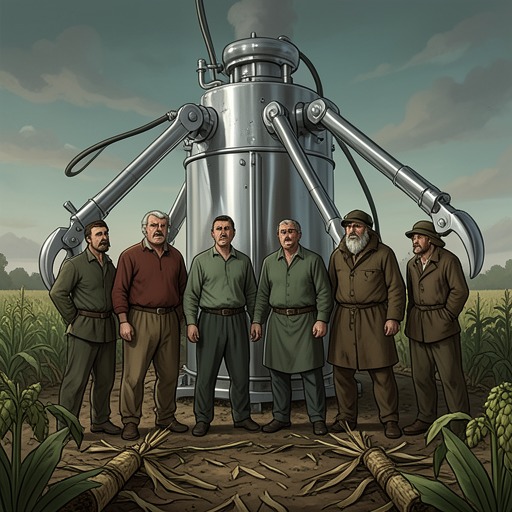
The Marines’ presence on Shinar emerged from a similar chain of escalation. Clanthas organized farmers and demonstrations in Katan and other major cities. Some demonstrations became riots; troops were called in, shots were fired, and unarmed civilians were killed. The resulting violence intensified the resistance, and the Terran governor was murdered. The Imperial Marines then arrived, while Komani warriors landed on the planet, transforming a political crisis into a three-sided conflict involving imperial troops, Shinarian rebels, and an external raiding force.
The rebellion’s logic was explicitly connected to the Marines’ method of rule. Merdon explained that Shinarians had first attempted resistance through words, protests, and street demonstrations, but that the Terran response had been force. The rebels therefore answered force with force, intending to continue fighting until the Terrans no longer considered Shinar worth the cost and left the planet in freedom. In this account, the Marines are not simply reacting to disorder; their suppression of public resistance helps produce the armed struggle they are then ordered to defeat.
The imperial military also confronted competing sources of legitimacy. The Komani claimed their own authority over prisoners, while Sittas, acting as a religious and local authority, rejected that claim when a Komani officer asserted that Terrans sheltering in his location belonged to Okatar Kang as prisoners. Sittas’s refusal shows that Marine operations took place within a dense field of overlapping rules: imperial orders, Komani custom, local sanctuary, religious protection, and military necessity could all be invoked at once. Vorgens later acknowledged that his emergency exercise of authority might have to be judged by a Star Watch court, revealing that even imperial officers operated under contested jurisdiction rather than possessing unlimited power.
From Pacification to Shinarian Self-Defense
The Marines’ most important development is their gradual movement away from treating Shinar as a population to be pacified. Vorgens proposed a system of Shinarian self-defense directed and supported by the Terrans, and he ordered Aikens to contact the commanders of the four occupied cities and take weapons and other stocks from their arsenals to arm the natives. Aikens accepted the order only under protest, but Vorgens insisted that it be carried out immediately. The change was operational as well as political: imperial resources would no longer be used only to suppress the population; some of those resources would be transferred to it so that Shinarians could defend their own communities.
This strategy placed the Marines in a contradictory position. They remained the force occupying the cities and supplying the weapons, yet their success increasingly depended on local trust and initiative. Vorgens argued that the Shinarians were trusting the Terrans and that the Terrans would consequently have to trust them. The Marines were thus recast from the sole agents of order into trainers, suppliers, and guarantors of a defense network whose immediate participants were local people.
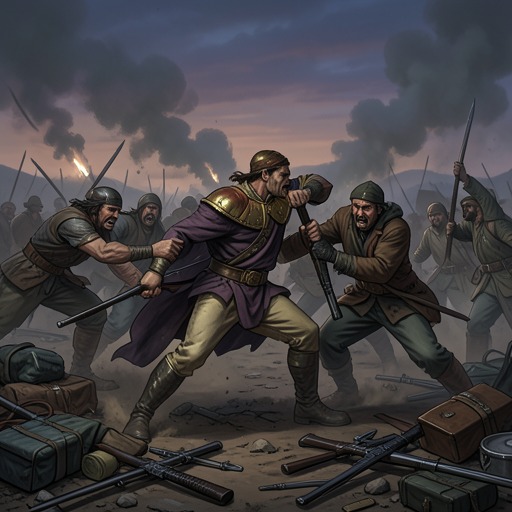
The contrast became clearest after the celebration at Katan. Six weeks of virtually uninterrupted fighting spread across Shinar. Okatar Kang pursued a policy of sacking the planet, raiding every district and town and systematically taking whatever food, weapons, equipment, and ammunition he wanted. Against this stood Vorgens’s concept of Shinarian self-defense, supported and organized by the Terrans. The resulting war was not a sequence of conventional set-piece battles: it consisted of skirmishes, maneuvering, feints, sudden attacks, and ambushes, with few individual actions involving more than a battalion. The Marines’ role therefore shifted toward sustaining a dispersed, asymmetric defense rather than winning a single decisive engagement through concentrated force.
Narrative Significance
The Imperial Marines embody the Empire’s assumption that planetary disorder can be solved by deploying disciplined force. Their control of Oran VI’s cities and spaceport demonstrates the practical power of that assumption, while their inability to secure the countryside demonstrates its limits. On Shinar, the murder of the governor and the arrival of Komani warriors show how quickly coercive administration can become a wider war involving civilians, rebels, raiders, and rival legal authorities.
At the same time, the Marines are not presented as a static instrument. Their operations become part of a larger argument about governance. Direct suppression produces resistance; negotiation can create a temporary opening; and the transfer of weapons to local communities offers a different relationship between imperial power and subject populations. The organization’s significance therefore lies in its unresolved duality: it is the Empire’s planetary fist, but the narrative suggests that the fist can preserve order only when it learns to support forms of local agency rather than replace them.