Star Watch
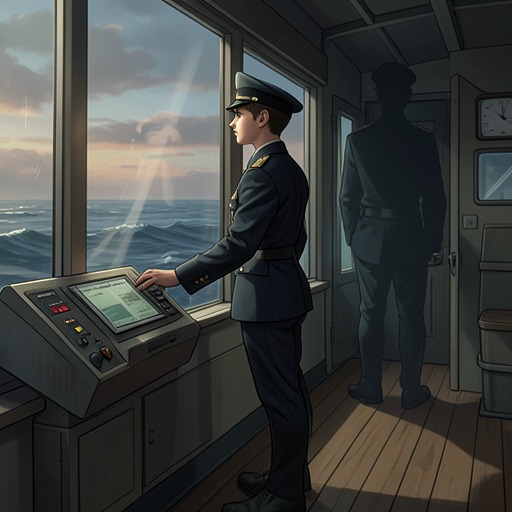
WatchmenThe Star Watch is the Terran Empire’s interstellar military arm and one of the principal institutions through which imperial power reaches across the galaxy. Its bases extend throughout the Empire’s territory, while its headquarters occupies the planet Mars, a world covered from pole to pole with the buildings, personnel, and machinery needed to administer the organization. The Star Watch is therefore both a fighting force and an immense communications, intelligence, and command network: its master files, computers, orders, officers, and courts convert distant political decisions into immediate action on contested worlds.
Origins and Imperial Function
The Star Watch predates the Terran Empire. It existed during the earlier Confederation, more than a century before the period of the novel, and fought the successful war against the Masters. That victory transformed the Terran Confederation, almost against its own will, into the dominant power over much of the galaxy. The political problem created by that expansion was solved through the establishment of the Empire, but the Star Watch remained the institution that had secured the new order.
Under imperial rule, the Star Watch is chiefly responsible for controlling the interstellar space routes. Its reach is consequently broader than that of a planetary army: it maintains bases across distant regions and sends officers wherever imperial communications, security, or political authority require intervention. Planetary fighting is assigned to the Imperial Marines, a subsidiary branch that handles combat on the surface of worlds. This division gives the Empire a layered military structure, with the Star Watch coordinating the wider strategic system and the Imperial Marines conducting local ground operations.
The organization’s orders are often deliberately indirect. A Star Watch instruction can appear simple while leaving its practical meaning unstated, requiring the assigned officer to interpret incomplete information in circumstances that headquarters could not foresee. On Oran VI, for example, an officer is ordered to assist the Imperial Governor in dealing with dissident natives. The apparent administrative language conceals a crisis involving warfare, negotiation, imperial legitimacy, and the danger that a local conflict may spread beyond the immediate battlefield.
Command, Orders, and Authority
The Star Watch’s bureaucratic scale is visible in its headquarters procedures. A chief-of-staff can demand the complete file on Oran VI from a noncommissioned officer, who immediately retrieves the information from the organization’s mammoth master computer. Information is thus treated as a military resource: distant events are collected, classified, and placed within a chain of command that can redirect personnel across interstellar space.
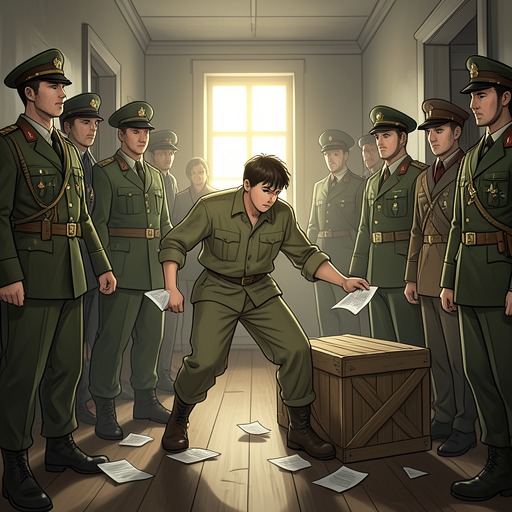
The organization’s authority is not merely advisory. When Brigadier Aikens continues to direct the Mobile Force according to his own battlefield judgment, Emil Vorgens formally relieves him of duty and assumes command. The transfer is abrupt and personally humiliating for Aikens, but it demonstrates that Star Watch rank can override a local commander’s authority when an officer believes the existing command has become incompatible with his orders or responsibilities. At the same time, the action exposes the tension between written procedure and emergency discretion: Vorgens acknowledges that whether he had the right to take such authority into his own hands will eventually be decided by a Star Watch court.
That prospective court matters because the Star Watch presents itself as a legal as well as military institution. Its officers may act decisively in the field, but their decisions remain subject to later institutional judgment. Authority is therefore divided between immediate command and retrospective accountability. The organization’s strength lies in this capacity to mobilize obedience across distance; its vulnerability lies in the fact that every crisis forces individuals to decide how far obedience and interpretation may go.
Local Conflict and Competing Laws
The Star Watch’s operations repeatedly place imperial law beside local customs and political claims. In the Oran VI campaign, its officer is instructed to negotiate with the chief of the Komani raiders. The proposed message invokes several layers of imperial reasoning: the raiders may return peacefully to their homeworld if they stop attacking Oran VI; Komani clan chieftains have pledged loyalty to the Empire; and the Komani were once allies of the Terrans during the Galactic War. The negotiation therefore relies not only on force but also on treaty obligations, historical memory, and the claim that an attack on imperial territory violates an established friendship.
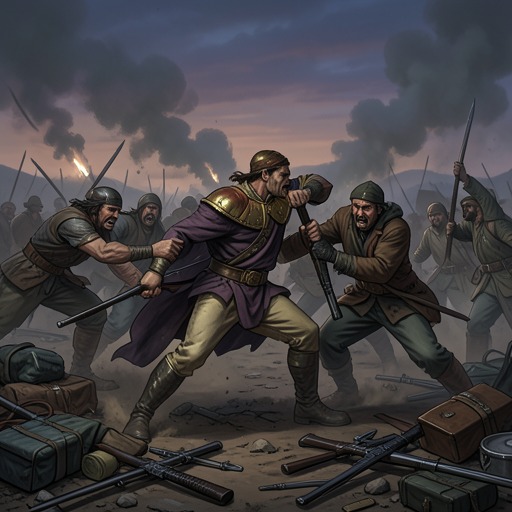
The same conflict reveals the limits of that imperial framework. Commander Aikens wants airpower and reinforcements from the city garrisons so that the Komani can be pinned between two forces and crushed. He expects the raiders to retreat into the hills once they begin taking losses, while the besieged Mobile Force faces an attritional struggle over food and water. Vorgens, however, is sent with orders that prioritize contact and negotiation. The Star Watch consequently becomes the institutional site where military expediency and political instruction collide.
The organization’s authority also confronts Komani custom. Okatar Kang declares that Vorgens, as a prisoner who attempted to escape, should traditionally be executed. Later, a Komani officer claims, in Okatar Kang’s name, that Terrans sheltered in a particular location are prisoners. In response, Sittas invokes the authority of the Star Watch, asserting that he had acted with powers whose legality would be settled by a Star Watch court. These confrontations show that the Star Watch does not operate in a legal vacuum: imperial military jurisdiction, Komani prisoner-execution custom, local protection, and religious or communal sanctuary compete to define who may command a person’s fate.
Technology and Institutional Reach
The Star Watch’s power is inseparable from the technical systems surrounding it. Its headquarters depends on master computers and interstellar communications, while its officers carry orders encoded on tiny films and consult information transmitted through the organization’s command network. The institution’s authority is made materially present through records, screens, communicators, weapons, vehicles, and the machinery that permits commands to travel faster than ordinary human contact.
The novel also places Star Watch personnel in relation to the dueling machine, a technology that can project and amplify thought patterns without physically injuring the participants. During experiments involving Dr. Leoh and Hector H. Hector, the machine reproduces environments ranging from jungles and cities to glaciers and interplanetary voids, while matching the participants’ knowledge and abilities within a shared mental experience. The experiments reveal that it projects personality as well as thought. This discovery has implications for military authority because it shifts conflict from ordinary weapons and bodily strength toward character, intention, and mental structure.
After Major Odal has used the machine to kill people, Dr. Leoh redesigns it to prevent further contact with the outside world during operation and to monitor every duel for later review by the chief meditech. The revised system creates a technological counterpart to Star Watch accountability: isolation limits unauthorized intervention, while recorded monitoring allows possible rule violations to be examined. The machine therefore does not simply add power to the story’s institutions; it redistributes responsibility among scientists, operators, medical personnel, combatants, and the systems that record their conduct.
The connection between military organization and experimental technology becomes still more consequential when Hector begins teleporting from one booth of the dueling machine to another. He makes the jump repeatedly while Dr. Leoh measures transit time and power consumption. The transfer takes an average of four picoseconds and consumes energy approximately equal to that required by a starship’s drive engines to propel a mass equal to Hector’s weight. Such experiments suggest that capabilities first studied within controlled technological environments may eventually alter the meaning of distance, confinement, escape, and military deployment—the very conditions on which an organization such as the Star Watch depends.
Ideological and Narrative Significance
The Star Watch embodies the Empire’s central justification: a unified authority is presented as necessary to prevent the chaos and starvation that might follow the collapse of imperial rule. Emil Vorgens refuses an invitation to join the Shinarian rebellion because he is a sworn Star Watch officer and cannot turn against the people with whom he has served. He also argues that, whatever wrongs the Empire has committed on Shinar, destroying the imperial structure would endanger the peoples it governs. His position makes the Star Watch more than an employer or military hierarchy; it is the institutional form of a political belief in order maintained across immense distances.
Yet the same institution supplies the novel’s strongest test of that belief. Its orders can be morally ambiguous, its commanders can disagree over whether negotiation or annihilation is the proper response, and its officers may have to act beyond clearly stated authority. The Star Watch’s power to protect can become the power to impose, while local groups experience imperial administration as military occupation or cultural interference. Its claim to lawful order is genuine, but it is continually strained by the gap between headquarters and frontier, between universal imperial rules and local customs, and between obedience and conscience.
For that reason, the Star Watch functions as a boundary organization: it joins the Empire to its distant worlds, military force to bureaucracy, historical memory to present command, and human judgment to machines. Its officers do not merely carry out policy. They interpret incomplete orders, negotiate with enemies, override commanders, answer to courts, and confront technologies that can transform the battlefield itself. The organization’s decisive significance lies in this double character. It is the mechanism that holds the Empire together, and it is also the structure through which the costs and contradictions of that unity become visible.