Psychonics, Incorporated
WatchmenPsychonics, Incorporated is the private enterprise founded by Dr. Leoh to manufacture, sell, install, and maintain the dueling machine. The company gives institutional form to Leoh’s attempt to turn a powerful psychological technology into a controlled social instrument: instead of allowing disputes to become physical violence or protracted legal conflict, the machine lets people act out aggression within an artificial environment while remaining physically unharmed. Its importance lies in the tension between that promise of civilized release and the risks created when an invention capable of amplifying thought is placed inside political, military, and legal systems.
Formation and Purpose
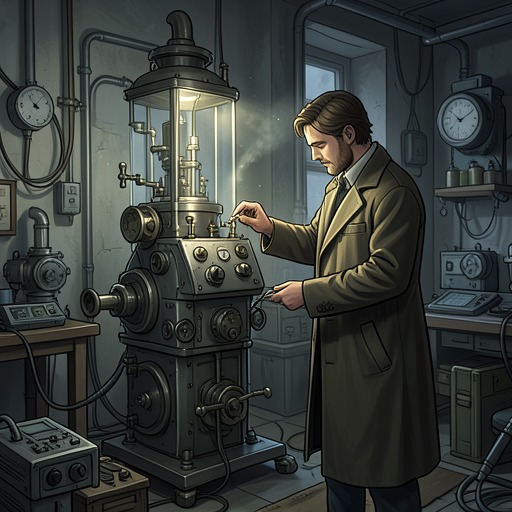
Psychonics, Incorporated emerged from Dr. Leoh’s decision to leave physics and electronics for psychology after recognizing that his scientific work had contributed to widening social tensions. He entered the new profession as a beginner, became a student and researcher, and eventually a professor of psychophysiology. From that change in discipline came the dueling machine, which combined an electroencephalograph with an autocomputer and amplified a person’s imagination into a shared world.
Leoh conceived the machine as a means of removing hostility and tension safely. Psychiatrists and psychotechnicians could use it in treatment, but Leoh pursued a broader application: preventing psychological tensions and disorders before they became destructive. In his model, two people with a sufficiently serious disagreement could enter the machine rather than rely exclusively on the courts. They could fight as violently as their imaginations permitted without injuring themselves or anyone else, and on most civilized worlds a properly monitored duel was accepted as legally binding.
The invention’s social usefulness also made it dangerous. Leoh regarded the machine as too powerful for indiscriminate use, so he established Psychonics, Incorporated as a private safeguard rather than releasing the technology without institutional control. He secured an exclusive license from the Terran Commonwealth, giving the company authority over the machine’s manufacture, sale, installation, and maintenance. Its customers were government health agencies and legal agencies, making the company a direct link between experimental science and public administration.
Institutional Responsibilities and Political Pressure
Psychonics, Incorporated was created partly to separate Leoh’s commercial activities from the university. When the president worried that the crisis surrounding the machine might reflect on the university, Leoh explained that he had formed Psychonics as a separate business enterprise. He treated financial gain as secondary to the company’s practical purpose, although the existence of a commercial organization inevitably placed his invention within systems of licensing, ownership, and governmental accountability.
Leoh understood the company’s obligations on several levels. It was legally responsible to the Terran Commonwealth, morally responsible to humanity, and personally answerable to Leoh’s own conscience. That threefold structure defines the company’s position in the narrative. Psychonics is not merely a manufacturer, because its product mediates disputes and affects public safety; nor is it simply a research laboratory, because its licensed machines operate within courts, hospitals, and government programs.
The company also becomes entangled with the Acquatainian authorities. When the Acquatainians sought discussions with Leoh, their interest reflected the machine’s wider political importance rather than an ordinary commercial inquiry. The Acquatainian staff subsequently entered the testing project and provided invaluable assistance in monitoring and analyzing the experimental duels. Psychonics therefore functions as a technical institution whose work cannot remain private once its invention begins to influence intergovernmental relations.
Testing the Dueling Machine
Psychonics’ staff helped support intensive trials involving Leoh and Hector. Their first exercises were deliberately nonviolent games of pursuit: one man selected an environment and the other attempted to find him. Although neither left the machine’s booths, they moved through imagined jungles, cities, glaciers, and interplanetary voids. These tests examined whether the system could reproduce and amplify thought patterns with strict fidelity.
After Leoh became satisfied with the machine’s accuracy, the trials developed into light duels. He and Hector fenced with blunted foils, then experimented with pistols, sonic beams, and grenades while imagining themselves protected by suitable equipment. The machine did not supply knowledge or physical ability that a participant lacked; it projected existing skills and knowledge into a shared dream. Hector had superior training and faster reflexes, yet Leoh won most of their encounters when they faced one another directly. Leoh concluded that the machine projected personality as well as thoughts, making Psychonics’ invention an instrument for exposing character through action rather than merely reproducing technical competence.
The work placed heavy demands on both the organization and its personnel. Leoh and Hector spent twelve or more hours a day inside the booths, became physically ragged and sharp-tempered, and often fell asleep in Leoh’s office while discussing the day’s results. The regular machine staff were driven nearly to exhaustion as well. Psychonics’ research thus depended not only on circuitry and measurement but also on sustained human labor, disciplined observation, and the willingness to test the psychological consequences of the device on its own investigators.
Safety Controls and Later Development
The company’s need for safeguards becomes explicit after Major Odal had used the machine to kill people, disproving the earlier assumption that the apparatus could never cause lethal harm. In response, Leoh added three new circuits. The first psychonically isolated the duelists inside the machine, making it impossible for Odal or anyone else to contact the outside world while a duel was in operation.
The second circuit monitored the entire duel. If either participant requested an investigation, the machine’s chief meditech could review the recording and determine whether rules had been broken. This provision introduced a form of technical oversight into the duel itself: the machine did not merely stage the encounter but preserved evidence by which foul play could be judged. The safeguards show Psychonics adapting its organization and product in response to failure, while also acknowledging that legal recognition requires verifiable procedures rather than trust in the participants alone.
Psychonics later became connected with experiments in Hector’s teleportation ability. After Hector and Leoh resumed their work, Hector first teleported himself from one booth of the dueling machine to another. He repeated the jump twelve times on the first day while Leoh measured transit time and power consumption. The average transit lasted four picoseconds, and the energy drain was approximately equal to that of a starship’s drive engines pushing a mass equal to Hector’s weight. Through this work, the company’s machinery became not only a controlled setting for psychological dueling but also the measuring environment for a radically new form of movement.
Narrative Significance
Psychonics, Incorporated embodies Dr. Leoh’s effort to make scientific responsibility concrete. The company’s machines promise to transform aggression into ritual, bounded imagination, and legally supervised release, yet the history of Major Odal demonstrates how quickly the boundary between harmless simulation and real-world danger can fail. The organization’s existence is therefore both an ethical response and an admission of risk.
Its structure also distributes agency across a network of people and devices. Leoh supplies scientific vision and conscience; government agencies supply authority and institutional demand; Acquatainian personnel contribute monitoring and analysis; the chief meditech provides adjudication; and the machine itself determines what thoughts, personalities, rules, records, and bodily limits can enter the encounter. Psychonics is significant because it makes technology an active participant in social order. The company does not simply sell a device: it establishes the procedures through which private hostility can become public evidence, legal settlement, psychological treatment, or—when safeguards fail—a political and human catastrophe.