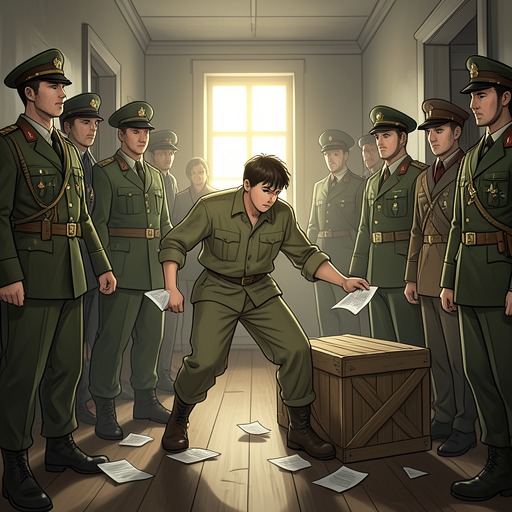
Star Watch Academy
WatchmenStar Watch Academy is the professional training institution behind the Star Watch’s officers. Its importance lies less in any single campus scene than in the habits and credentials its graduates carry into the wider imperial order: Emil Vorgens leaves it as a commissioned officer expected to interpret politically dangerous orders, while Hector H. Hector brings from it the combat training that later makes him useful in an experimental struggle conducted through the dueling machine.
Training and Professional Formation
Star Watch Academy gives its students a formal route into service. When Emil Vorgens first receives his commission, he has spent four years at the Academy, the regulation period, before beginning his active career. His training is therefore presented as a transition from institutional preparation to operational responsibility: school is finished, his commission is secured in his travel kit, and his first official orders send him to Oran VI to assist the Imperial Governor with dissident elements of the native population.
The Academy’s authority is visible in Vorgens’s sense of obligation. Although he is not a native Terran and acknowledges that his people once fought against the Terrans, he identifies himself as a citizen of the Empire and a sworn Star Watch officer. That oath prevents him from joining Merdon’s rebellion against imperial rule. His refusal shows that the Academy does not merely provide technical instruction; it helps produce an officer whose personal identity has been bound to service, duty, and the continuity of imperial institutions.
Hector’s experience reveals a different side of the same formation. He has also completed the Academy’s four-year course and was trained to fight, even though he is uncertain about his mechanical aptitude. Dr. Leoh therefore reassures him that mechanical expertise is unnecessary for their immediate task: the work can be done mentally, using the fighter’s training rather than conventional engineering ability. The Academy’s curriculum thus becomes unexpectedly transferable. Skills acquired for armed service are redirected into the mental contests used to test the dueling machine.
Graduates in Imperial Crisis
The Academy’s graduates enter an institution whose orders are not always self-explanatory in practice. When Brigadier Aikens asks Vorgens how he interprets orders issued by Star Watch Headquarters, the young officer initially sees little room for interpretation. Aikens’s question exposes the gap between centralized paperwork and conditions in the field, where imperial commands must be applied amid rebellion, Komani intervention, military encirclement, and competing definitions of order.
Vorgens’s response to that gap is not passive obedience. He eventually relieves Aikens of duty and assumes command of the Mobile Force. The act places a junior officer, shaped by the Academy but no longer sheltered by it, in direct conflict with a brigadier’s authority. His institutional training is tested by the need to make immediate judgments: he orders Aikens to contact the garrisons in the four cities held by the force and to release stocks from their arsenals for the native population, insisting that the order be carried out even under protest.
That decision contrasts sharply with the coercive imperial response that helped create the Shinarian rebellion. In Shinar, demonstrations organized by Clanthas turn into riots; troops are called in, shots are fired, unarmed civilians are killed, the Terran governor is murdered, and the Imperial Marines arrive as Komani warriors land on the planet. The Academy itself is not shown directing these events, but its graduates are placed inside the system responsible for responding to them. The story uses that position to distinguish professional service from unquestioning support for every imperial policy.
Discipline, Surveillance, and Combat
The Star Watch Academy belongs to a broader network of military and intelligence institutions that organize conduct through training, orders, records, and observation. Its graduates operate in environments where authority is repeatedly made visible: Vorgens rereads his mission orders, Aikens keeps a copy of them, and command can be transferred through a formal declaration even when personal authority resists it. The Academy’s discipline continues beyond graduation as self-monitoring, especially when officers must decide what their orders mean and what their oath requires.
The novel also places Academy-trained people beside more literal systems of surveillance and confinement. Kor, head of Intelligence and technically Odal’s superior, possesses an extreme capacity for cruelty, while Hector later finds himself restrained in a metal-walled cubicle with equipment attached to his head and chest, unable to move his hands. These scenes do not establish that the Academy operates such apparatus, but they clarify the institutional world for which its training prepares officers: a world in which bodies are examined, controlled, arrested, and converted into sources of information.
Combat training likewise acquires new meanings. Vorgens’s Academy background supports his movement from newly commissioned junior officer to field commander during the Shinarian war. Hector’s training, by contrast, is detached from ordinary battlefield action and placed within Leoh’s plan to test the dueling machine by operating it through actual duels. The Academy therefore serves as a common origin for two different forms of action: command over irregular warfare and direct participation in a technologically mediated contest.
Narrative Significance
Star Watch Academy functions as an unseen but decisive institution. It explains Vorgens’s confidence in duty, his reluctance to abandon the Empire, and his eventual willingness to exercise independent judgment within the chain of command. It also gives Hector a credible foundation for his role beside Dr. Leoh, even when Hector doubts his mechanical qualifications. In both cases, the Academy supplies competence before the plot asks its graduates to improvise.
Its deeper significance comes from the tension between institutional formation and moral choice. The Academy trains officers to serve an imperial order, yet the book repeatedly places that order beside civilian deaths, rebellion, coercion, and the possibility of self-defense. Vorgens does not answer the crisis by rejecting service altogether; he attempts to redirect military power toward Shinarian self-defense and practical trust. The Academy consequently represents both the discipline that sustains imperial authority and the education that enables one of its officers to challenge how that authority is used.