Mobile Force
WatchmenMobile Force is the 305th Imperial Marines formation whose crisis on Shinar transforms an imperial pacification mission into a struggle for survival, political legitimacy, and possible self-government. Dispatched as an extension of the Terran Empire, it begins as an instrument of colonial order; surrounded in Carmeer Valley and unable to defeat the Komani alone, it becomes dependent on the very population it was meant to control. Its commander’s decision to arm and cooperate with the Shinarians gives the organization a new, conditional role: defending Shinar against conquest while creating the possibility that imperial rule might yield to local government.
Mission and Imperial Function
Mobile Force was sent to Oran VI to reinforce the Imperial garrison and restore order among the native populace. When Komani raiders landed, its orders were to induce them to return to their homeworld through what imperial commanders called a “demonstration of force.” The assignment therefore combined military deterrence with colonial policing: Mobile Force was expected to make the Empire’s authority visible without necessarily beginning a full-scale war.
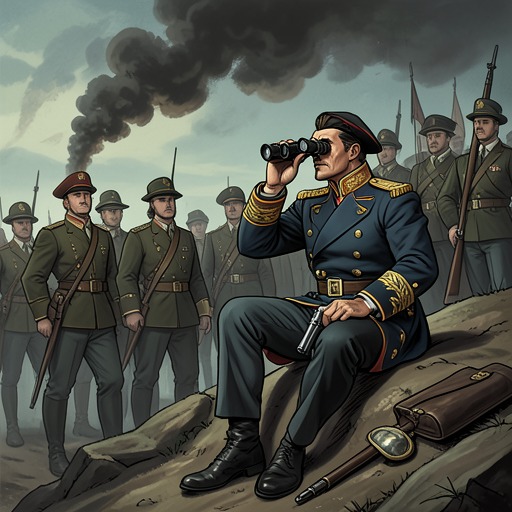
That mission failed to remain limited. For nearly three weeks, the Komani avoided being pinned down while drawing the Marines into a trap. Brigadier Aikens acknowledged that the enemy had led the force around “by the nose” and was now prepared to fight a full battle. The Komani possessed modern weapons and had used masterful tactics, turning a punitive expedition into a strategically exposed occupation force.
Encirclement and Emergency Organization
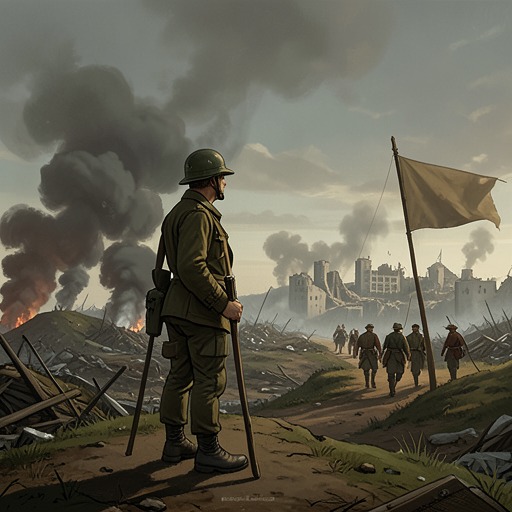
By evening, the routine of military life had collapsed. Mobile Force was spread through a valley crowded with land cruisers, dreadnaughts, troop carriers, supply vans, and scout cars, while units dug in across the ground. The absence of ordinary identity checks and uniform inspections revealed the severity of the emergency: survival had displaced regulations and petty hierarchy. The Mobile Force of the 305th Imperial Marines faced the threat of annihilation.
The organization’s immediate strength was defensive rather than offensive. Emil Vorgens recognized that Mobile Force could defend itself but could not defeat the Komani on Shinar by itself. Reinforcements were coming, yet Okatar Kang could ravage the planet before they arrived. The force was thus caught between two clocks: it had to preserve its own perimeter while preventing a rapid Komani victory that would make outside intervention too late.
Vorgens responded by treating the surrounding population as a necessary political and military actor rather than as a passive subject. He argued that Okatar Kang needed a quick, decisive victory; if the Komani could be held back and frustrated, other Komani clans might refuse to join him, and even his own people might tire of a fruitless war. Mobile Force’s task became not simply to defeat an enemy formation, but to deny it the momentum required for expansion.
From Pacification to Cooperation
The strategic choice presented to the Shinarians was stark. They could fight for their world alongside the Terrans against the Komani, or allow the Komani to seize Shinar and use it as a springboard for galactic war. Vorgens could suggest that imperial cooperation might support a Shinarian request for self-government, but he could not guarantee that result. The force therefore offered an uncertain political bargain rather than a promise of emancipation.
The bargain became credible when Clanthas and the other Shinarian leaders decided to accept Vorgens’s word. Clanthas reported that they would help Mobile Force and work against the Komani in whatever way possible. Their decision marked a reversal in the relationship between the Marines and the population: the people formerly treated as a population to be pacified became partners whose cooperation was essential to the force’s survival and the planet’s defense.
Mobile Force then had to make material concessions. Vorgens ordered Brigadier Aikens to contact the garrison commanders in the four cities held by the Terrans and remove stocks from their arsenals to arm the natives. Aikens agreed only under protest, but Vorgens insisted that the measure be implemented immediately. Weapons, supplies, and imperial stores consequently became instruments of alliance-building, redistributing military capacity beyond the formal colonial garrison.
The force’s new posture was tested when the Komani attacked. Merdon initially lacked enough groundcars to reach Katan quickly and reinforce the threatened position. Vorgens answered that he could bring a squadron of vans and troop carriers within the hour. Merdon, who had previously misjudged the Watchman, then agreed to order his people to follow Vorgens’s commands and asked to fight beside Mobile Force himself. Their handshake and joint descent toward the waiting people dramatized the organization’s transition from an occupying formation to a coalition command.
Mobility, Logistics, and Command
Mobile Force’s power depended on a large and varied transport system. Its valley deployment included land cruisers, dreadnaughts, troop carriers, supply vans, and scout cars, and its emergency response relied on rapidly assembling vans and troop carriers for reinforcement. The ability to move a squadron within an hour could determine whether the force held a city or surrendered the initiative to the Komani.
Its logistical world also intersected with civilian infrastructure. Emil Vorgens could reach Matara before nightfall in a scrambler driven by Sergeant McIntyre, while the slower farmer’s truck carried Sittas through the dusk toward a town overwhelmed by hospital activity and Komani casualties. These contrasting vehicles and journeys show the uneven mobility of the wartime landscape: imperial transport enabled rapid command movement, whereas local vehicles carried exhausted intermediaries through the human aftermath of the fighting.
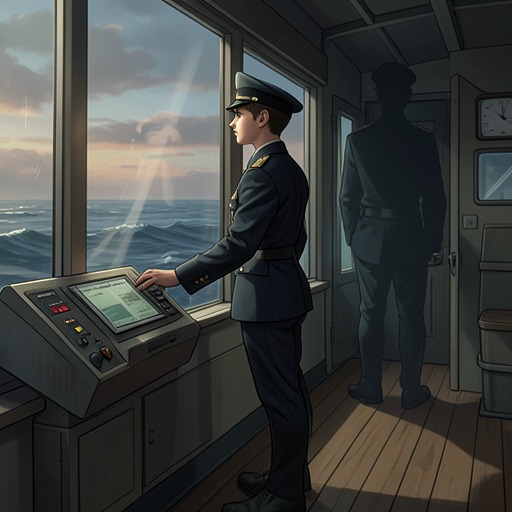
Command within Mobile Force likewise changed under pressure. Emil Vorgens returned to his cruiser, changed out of ragged, bloodstained clothing, took a stimulant, and prepared to hunt for Sergeant McIntyre. The stimulant restored his strength and clarity for several hours, but the decision before him was not merely tactical. He understood that the best available alternative required trusting former enemies and compelling his own superiors to accept that dependence.
Narrative and Political Significance
Mobile Force embodies the contradiction of Terran imperial power. It possesses advanced vehicles, weapons, disciplined personnel, and the authority of the Empire, yet it cannot secure Shinar through force alone. Its entrapment exposes the difference between occupying territory and governing it: military superiority does not produce reliable intelligence, local legitimacy, or control over the political consequences of violence.
The organization’s crisis also connects military action to the history of resistance. Clanthas’s demonstrations began after Terran authorities disrupted local economic life, and protests escalated into riots, civilian deaths, the murder of the Terran governor, the arrival of Imperial Marines, and the Komani landing. Mobile Force therefore enters a conflict already shaped by grievances against imperial rule. Its later decision to arm the natives does not erase that history; instead, it makes the force an unwilling participant in a possible redefinition of the Empire’s relationship with Shinar.
Its most important achievement is consequently not a single battlefield victory but a change in the structure of action. Mobile Force can no longer operate as an isolated imperial instrument. It must coordinate with Shinarian leaders, rely on local fighters, share weapons, and use delay rather than simple superiority to contain the Komani. The organization survives politically only by acknowledging that Shinar’s inhabitants are actors with their own objectives, including the demand for self-government.